
by Kate Redmond
A Quartet of Moths
Greetings, BugFans,
In honor of National Moth Week, here are three lovely moths that the BugLady has found recently, plus one from BugFan Freda (the BugLady’s definition of a “lovely moth” includes being identifiable).
In the past, moth books, including Holland’s venerable, century-old Moth Book, upon which the BugLady cut her teeth, entomologically speaking, pictured moths in a pinned position, with the front wings stretched forward so that their trailing edge stands at right angles to the body, and the hind wing extends behind it. Yes, this dorsal view makes visible the patterns on the upper surfaces of all four wings, but most moths just don’t sit like that out in the field, and posture can be a great clue in identifying them. Newer guides, like the Peterson Field Guide to Moths of Northeastern North America and Sogaard’s Moths and Caterpillars of the North Woods show the moths at rest – wings extended in a V, wings folded, wings stacked over their bodies, or wings wrapped around it.
Remember, the Order Lepidoptera includes both the butterflies and the moths, and although they are less charismatic, moths overwhelmingly outnumber butterflies by 180,000 species to 20,000 globally and by 11,000 species to 700 in North America. Although numerous, moths are shy and retiring and most do no harm, so biographical information for many is scanty.
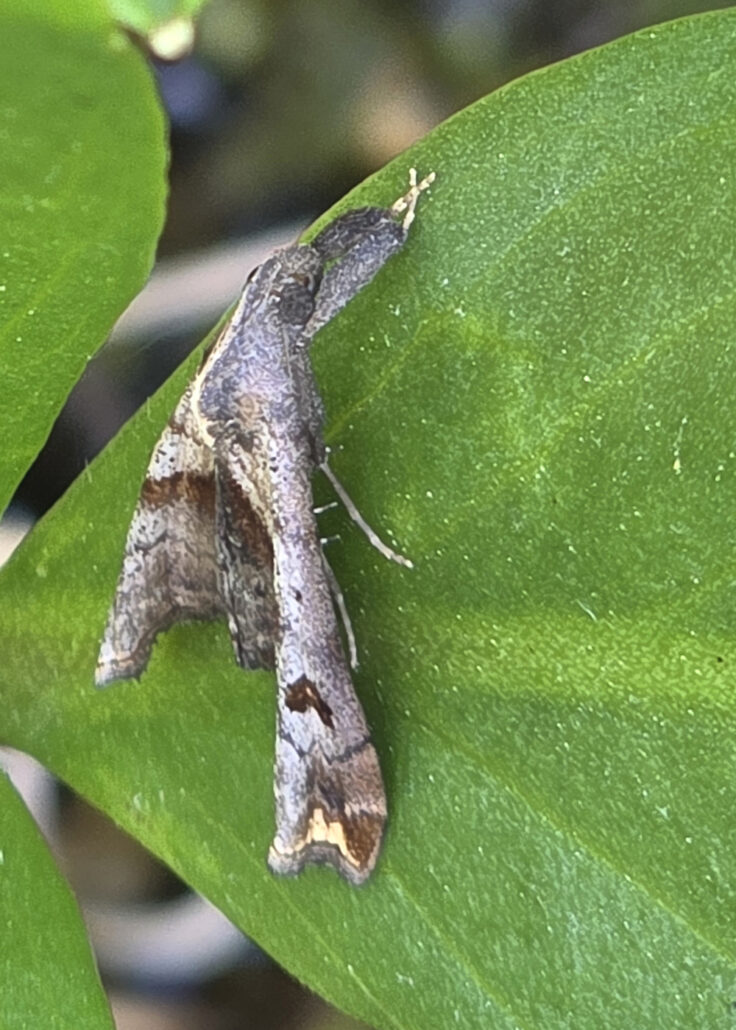
The DARK-SPOTTED PALTHIS, AKA the Angulated snout-moth (Palthis angulalis) is a poster child for how different a pinned specimen https://www.bugguide.net/node/view/1263477/bgimage can look compared to a live moth. Even its dorsal view https://www.bugguide.net/node/view/2178817/bgimage doesn’t really match the gnarled and twisted side view. Thanks to BugFan Freda for sharing.
Dark-spotted Palthis moths are in the family Erebidae and in the subfamily Herminiinae (which used to be a separate family), the Litter moths, so called because the caterpillars of many species feed on dead leaves. They have a wingspan of about an inch, and there can be a lot of variation in color https://www.carolinanature.com/moths/palthisangulalis.html. Males have long, sensory organs (palps) attached to their mouths that are sometimes called “a snout” https://www.bugguide.net/node/view/1291220/bgimage, and several authors said that they resemble jet planes because of the way the curled/folded outside edges of their swept-back wings.
They’re found in woodlands across the eastern half of the continent, with some records in British Columbia. Caterpillars https://www.bugguide.net/node/view/2485329 eat living or dead leaves, flowers, and fruits of a wide variety of woody plants like basswood, birch, alder, maple, willow, some conifers, and more, and some herbaceous plants like aster and goldenrod.
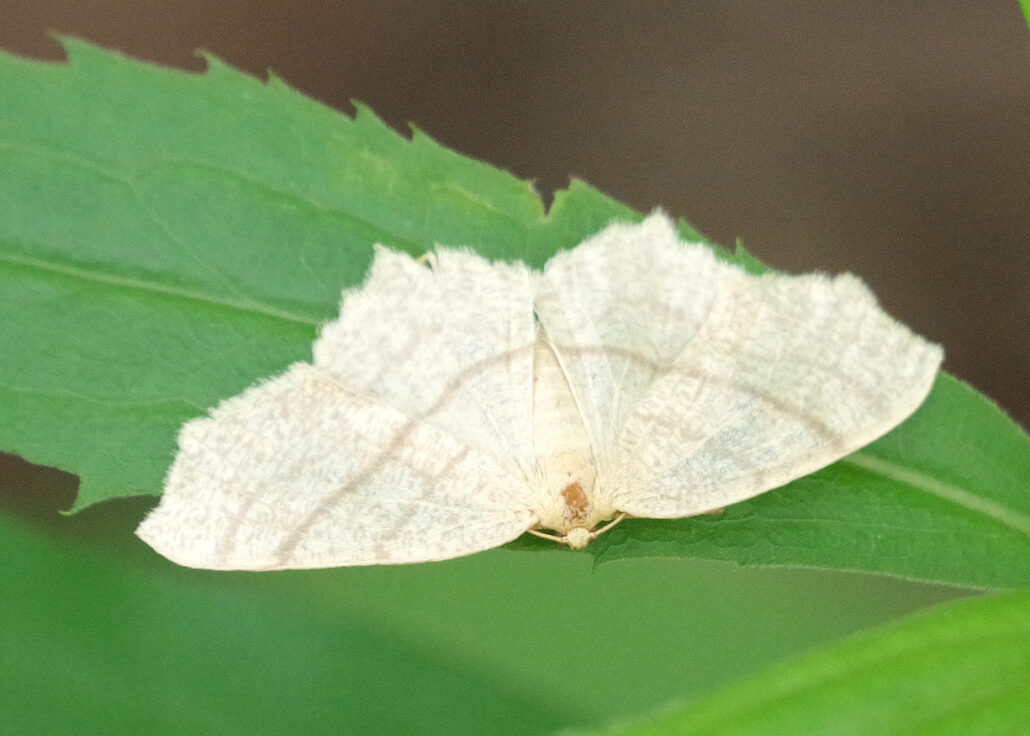
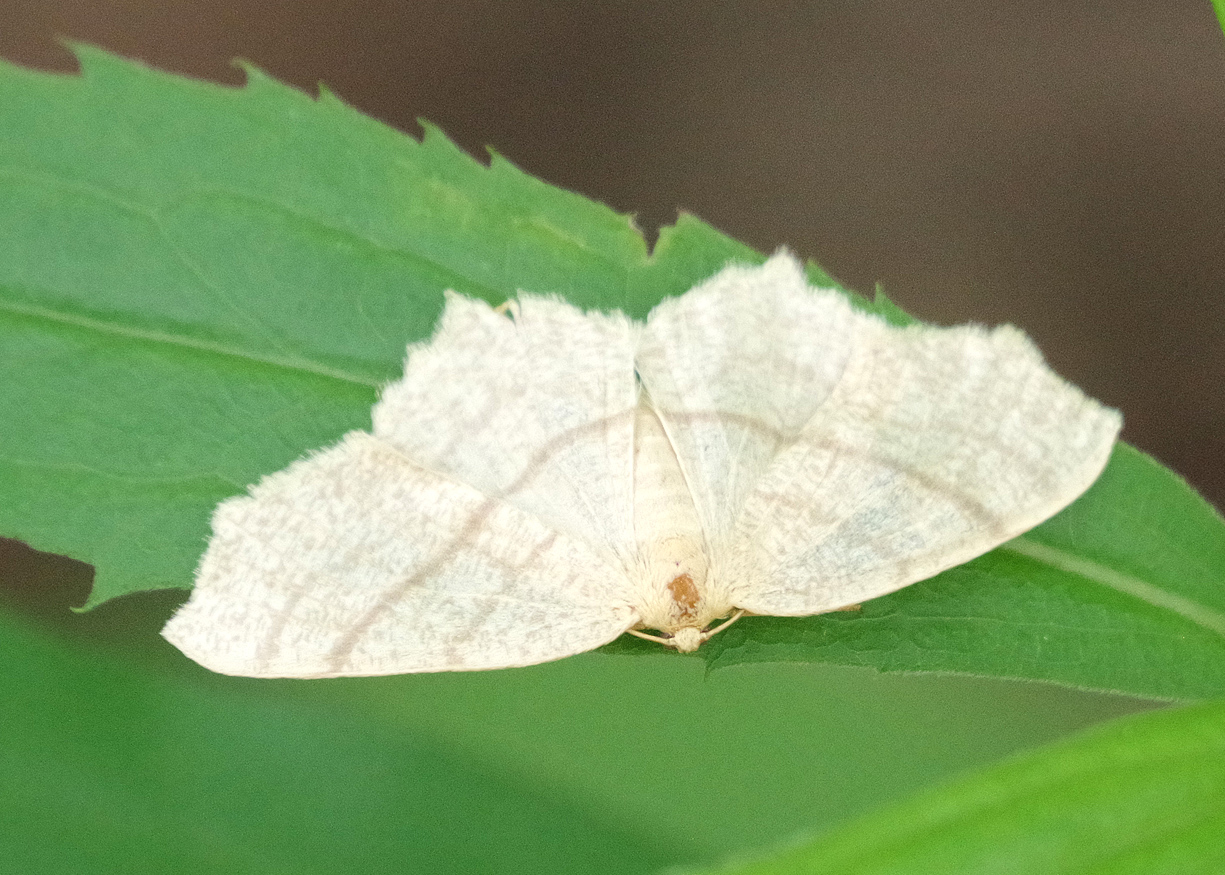
The STRAW BESMA (Besma endropiaria) is in the family Geometridae, whose caterpillars are called the Earth-measurers or inch worms. Straw Besmas are found in woodlands east of the Great Plains.
Sogaard describes the caterpillars https://www.bugguide.net/node/view/1142291/bgimage as “looking like a reddish twig” and goes on to say that they are “prime examples of what was dubbed ‘vegetable disguise’ by Alfred Russell Wallace” (the naturalist/polymath who lived from 1823 to 1913, whose independently published theory of evolution through natural selection is said to have spurred Charles Darwin to collect his thoughts and publish on the matter). They feed on a variety of hardwoods like alder, birch, oak, and especially sugar maple, and they overwinter as pupae.
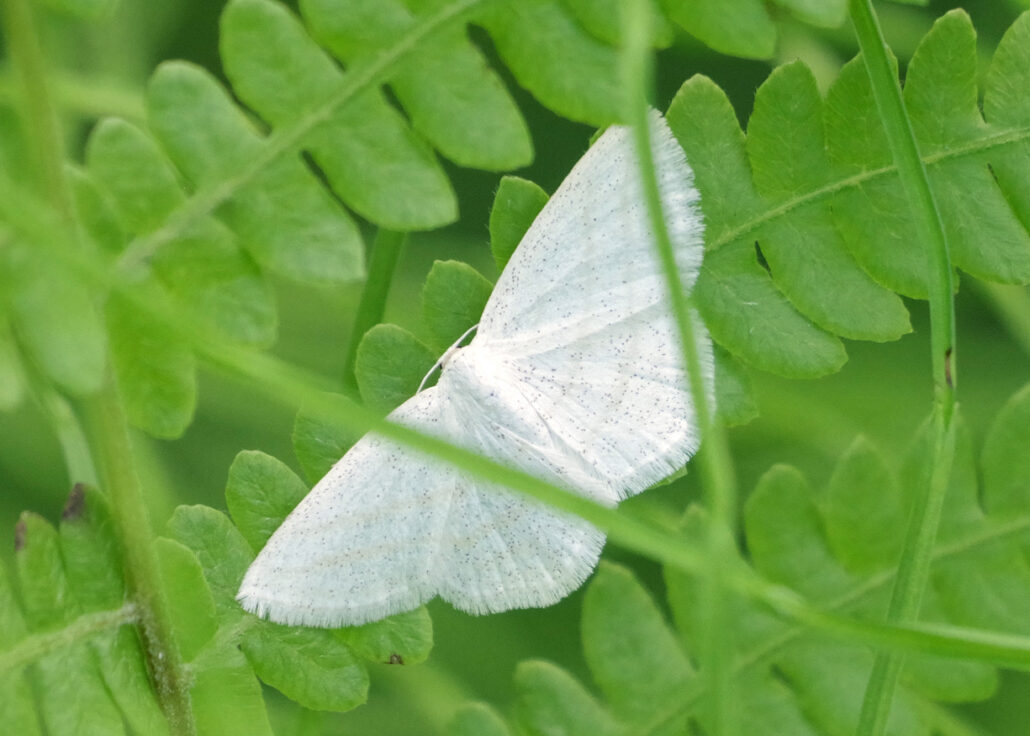
The YELLOW-DUSTED CREAM MOTH (Cabera erythemaria), another Geometrid, is found in sunny woodlands and edges and thickety stream sides. At first glance, it’s another little, white moth, but a second glance reveals fringed wings peppered with tiny, black dots and divided by subtle, yellow lines. The BugLady couldn’t find any explanation of the species name erythemaria, which suggests that something is red, unless it refers to markings on the caterpillar.
Caterpillars https://wildcolumbia.org/wp-content/uploads/2023/03/original.jpg love willow leaves, but they also feed on birch and blueberry. They overwinter as caterpillars.
(When the BugLady was researching the Yellow-dusted Cream moth, the always-excitable internet posed a few related questions, like “Are Yellow moths dangerous?” and “Are yellow moths poisonous?” No and No.)
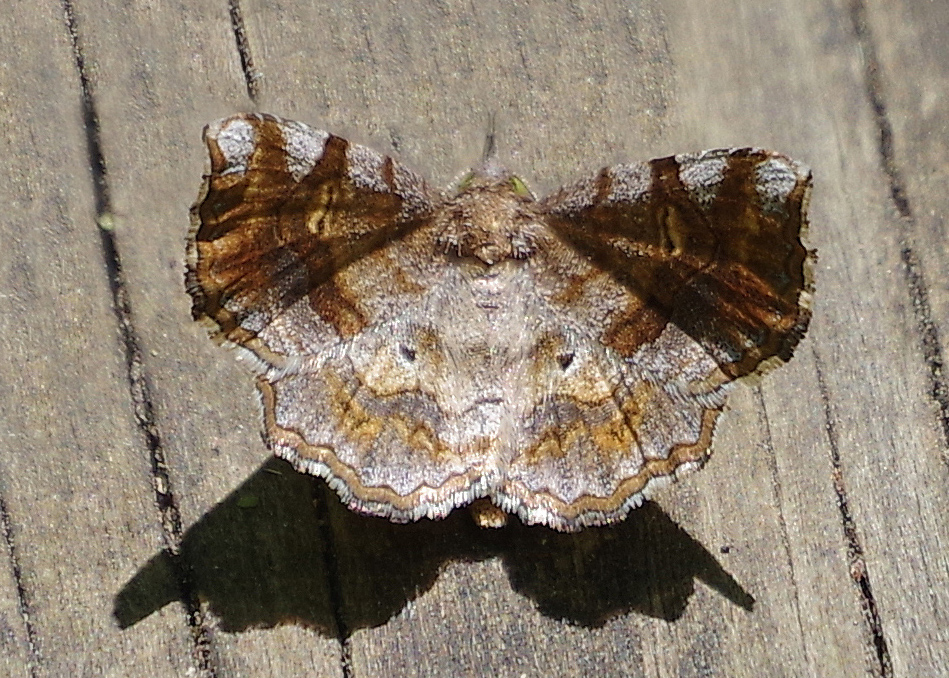
The DECORATED OWLET (Pangrapta decoralis, family Erebidae) looks (and sits) like a small butterfly and is another species whose unique posture would be lost in a pinned specimen. The BugLady posted it on her Facebook page as an as-yet-unidentified moth and got an ID within hours (thanks, Robert). It comes in a variety of colors and patterns https://www.bugguide.net/node/view/2265925/bgimage, https://www.bugguide.net/node/view/2412939/bgimage, https://www.bugguide.net/node/view/2017389/bgimage, https://www.bugguide.net/node/view/682515/bgimage, and researchers suspect that it is part of a complex of three sibling species – species that look the same but are “reproductively isolated” – they do not interbreed. In other words, we may not be able to tell them apart, but they can. They are close relatives that have recently diverged.
They are found over much of Eastern North America, and their caterpillars https://www.bugguide.net/node/view/936111/bgimage eat blueberry and huckleberry (this one was found in a bog, surrounded by blueberry and huckleberry). They overwinter as pupae.
Go outside – say hello to a moth.
Kate Redmond, The BugLady
Bug of the Week archives:
http://uwm.edu/field-station/category/bug-of-the-week/