
by Kate Redmond
A Tale of Two Sawflies…
Greetings, BugFans,
Sawfly? An insect that has graced previous BOTWs, but here’s a quick review of some generic sawfly facts.
Sawflies have been around for 250 million years.
They are in the ant-bee-wasp order Hymenoptera (“membrane wing”) and suborder Symphyta, which has about 8,000 species worldwide. And in the family Tenthredinidae, which accounts for 7,500 of those species. One characteristic of the Hymenoptera is a “wasp waist” – an elongated stalk called a petiole that connects the thorax to the larger part of the abdomen (which some groups carry to an extreme https://www.bugguide.net/node/
Sawfly larvae look a lot like the caterpillars of butterflies and moths, but their legs are different. Both groups have structures called “prolegs” – hydraulically-operated appendages on the underside of their abdomens (the “true legs” are attached to the thorax). True legs are jointed, and prolegs aren’t, but both serve to help the larva grip the surfaces it’s moving across. Sawflies have more of them – six or more pairs of prolegs – than a butterfly/moth caterpillar’s two to five pairs. The ends of the prolegs of butterfly and moth larvae are tipped with tiny gripping hooks called “crochets,” but a sawfly’s aren’t. While you have your hand lens out to count prolegs, notice that a sawfly larva has only one pair of tiny eyes, and a caterpillar has four to six pairs.
The “saw” in “sawfly” is the serrated ovipositor of the female – she uses it to cut into various plant parts before ovipositing a group of eggs in a “raft” or “pod.” When the larvae hatch, they feed together. The saw looks like a stinger, but sawflies are harmless.
While a sawfly larva may spend more than a year in that stage, the adult is ephemeral, living only about a week. Many species include males, but females of some species are parthenogenic – able to produce fertile eggs with no contribution needed from a male, and males are rare or unknown in those species.
Most sawflies are vegetarians, and they’re pretty faithful to their assigned host plants. As larvae they eat fruit and leaves – often leaves that contain chemical defenses that may make them unpalatable to some birds – but they’re an important food source for parent birds looking for larvae for their nestlings. Adult sawflies eat pollen and nectar, honeydew generated by aphids and treehoppers, and sap. The larvae of some species are capable of damaging forest trees, horticultural plantings, and agricultural crops.
While adult sawflies cash in on their resemblance to wasps as a defense strategy, some larvae protect themselves by spitting nasty liquids at their predators, and others cluster in a group (making it hard for a predator to pick out just one), or rear up and twitch when alarmed.
There’s some good info about sawflies in Donald W. Stokes’ excellent A Guide to Observing Insect Lives.
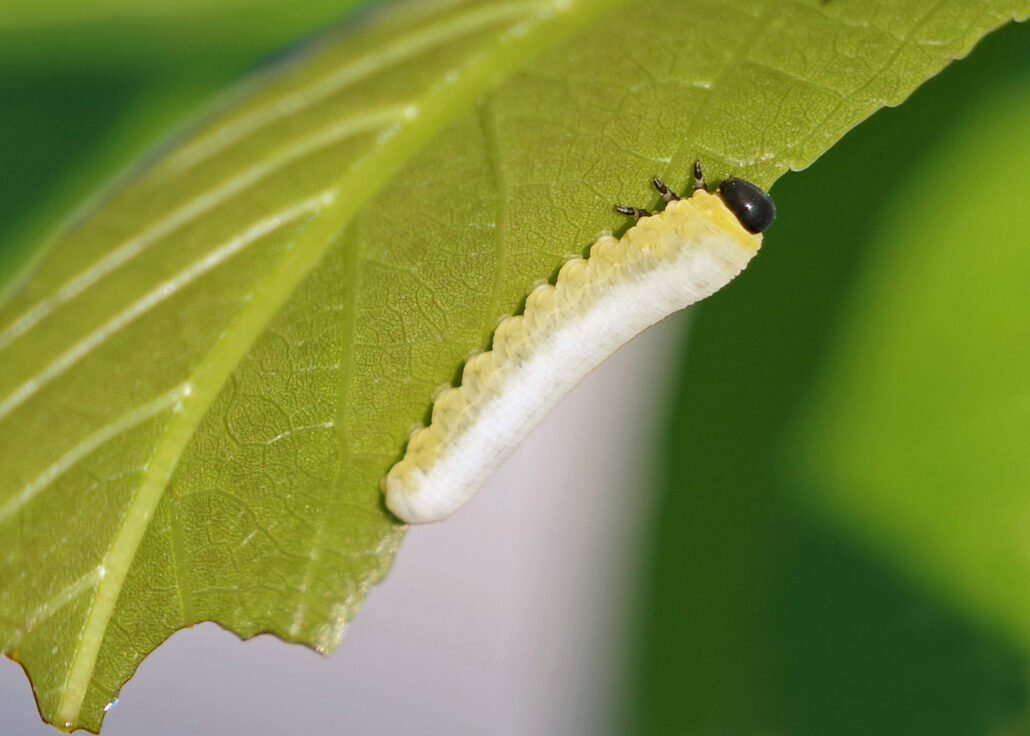
BLACK-HEADED ASH SAWFLIES (Tethida barda) are found over much of the eastern half of the US, plus Ontario, wherever ash trees are found. Most years there are not enough to stir people up, but in response to a big year in 2023, the University of Nebraska-Lancaster Extension wrote that, “the Nebraska Extension office has been getting questions about this little greenish ‘songbird Snickers bar’ all week!”
In May, females create a slit in an ash petiole (leaf stem) and insert six to ten eggs. The larvae feed gregariously for about two months https://www.bugguide.net/node/
Hits for “Black-headed ash sawfly” dropped off pretty quickly after the first two pages, suggesting that unless there’s population boom, it mostly doesn’t have a huge impact on ash trees. As always, healthy, mature trees can weather defoliation. And of course, in some areas of the country, ash has been severely impacted by the Emerald Ash Borer (EAB); the BugLady found this one on a sapling. Ripples.
When DOGWOOD SAWFLIES were named, there was only one species, but that species has since been “split” into four. The BugLady thinks this is Macremphytus tarsatus, whose range covers the northeastern quadrant of North America plus Texas and Saskatchewan. BugFan Freda sent these pictures – thanks, Freda!
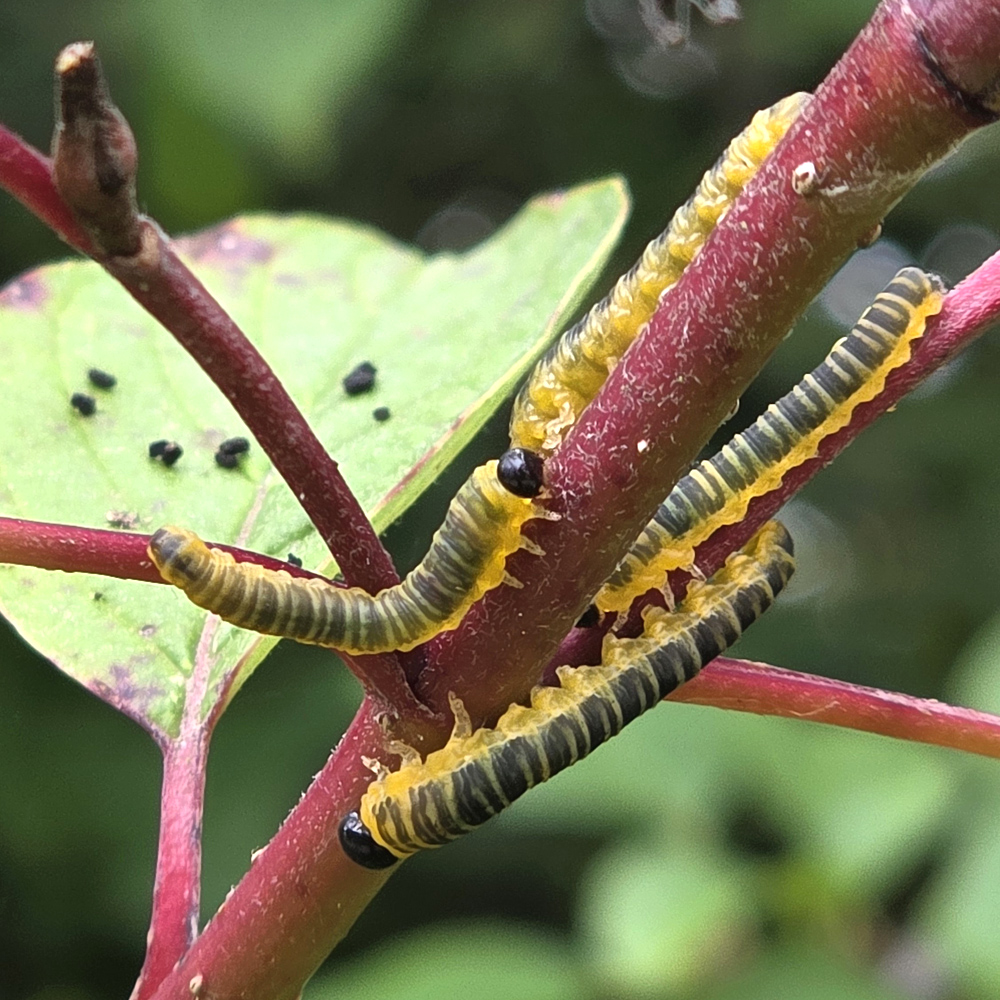
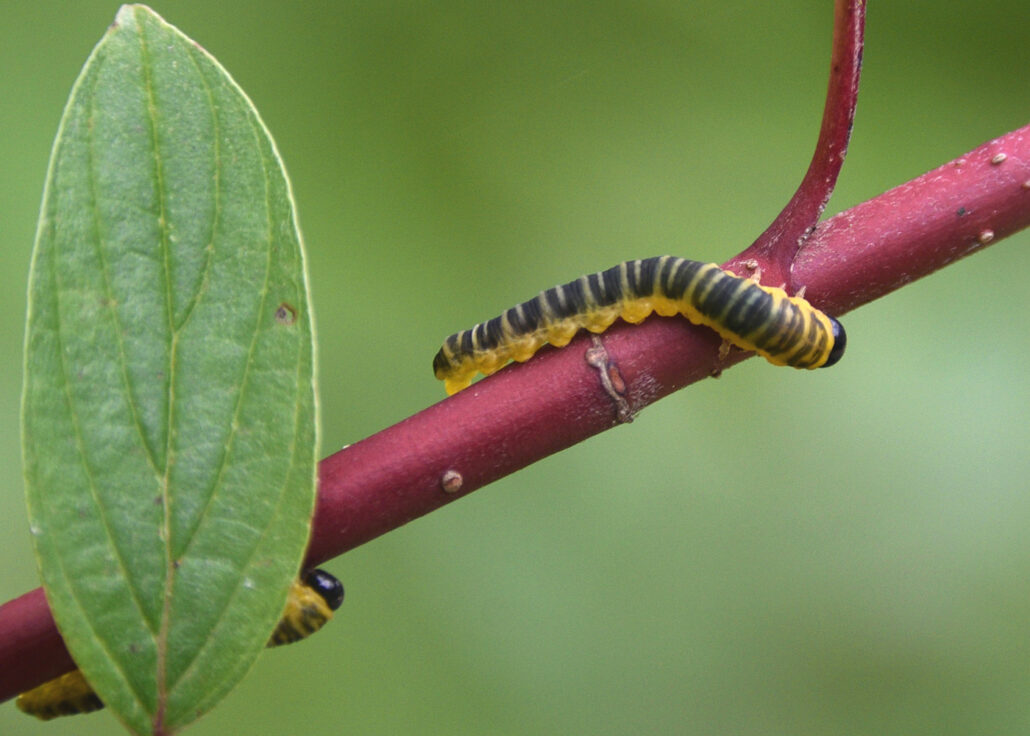
The adults are about ¾” long and are pretty spiffy – https://www.bugguide.net/node/
Adults emerge in late spring and early summer and get right to work https://www.bugguide.net/node/
When they’re mature, they look for some rotten wood to excavate a pupal chamber in. If rotting trees/logs are not available, they may substitute landscape timbers, patio furniture, decking, or siding in order to tuck themselves in for the winter https://www.bugguide.net/node/
Kate Redmond, The BugLady
Bug of the Week archives:
http://uwm.edu/field-station/category/bug-of-the-week/