
by Kate Redmond
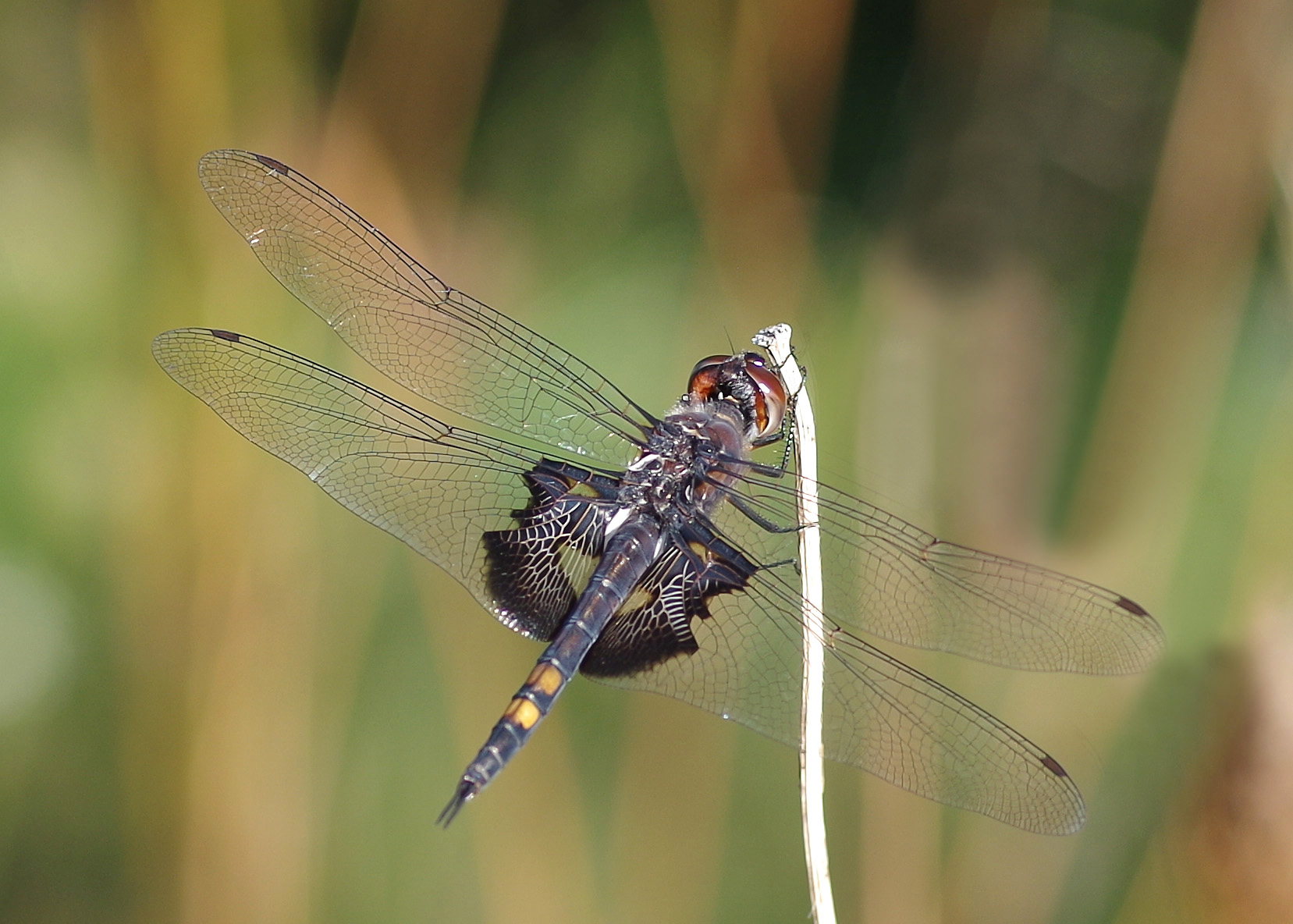
Black Saddlebags Dragonfly
Salutations, BugFans,
2026: When the BugLady was on the hawk tower last week, hoping to log some raptors migrating along the shore of Lake Michigan, she saw a pair of dragonflies flying in tandem toward a small pond. She could see that they were saddlebags, but not which species. Black Saddlebags are more common on the Preserve, but she tends to see Red Saddlebags a bit later in fall. Either, according to Dragonfly Guy Dan, would have been a pretty late record. The southbound migration of darners and saddlebags came in three segments this year, the last of which occurred in mid-October. The saddlebags that the BugLady saw probably left eggs in the pond and their offspring will fly next summer.
Saddlebags are large, lovely dragonflies that often pop out of the prairie, fly a few yards, and then settle down into the vegetation, and despite the BugLady’s marking their descent, she often can’t find them again. They’re equally challenging to photograph in the air, too.
Here’s a BOTW about them from September of 2015 – mostly old words, new pictures.
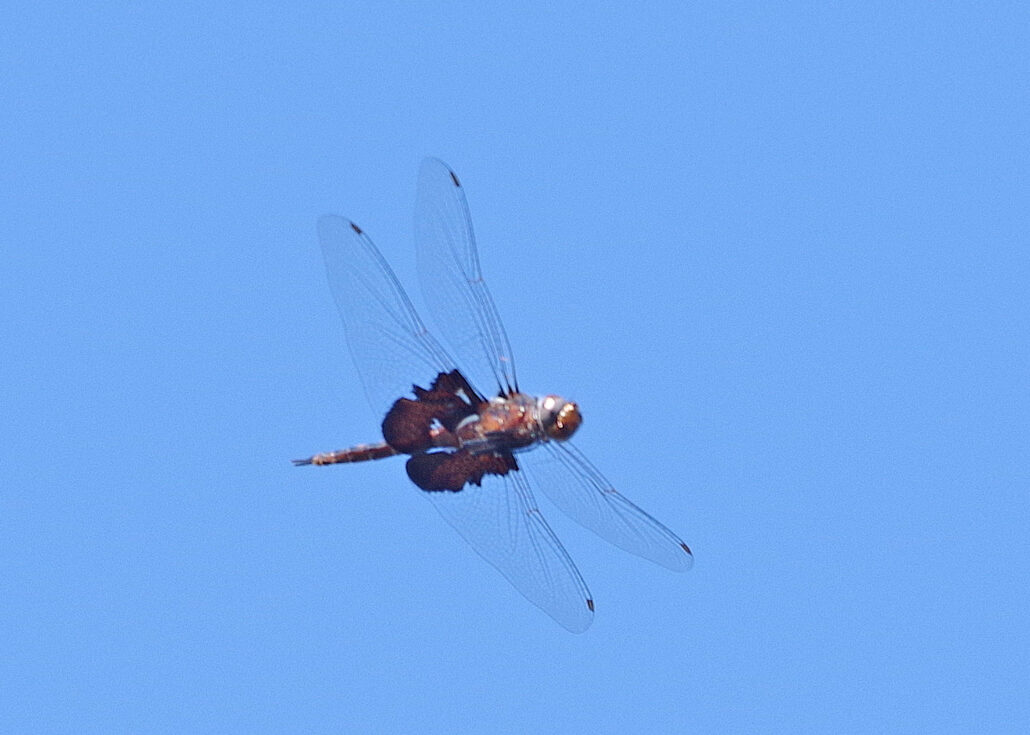
2015: While the BugLady was stewing about who would star in this week’s show, she took a nice walk at Forest Beach Migratory Preserve, an Ozaukee-Washington Land Trust (OWLT) property between Port Washington and Belgium (WI). Her mind was made up by the three Black Saddlebags that exploded from the grasses and flew (tantalizingly) around (and around) over her head, and especially by the one that was exceptionally cooperative. Problem solved (well, except for the problem of photographing one in the air. The BugLady takes a lot of “Hail Mary” shots, a.k.a. dragonfly flight shots, and this one is typical, but the saddlebag markings are apparent).
There are seven species of Saddlebags, family Libellulidae (Skimmers), genus Tramea, in North America, but only three grace Wisconsin – the Red, the Black and the Carolina, a migrant from the south that has been getting more common in the state recently. Genus members are largish (2+ inches long), long-winged dragonflies with clear front wings and a dark spot at the base of their two otherwise-clear hind wings. They have a slender body and a broad head.
[Nota Bene – in 2018 a fourth saddlebags, the extremely rare Striped Saddlebags, appeared at Forest Beach https://uwm.edu/field-station/
They fly and glide A LOT, reaching speeds of 17 mph, and when they perch, it may be down in the grasses close to the ground (where they become invisible), or clinging to a twig high in a tree (where they become invisible). Paulson, in Dragonflies and Damselflies of the East, says saddlebags perch more vertically than most skimmers http://bugguide.net/node/view/
According to bugguide.net, the saddlebags narrowly escaped having their genus named Trapezostigma (for their trapezoidal wing-spot) rather than Tramea, from a Latin word “trameo” meaning “to go over or through.”
The Black Saddlebags (Tramea lacerata) is found throughout the US, into Canada, and south of the border well into Mexico. Black Saddlebags also have a presence on the Hawai’ian and the Caribbean Islands. They choose fish-free still/stagnant/very slow-moving water with lots of vegetation for their nurseries and will oviposit in roadside ditches.
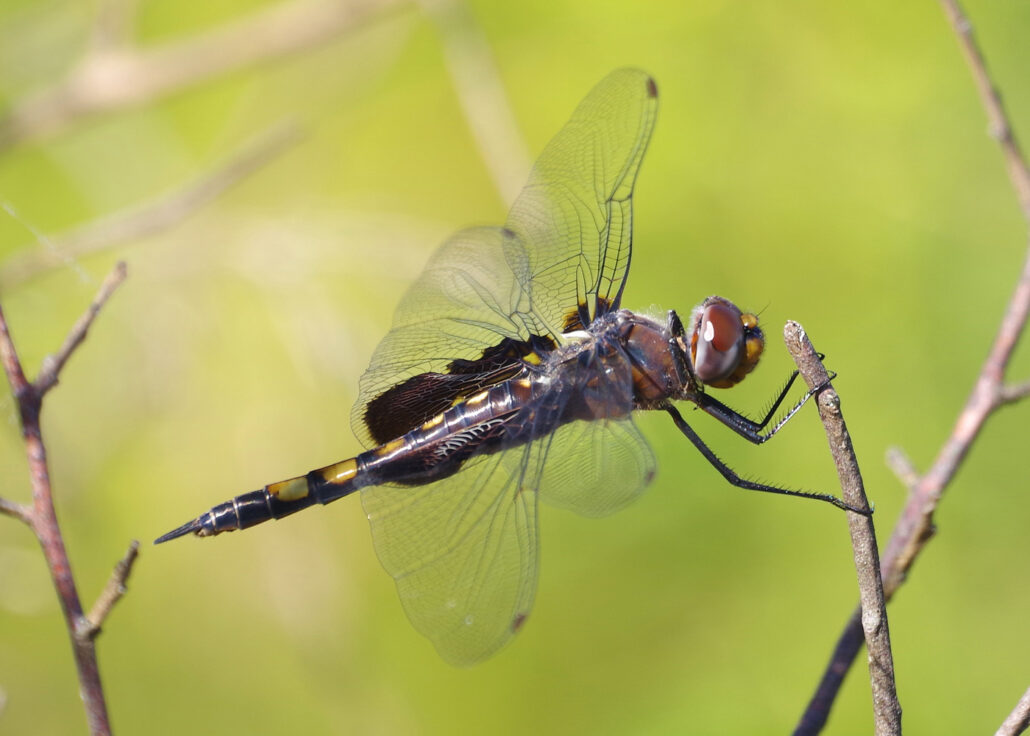
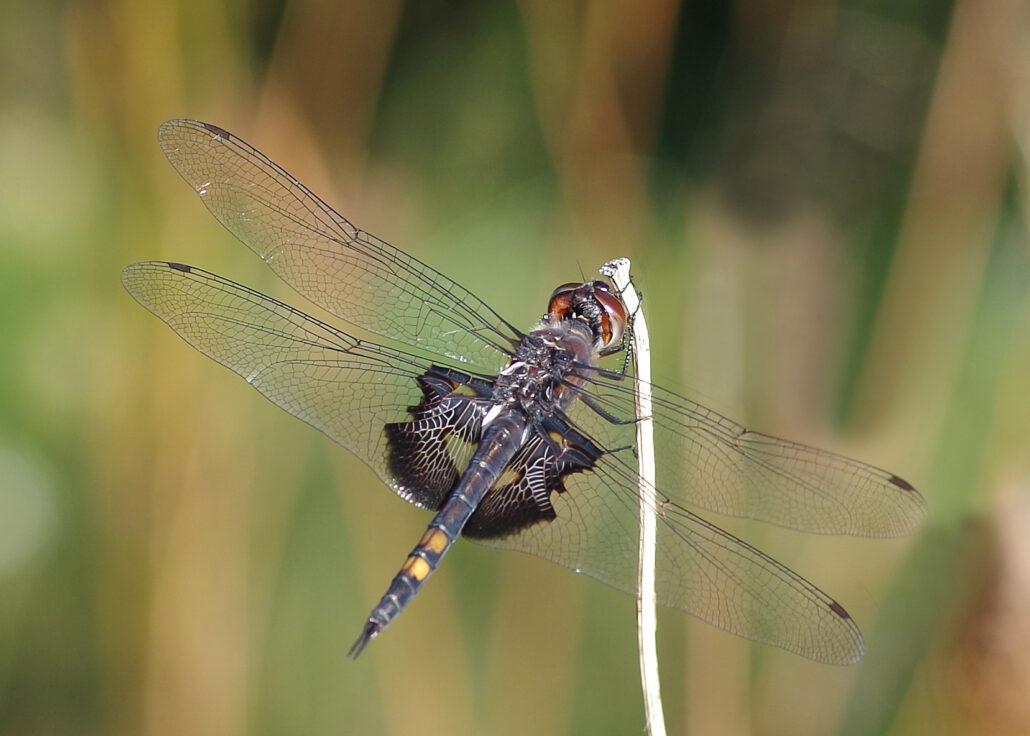
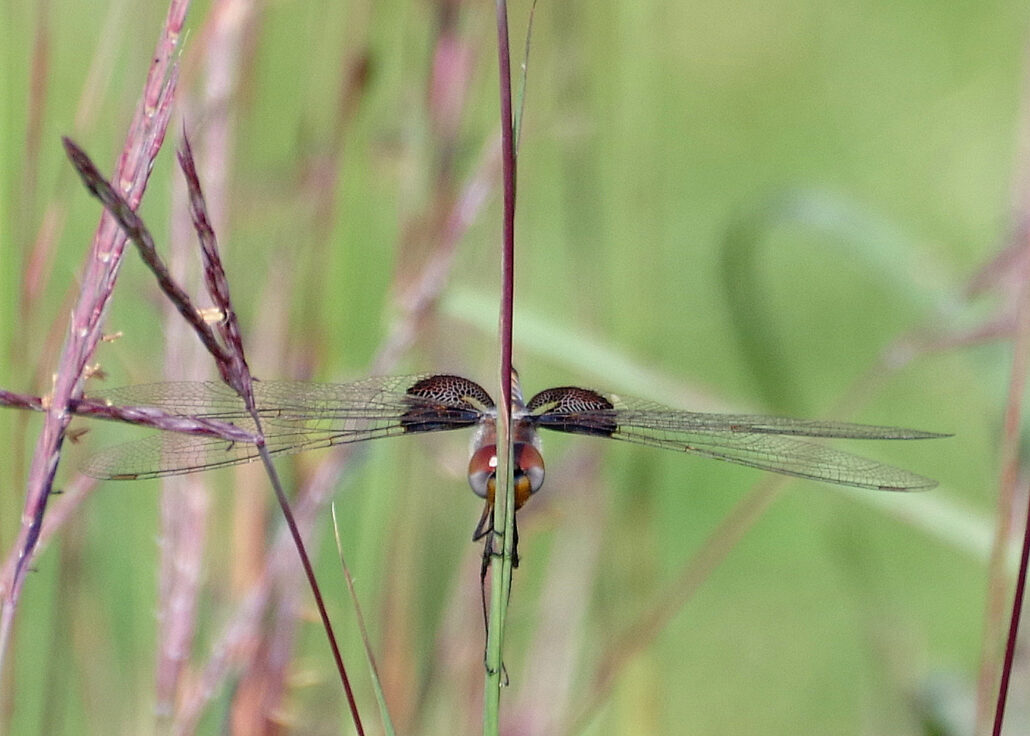
They are one of a dozen or so American dragonflies that migrate; the offspring of the northbound Black Saddlebags return to the South, and their offspring will come north with the spring. In fall, they may join the Common Green Darners that drift along the Atlantic coast and the shore of Lake Michigan (Forest Beach, Concordia University, and Lion’s Den Gorge Nature Preserve are great spots to watch migration at eye level).
Saddlebags are called “dancing gliders” because of their uniquely choreographed courtship and egg-laying behaviors. A male patrols a territory about 100 feet long along the shoreline and open water. He approaches a female and hovers above her, grasps her by the head and thorax with his legs and then bends the claspers at the tip of his abdomen forward to grip the back of her head. Because they can store sperm, female Black Saddlebags only need to mate once, so before he clasps the back of her head, the male must clean out any bodily fluids from a previous mating. Mating is brief if done aerially (the ultimate multitasking) and only slightly longer if the pair is perched http://bugguide.net/node/view/
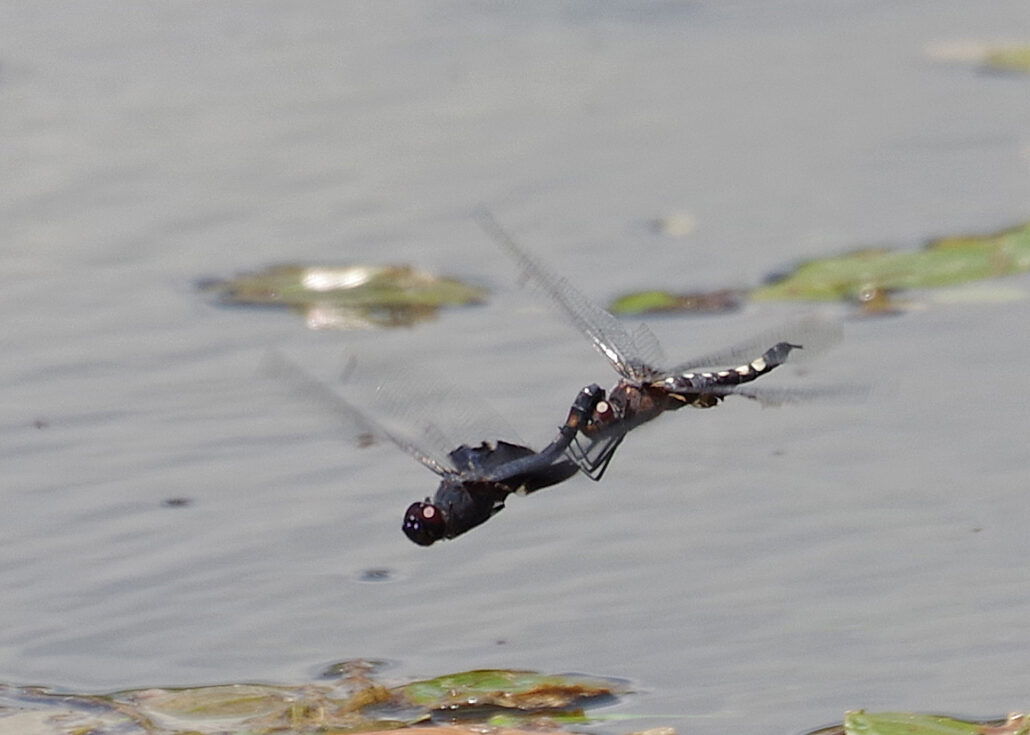
Together they fly out over the water at about knee height (our knees, not theirs). When she is ready to oviposit, he releases her http://bugguide.net/node/view/654958/bgimage, but hovers over/guards her as she dips down and taps the water surface gently to deposit a few eggs. Then she returns, the male reestablishes contact, and they resume the dance, cruising over the water surface until she is ready to lay more eggs. Her egg-laying is done with minimal disturbance to the water’s surface – Paulson says that the dance is observed from underwater, and that bass and other predatory fish have been known to follow a pre-occupied couple.
Young dragonflies http://bugguide.net/node/view/
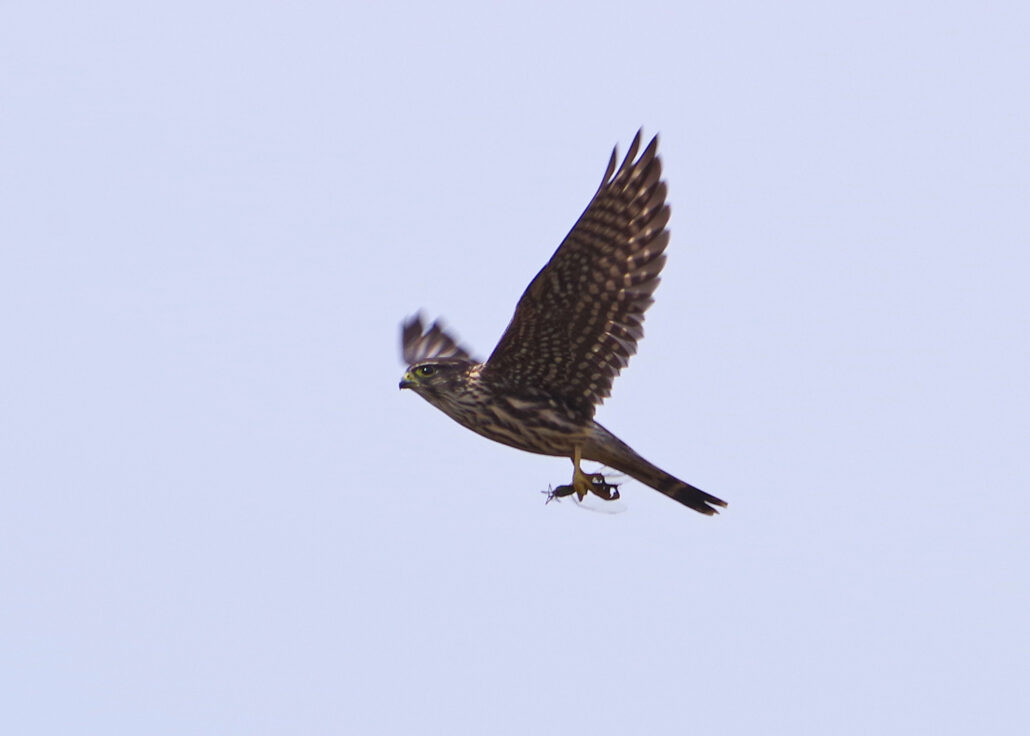
Black Saddlebags are pretty effective at mosquito control, both as naiads and as adults. Studies have demonstrated that the aquatic naiads will eat several species of (aquatic) mosquito larvae and can consume as many as 38 larvae in two days. Adults use their excellent eyesight to pick their prey out of the air (they eat on the wing – more multitasking). Black Saddlebags form feeding swarms that are typically male-only (females don’t). Despite their great eyesight, adults are preyed on by Kestrels, Merlins (the BugLady was lucky to snap this shot of a Merlin with a Black Saddlebags in its fist), and nighthawks. Their feisty, somewhat armored, spiny offspring fall prey to a variety of birds, frogs, and other aquatic critters including other dragonfly naiads.
Go outside – watch bugs!
Kate Redmond, The BugLady
Bug of the Week archives:
http://uwm.edu/field-station/category/bug-of-the-week/