
Bug o’the Week – Lichen Moths

Bug o’the Week

Lichen Moths

Howdy, BugFans,

The BugLady sat on the hawk tower today, watching the start of the fall migration.  She was surrounded by the start of the dragonfly migration – there was a big emergence of the migratory population of Common Green Darners yesterday, and both darners and Black Saddlebags were drifting south along the lakeshore.  It doesn’t get any better than this.

A friend of the BugLady’s found one of these spiffy moths recently and wanted information about it.  Here’s a rerun from 10 years ago.

Lichen moths have it all!!  Toxins, aposematism, attitude, thoracic tympana and ultrasonic emanations, sensory setae, fecal flicking, mimicry, and even cannibalism!  What an insect!!

Taxonomic Lumpers and Splitters have been working on the moths again.  Lichen moths (Hypoprepia sp) are in the Tiger moth family Arctiidae – or in the family Erebidae – depending on whose book you read.  Apparently, a bunch of moths in the Owlet moth family plus all of the members of the tussock moth and tiger moth families, plus a bunch of small families have been assigned to the family Erebidae, but Moth People are not 100% onboard with that yet, so stay tuned.  And, according to Wagner in Caterpillars of Eastern North America, “Adults of eastern Hypoprepia vary considerably in different parts of the Southeast, so much so that some lepidopterists feel additional species will eventually be recognized.” 

Lichen moth larvae https://bugguide.net/node/view/1483889/bgimage eat lichens and blue-green algae that they find growing on tree trunks.  As BugFans will recall from high school biology, lichens are a plant partnership – two plants growing symbiotically as one.  Structure, roots, and water are provided by a fungus “body,” and photosynthesis is carried out by algae that live within the fungus (or, as we Naturalists say – too often – “a lichen is a fungus and an alga that have taken a likin’ to each other.”).  Along with lichens, caterpillars have been reported to eat their smaller brethren and even LM pupae.  

Toxins from their veggies may make LM caterpillars poisonous to predators. The hairy caterpillars don’t come in startling warning (aposematic) colors (they look a bit like gypsy moth caterpillars http://bugguide.net/node/view/121849/bgimage), but the bright colors of the adults probably signal a non-tasty morsel within. 

Like the caterpillars of the Silver-spotted skipper butterfly (of previous BOTW fame), caterpillars in the genus Hypoprepia are able to fire their frass (bug poop) up to 30 body lengths away from themselves.  It’s called “fecal flicking.”  Why do it?  Some parasitic and predatory wasps track down potential prey by the scent of its frass, so the LM distances itself from its by-products.  Anal combs trap frass that’s coming down the pipeline and hold it until the “blood pressure” at the caterpillar’s tip becomes too great and the frass rifles out (the BugLady couldn’t make this up). 

LMs have some interesting sensory abilities, both as caterpillars and as adults.  Like typical adult tiger moths, LMs have “ears” located on their thorax.  They also make a variety of ultrasonic noises with organs on their thorax – this is an insect that can hear bats coming and, confident in its toxicity, sass them back, warning them against feeding on unwholesome LMs.  They also “vocalize” during courtship, and females have a pair of glands on the top of their thorax that crank out pheromones – chemical “scents” that lure males to them.  According to Sogaard, in Moths of the North Woods, caterpillars in the family are “typically densely hairy.  Some (perhaps all) caterpillars are sensitive to low-frequency sound through setae” (hairs). 

LMs overwinter as caterpillars, and adult LMs in this neck of the woods probably do not eat, though their tropical brethren do. 

The BugLady has been going happily bug-eyed trying to decide whether these are

SCARLET/SCARLET-WINGED LICHEN MOTHS or PAINTED LICHEN MOTHS or both (she suspects both).  SLMs are supposed to be very red and PLMs to have a yellowish cast, but she’s seen official pictures of each that stray into the other’s tint https://bugguide.net/node/view/2144967/bgimagehttps://bugguide.net/node/view/853217/bgimage.  One reference suggests that SLMs have red heads and PLMs have yellow/gray heads (or maybe not).  At any rate, their lifestyles, ranges, and habitats (woodlands, east of the Rockies) are very similar, and these are two of only four species in the genus in North America.  Right now.

It has been suggested that adult PAINTED LICHEN MOTHS (Hypoprepia fucosa) mimic lightning beetles, which have toxic blood.

SCARLET LICHEN MOTHS (Hypoprepia miniata) are partial to lichens that grow on the trunks of red pine, and therefore gravitate to more coniferous woodlands (though they will nosh on lichens elsewhere if red pines aren’t available).  Miniata comes from the Latin word miniatus, which references lead-based vermillion or red paint.

Oh – and they have beauty!

Kate Redmond, The BugLady

Bug of the Week archives:
http://uwm.edu/field-station/category/bug-of-the-week/

Bug o’the Week – Great Blue Skimmer Dragonfly

Bug o’the Week

Lichen Moths

Howdy, BugFans,

The BugLady sat on the hawk tower today, watching the start of the fall migration.  She was surrounded by the start of the dragonfly migration – there was a big emergence of the migratory population of Common Green Darners yesterday, and both darners and Black Saddlebags were drifting south along the lakeshore.  It doesn’t get any better than this.

A friend of the BugLady’s found one of these spiffy moths recently and wanted information about it.  Here’s a rerun from 10 years ago.

Lichen moths have it all!!  Toxins, aposematism, attitude, thoracic tympana and ultrasonic emanations, sensory setae, fecal flicking, mimicry, and even cannibalism!  What an insect!!

Great Blue Skimmers are common across the Southeast, but they wander north, sometimes as far north as Massachusetts, and rarely, Maine and Ontario.  One source referred to them as migrants, but that implies a return trip (only about 15 of the 331 North American dragonfly species are migratory (and a few of the damselflies roam a bit) – here’s the Xerces Society’s Guide https://www.xerces.org/sites/default/files/2018-05/12-036_01_MDP_Field_Guide_4-4-2013Websec.pdf).  In Dragonflies and Damselflies of the East, Dennis Paulson speculates that climate change may be allowing these skimmers to extend their range northwards, but he also wonders whether wet periods in the East may drive their episodic range expansions. 

Great Blue Skimmers (Libellula vibrans) are in the Skimmer family Libellulidae.  Members of the genus Libellula are called the King Skimmers – large, often flashy, aggressive dragonflies that dominate the sunny ponds where they live.  At almost 2.5” long, Great Blue Skimmers are the largest of the skimmers.  Their “plumage” changes depending on age and sex – young females https://bugguide.net/node/view/182934/bgimage and young males have yellow abdomens with a black stripe https://bugguide.net/node/view/1936981/bgimage.  Older females turn a dull brown with blue-ish to reddish-brown eyes https://bugguide.net/node/view/700746/bgimage, and mature males are a spectacular blue, with teal-colored eyes https://bugguide.net/node/view/787748/bgimage.  Like many dragonflies, the intensity of the adult colors is softened somewhat as it ages by tiny wax particles called pruinescence, which produce a hoary appearance.  They have white faces and pale, unstriped thoraxes https://bugguide.net/node/view/110122/bgimage, and the amount of black wrapping the tips of the wings is variable.   

Don’t look for them over sunny ponds with the other King Skimmers – these are dragonflies of the dappled sunlight of woodlands, edges, and roads through wetlands and bottomlands, where they may be the only dragonflies around.  They perch on twigs (at eye level and easy to photograph, said one source; at five to ten feet above the ground, said another).  

Males vigorously defend stretches of ponds that look like good spots for a female to oviposit – Great Blue Skimmers prefer shallow, wooded pools and ponds, swamps, ditches, and very slow-moving sections of streams (and there are reports of females ovipositing in muddy tire tracks).  Paulson says that they like “dark, mucky water.”  They mate (very briefly) https://bugguide.net/node/view/1664022/bgimage, and then he releases her, but he guards her from the air (“hover guarding”) and shoos away rival males as she lays eggs. 

She has a unique approach to ovipositing – she flies down to the water’s surface with eggs at the ready (scroll way down for a picture of eggs https://www.marylandbiodiversity.com/view/740), then she dips down and uses her abdomen to scoop and splash a bit of water, plus eggs, up to six inches away (“She may splash eggs and water onto the bank, presumably for a rainy day,” says Legler, in Dragonflies of Wisconsin).  Watch the video to see her technique https://waltersanford.wordpress.com/2012/07/16/great-blue-skimmer-dragonflies-mating-pair-fe/.  The drops of water are thought to help the eggs adhere to land.  When the eggs hatch, the tiny naiads crawl into the water.    

As always, both the aerial adults and the aquatic naiads are carnivorous – the adults spot their insect prey from perches in the shade and fly out to grab it, a behavior called “hawking,” and their menu includes smaller dragonflies. 

The BugLady doesn’t care how common this dragonfly is within its range, it distresses her to find ads offering pinned specimens for “$40 to $60 depending on quality and sex” (which also sounds caveat emptor-ish to her). 

The BugLady attempts a lot of Hail Mary Shots of dragonflies in flight (in fact, a recent shot of distant Common Green Darners flying in tandem seems to have an equally-distant Great Blue Skimmer in it), but most of them end up on the cutting room floor.  She’d like to give a shout-out to this one https://bugguide.net/node/view/231364/bgimage.  

Kate Redmond, The BugLady

And speaking of rare Lepidopterans – heads-up in the Pacific Northwest: https://www.smithsonianmag.com/smart-news/first-us-sighting-of-massive-atlas-moth-confirmed-180980617/?utm_source=smithsoniandaily&utm_medium=email&utm_campaign=20220822-daily-responsive&spMailingID=47269440&spUserID=ODg4Mzc3MzY0MTUyS0&spJobID=2302313711&spReportId=MjMwMjMxMzcxMQS2

Bug of the Week archives:
http://uwm.edu/field-station/category/bug-of-the-week/

Bug o’the Week – Rose Chafer Beetle

Bug o’the Week

Lichen Moths

Howdy, BugFans,

The BugLady sat on the hawk tower today, watching the start of the fall migration.  She was surrounded by the start of the dragonfly migration – there was a big emergence of the migratory population of Common Green Darners yesterday, and both darners and Black Saddlebags were drifting south along the lakeshore.  It doesn’t get any better than this.

A friend of the BugLady’s found one of these spiffy moths recently and wanted information about it.  Here’s a rerun from 10 years ago.

Lichen moths have it all!!  Toxins, aposematism, attitude, thoracic tympana and ultrasonic emanations, sensory setae, fecal flicking, mimicry, and even cannibalism!  What an insect!!

Rose chafers can be found in grasslands, gardens, and viney edges over much of eastern North America as far west as Colorado and Montana, although distribution gets spotty the farther South you get. They especially like sandy areas (more about that in a sec).  Bugguide.net considers the western records to be “iffy” because of the possibility of confusing the Rose chafer with one of the other two species in the genus Macrodactylus that live north of Mexico (https://bugguide.net/node/view/939033/bgpage, and https://bugguide.net/node/view/1253988/bgimage), but insects can find an infinite number of ways to hitchhike.

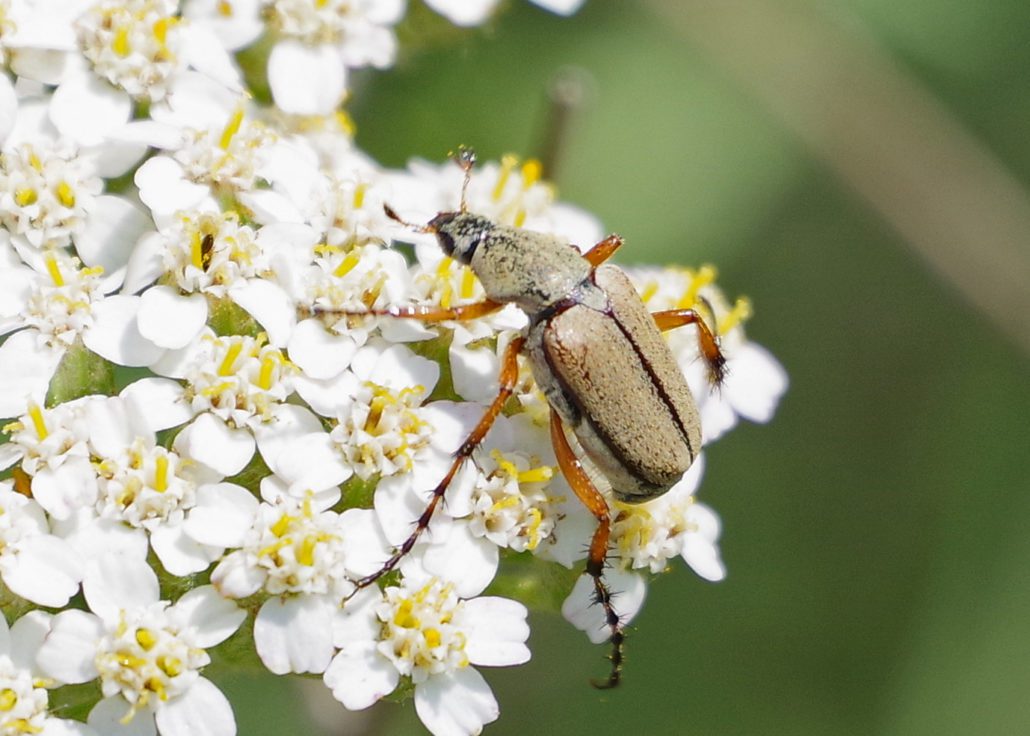
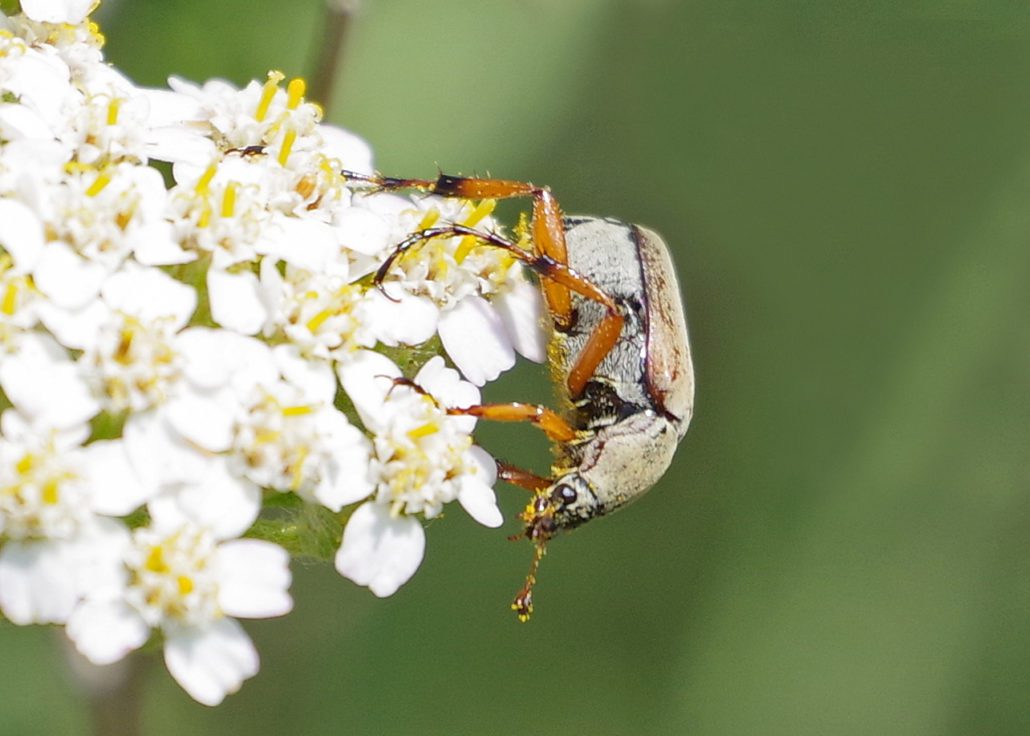
They’re about a half-inch long (females are bulkier than males), covered with yellow hairs that rub off with age (or in the case of the female, with mating), exposing the dark cuticle beneath.  The official name for their antennae is “lamellate,” which means “plate or leaf-like” https://bugguide.net/node/view/110081.  The legs are spiny and the feet/tarsi are clawed (all the better to hang on with, my dear) https://bugguide.net/node/view/1275119/bgimage.  Several sources said that the beetles may resemble a wasp while in flight (maybe because of the dangling legs?).

The BugLady does not garden.  She puts her geraniums out on the porch in May, waters them when she thinks of it (they’re very patient), and hauls them back in at the end of October, at around midnight as the first killing frost is descending, and she wouldn’t know what to do with a rose bush if she had one.  Rose chafer beetles feed on the leaves and flowers and maybe the nectar and pollen of lots of different kinds of plants.  Their jaws are weak, so they eat the tender tissue between the leaf veins, skeletonizing the leaf; they make holes in petals; and they eat soft fruits like raspberries and grapes. 

Some sources say that the beetle is only a slight nuisance, doing mainly cosmetic damage; others give instructions for all-out warfare.  Their populations wax and wane, and when there’s a Rose chafer population boom, the beetles may consume a substantial portion of a leaf’s photosynthetic surface and may also impair pollination.  Plus, they may feed in groups.  Interestingly, the North Carolina State Extension write-up about Rose chafers calls them a “relatively minor pest of roses that at one time was apparently much more abundant.

With many insect “pests,” it’s the larvae that do the most damage, but with the chafers, it’s the adults who are the problem.  Rose chafer larvae feed underground on the roots of grasses and other plants, and although a bumper crop of larvae can stunt a plant, they don’t seem to be a real threat to turfgrass or ornamentals. 

Rose chafers can be seen during June and July here in the North.  The plants that they feed on also serve as Social Clubs where males and females meet and mingle https://bugguide.net/node/view/265114/bgimage.  When this “What’s going on here?” picture https://bugguide.net/node/view/120287/bgimage was posted on bugguide.net, entomologist Eric Eaton responded “I don’t think they are ‘eating’ the milkweed. This kind of aggregation is usually associated with mating or “sleeping.”  This seems to be another example of insects chewing on plants; plants releasing volatile compounds to discourage that; and those compounds, perversely, attracting a crowd.  The Rose chafers use their antennae to key in on those plant “odors.”

The female oviposits in the soil, digging down as far as six inches below the surface (!!!), which is why she prefers plants that grow in sandy soil.  She may lay from six to forty eggs, and when they hatch in a few weeks, the larvae locate roots to feed on.  They will move up and down in the soil, depending on soil moisture and soil temperature, and they will overwinter deep in the ground, below the frost line, moving up toward the surface to pupate when the earth warms in spring. 

Many of the scarabs are nocturnal, but Rose chafers are abroad during the day.  They are strong fliers.

Rose Chafer Surprise:  Rose chafers produce cantharidin, a caustic chemical mainly found in beetles in the blister beetle family Meloidae (see https://uwm.edu/field-station/blister-beetle/)!  Although the author of one gardening blog noted that he had been picking them off of plants for decades with no ill effects (the skin on our fingers is pretty tough), he joined the chorus of authors who stressed that the beetles are poisonous to chickens and other birds.

In his “Living with Insects” blog, entomologist Jonathan Neal explains “Their toxicity to chickens led to one of the early scientific studies of toxins in insects. In 1909, George Lamson, Jr, of the Connecticut Agricultural Experiment Station investigated reports of a flock of chickens that died after feeding on the abundant Rose Chafers. Lamson fed Rose Chafers to chickens and determined the numbers required to kill week-old (15-20 Chafers) and 3-week-old chickens (25-45 Chafers). In the early 1900s, chickens were commonly allowed to range free and could easily consume large numbers of Rose Chafers in years with high populations. Lamson recommended that chickens be excluded from areas that contained large numbers of Rose Chafers.  Lamson made an extract of Chafers and demonstrated that the extract was toxic to both chickens and rabbits. These tests proved that the deaths were due to a chemical toxin and not a physical effect from the insect spines or other physical properties. Lamson reported his findings in the Journal “Science” in 1916.”

Kate Redmond, The BugLady

Bug of the Week archives:
http://uwm.edu/field-station/category/bug-of-the-week/
Bug o’the Week – Mid-summer Scenes

Bug o’the Week

Lichen Moths

Howdy, BugFans,

The BugLady sat on the hawk tower today, watching the start of the fall migration.  She was surrounded by the start of the dragonfly migration – there was a big emergence of the migratory population of Common Green Darners yesterday, and both darners and Black Saddlebags were drifting south along the lakeshore.  It doesn’t get any better than this.

A friend of the BugLady’s found one of these spiffy moths recently and wanted information about it.  Here’s a rerun from 10 years ago.

Lichen moths have it all!!  Toxins, aposematism, attitude, thoracic tympana and ultrasonic emanations, sensory setae, fecal flicking, mimicry, and even cannibalism!  What an insect!!

ARROW CLUBTAIL:  In early July, the BugLady came across this just-emerged dragonfly sitting on a stalk in the Milwaukee River.  She photographed it for half an hour as it lengthened and strengthened and spread its wings and grew its abdomen.  She guarded it from marauding geese and grackles.  And she watched as it took its maiden voyage, eight feet straight up and true – into the beak of a swooping Cedar Waxwing.  She may have used a few bad words. 

JAPANESE BEETLE   Precarious as this bundle of beetles looked, it kept its shape as it fell off and into the grasses.  In order to jump-start her love life, a female Japanese beetle may use “come hither” pheromones, but this aggregation of beetles was probably initiated (inadvertently) by the plant itself.  Research suggests that a female Japanese beetle chewed on a leaf, and the leaf gave off signature chemicals (OK – feeding-induced plant volatiles), and that instead of repelling the beetles, the scent attracted more beetles, both male and female, to feed.  And, since all those guys and gals are in the same neighborhood……… 

MAYFLY MOLT:  BugFan Freda sent this amazing “What-is-it?” picture recently, taken from a canoe on the Milwaukee river.  Mayflies (called “lake flies” regionally) emerge from their watery cradles by the googol.  Their lives are brief, averaging only three days (not coincidentally, the name of the mayfly order is Ephemeroptera).    

Mayflies are the only insects that shed their skins after they reach the winged adult stage (silverfish shed as adults, too, but they’re spindle-shaped and wingless).  The mature mayfly naiad https://bugguide.net/node/view/517056/bgimage crawls out onto a plant or rock and sheds its final skin (exuvia), emerging as a form called a subimago (or a “dun” if you’re a fly fisherman) that is cloudy-winged, dull in color, weak-flying, and not ready to reproduce.  The sub-imago rests (often overnight) and then sheds again, this time into a mature adult/imago with shiny wings (a “spinner” to fishermen).  Here’s a typical adult/imago https://bugguide.net/node/view/933725/bgimage.  No – scientists do not know how this pre-adult stage benefits the mayflies – lots of insect groups apparently has a subimago stage in ancient times, and most have dropped it from their repertory. 

Freda’s picture shows the exuviae of lots of sub-imagoes – it must have been an amazing sight to see!  Scroll down this series of pictures of that final shed – http://www.troutnut.com/article/10/pictures-of-mayfly-dun-molting-to-spinner.  

DOGBANE LEAF BEETLE:  Its fabulous, shimmering exterior is all done with mirrors (complex nanoarchitecture).  Light is bent when it hits small, randomly-tilted plates that sit between the pigment layer and the top layer of the beetle’s cuticle, and the beetle’s color changes depending on the angle of the eye of the beholder.  What good is that glow?  Rather than being an aid in courtship or a warning of the beetle’s toxicity (and this particular beetle is, but not all iridescent insects are), this fiery iridescence actually camouflages it.  To test the hypothesis, researchers disguised meal worms with beetle elytra (the hard outer wings) – some shiny and some not – and then hid them.  Birds found and ate 85% of the “dull-winged meal worms,” but only 60% of the “iridescent meal worms,” and the scientists themselves found it difficult to locate the shiny ones. 

STREAM BLUET AND MAYFLY: In order to make it to adulthood, a mayfly naiad must avoid being eaten by fish and a variety of insects during its aquatic stage, and by fish, birds, fishing spiders, frogs, and other predators as it completes both of its molts.  When it takes to the air, more predators await.  This mayfly became lunch for a Stream Bluet damselfly.  

DOODLEBUG:  The BugLady found this doodlebug on the dunes at Kohler-Andrae State Park in mid-July, plying its trade.  She looked into lots of inverted, sandy cones before she found one that held prey – in this case, a small spider.  The doodlebug will grow up to be an antlion https://bugguide.net/node/view/1708468/bgimage.  For an account of the life of a doodlebug, see https://uwm.edu/field-station/spotless-antlion/.  

SAWFLY:  Sawflies are not flies, but are primitive wasps with no stingers (as she did when she wrote her first episode about sawflies in 2009 https://uwm.edu/field-station/sawfly/, the BugLady recommends reading the sawfly chapter in David W. Stokes’ excellent A Guide to Observing Insect Lives).  Sawfly larvae look a lot like butterfly and moth caterpillars, but there’s a difference in the arrangement and types of legs.  This beauty just might be the Poison ivy sawfly (Arge humeralis), whose pretty cute offspring the BugLady is going to have to keep a cautious eye out for https://bugguide.net/node/view/826616/bgimage.  “Sawfly” because the female uses a saw-like structure at the end of her abdomen to cut slots in vegetation to lay her eggs in.

BLACK SWALLOWTAIL CATERPILLAR: While the BugLady was photographing the sawfly, she noticed a prickly head among the Queen Anne’s lace florets, so she bent the stem sideways to see what it was.  There was a cute little jumping spider under there, too, which she hoped did not have designs on the caterpillar.  Black Swallowtails lay their eggs on plants in the carrot family, and most gardeners who plant dill are familiar with them (and, the BugLady hopes, are generous enough to share). 

BLUE MUD DAUBERS are all over the Queen Anne’s lace these days.  Adults cruise the flower tops, sipping nectar and looking for spiders to cache in the egg chambers of their offspring, who will grow up on protein but eschew it as adults.  Sometimes the wasps pick spiders right off of their webs, and they especially like to collect Black widow spiders (which are here in God’s Country but are rare https://bugguide.net/node/view/1876965/bgimage).  They grab spiders with their mandibles https://bugguide.net/node/view/1268654/bgimage and paralyze them with a sting, but they don’t bite people, and you have to rough one up considerably before she’ll sting you.

EMERALD ASH BORER:  The BugLady loves ash trees, but these days, the landscape is littered with their skeletons.  The first Emerald ash borer was detected in Wisconsin in Ozaukee County during the summer of 2008, though the EABs had undoubtedly been around for a few years before that.  The picture shows an ash that is fighting for its life, a battle that it will not win.  The top of this ash is dead, because the EAB larvae’s tunnels (galleries) just below the bark interfere with the flow of nutrients between the crown of the tree and its roots.  The stressed tree responds by growing a bunch of shoots (called epicormic sprouts) from dormant buds in the bark of the trunk.  The leafy sprouts, which are below the EAB damage, will allow the tree to photosynthesize – for a while.  Read about EABs in a previous BOTW.https://uwm.edu/field-station/emerald-ash-borer-redux-family-buprestidae/.  EABs are, undeniably, beautiful beetles https://bugguide.net/node/view/1770902/bgimagehttps://bugguide.net/node/view/1233730/bgimagehttps://bugguide.net/node/view/938332/bgimage

SIX-SPOTTED FISHING SPIDER:  Moving from a “solid” water lily leaf to a liquid substrate is no trick at all for a Six-spotted Fishing spider (the six spots that give it its name are on its underside) – in fact, it has more moves on the water than it does on dry land.  It can walk, run, sail, or skate over the surface film and can dive under it, too. 

GIANT SWALLOWTAIL: If there’s anything more stunning than a couple of Giant Swallowtails dancing in the air over purple coneflowers, the BugLady doesn’t know what it is. 

Kate Redmond, The BugLady

Bug of the Week archives:
http://uwm.edu/field-station/category/bug-of-the-week/
Bug o’the Week – A Tale of Two Butterflies – Part 2 – Marine Blue

Bug o’the Week

Lichen Moths

Howdy, BugFans,

The BugLady sat on the hawk tower today, watching the start of the fall migration.  She was surrounded by the start of the dragonfly migration – there was a big emergence of the migratory population of Common Green Darners yesterday, and both darners and Black Saddlebags were drifting south along the lakeshore.  It doesn’t get any better than this.

A friend of the BugLady’s found one of these spiffy moths recently and wanted information about it.  Here’s a rerun from 10 years ago.

Lichen moths have it all!!  Toxins, aposematism, attitude, thoracic tympana and ultrasonic emanations, sensory setae, fecal flicking, mimicry, and even cannibalism!  What an insect!!

Its normal range is the scrublands and deserts of southwestern of North America, south into Mexico and Central America, but it shows up as an “emigrant” elsewhere http://mothphotographersgroup.msstate.edu/species.php?hodges=4357.  Wisconsin has had at least seven records so far this summer, one on the west side of the state, one in Madison, and the rest in Ozaukee and Sheboygan Counties, on the east side (Wisconsin butterfly watchers are a dedicated community). 

In The Butterflies of Iowa (2007), Schlicht, Downey, and Nekola pose an interesting question.  Marine Blues spend only 5 to 10 days as adults.  How does such a short-lived butterfly get from, say, Arizona to Iowa?  Or Wisconsin, or Ohio, or New York?  They speculate that it may be transported in shipments of alfalfa. 

It’s an ecologically flexible species, which is a recipe for success.  Marine Blues inhabit the Southwestern deserts, but they’re also at home in tropical lowlands, conifer forests, higher altitudes, open/disturbed/”weedy” areas, urban gardens, and agricultural fields.  There are plenty of species of food plants available for both the adults and the caterpillars.    

Marine Blues (aka Striped Blues or Marine Striped Blues) are in the Gossamer-winged butterfly family Lycaenidae (Blues, Coppers, Hairstreaks, and Harvesters).  Samuel Scudder (19th century entomologist and paleontologist and insect namer) called the genus Letotes the “banded blues.”  Like other blues, they’re small, with a wingspan of a little over an inch.  Males and females have similar “tiger-striped” underwings; the upper wings of males have a purplish tinge https://bugguide.net/node/view/1450319/bgimage (the BugLady didn’t find an explanation of why a desert butterfly was named the Marine Blue, but it must have been a nod to the male’s color).  The blue on the females is restricted to the base of the upper wings, which often show grid-like lines that echo the pattern of stripes on the underwing https://bugguide.net/node/view/411840.  

As always, blue pigments are extraordinarily uncommon in animals; most blue is a trick of the light.  In butterflies, it’s a result of light being bent/diffracted by the “complex nanoarchitecture” in the cuticle of the scales that cover the butterfly’s wings (for a deeper dive, see “Butterflies Hack Light Waves” https://asknature.org/strategy/wing-scales-cause-light-to-diffract-and-interfere/).

Their flight is fast and erratic.  Males actively patrol for females, the male flashing his wings and “calling her” with pheromones https://bugguide.net/node/view/716954/bgimage.  Her response to him includes an assessment of the “nutritional abundance of the environment”.  She ultimately lays eggs on the flower buds of legumes.    

The variably-colored, slug-like caterpillars eat the flower buds and developing flowers and seeds (but never the leaves) of woody and herbaceous, wild, agricultural, and ornamental plants in the Pea/Legume family – plants like Acacia, Mesquite, vetch, prairie clover, sweet pea, trefoils, wisteria, and alfalfa.  The caterpillars eventually form a chrysalis in the litter below their host plants https://bugguide.net/node/view/2114148/bgimage.  They produce multiple/continuous broods in the far south.   

Adults get nectar from a variety of flowers – some legumes and some not – and sip other nutrients from dung and from damp soil https://bugguide.net/node/view/675418/bgimage.  Here are some great shots of various life stages: http://leps.thenalls.net/content2.php?ref=Species/Polyommatinae/marina/life/marina_life.htm.     

Like other family members, Marine Blue caterpillars are myrmecophiles – they form close associations with ants.  Ants protect them from parasitoids (insect larvae that would eat them alive) in exchange for honeydew produced by the caterpillar. 

Marine Blues are common throughout the Southwest, but their population in Southern California has gotten an unexpected bump (the Snout had “dominoes,” and so does the Marine Blue).  There, Marine Blues have become urban butterflies – one source says that they’re the most common butterfly in Orange County, California!  In a paper that appeared in the Journal of the Lepidopterists Society in 1990, entomologist John Brown explains that the Marine Blue has been a common backyard butterfly in Southern California, where wisteria has been its favored host plant, since the 1920’s.  But the butterfly has jumped to a new, non-legume host, a South African evergreen shrub called Cape Plumbago (Plumbago auriculata), which is widely planted in landscaping and along roadways and blooms year round. 

The ant in the Marine Blue-ant partnership is the Argentine ant (Linepithema humile, formerly Iridomyrmex humilis), a pretty interesting species that forms super colonies over vast areas (https://en.wikipedia.org/wiki/Argentine_ant) and that balances the negatives of routing native ant species and being a persistent home invader with the positives of eating mealybugs and scale on citrus.  Brown noted that “Leptotes marina is one of few native North American butterflies that has benefited from the activities of man by its remarkable switch to a new larval host introduced from South Africa and to a nectar source and an ant introduced from South America [the butterflies strongly favor the introduced Brazilian pepper flowers for nectaring], none of which are closely related to the butterfly’s native resources. This flexibility undoubtedly has led to an expansion in range, at least ecologically and temporally, over the past 60 years, resulting in the butterfly’s invasion and successful colonization of urban environments.”

So – another day, another Southwestern visitor, but unlike the American Snout, there don’t seem to be a set of precipitating factors for Marine Blues’ wanderings (other than northbound truckloads of hay).  And, unlike the Snout, Marine Blues (probably) do not produce broods at the ends of their journeys.  

Thanks to BugFan Freda for the use of her beautiful picture of a mint-condition Marine Blue sitting on a clover. 

Kate Redmond, The BugLady

Bug of the Week archives:
http://uwm.edu/field-station/category/bug-of-the-week/

Bug o’the Week – A Tale of two Butterflies – Part 1 – the American Snout

Bug o’the Week

Lichen Moths

Howdy, BugFans,

The BugLady sat on the hawk tower today, watching the start of the fall migration.  She was surrounded by the start of the dragonfly migration – there was a big emergence of the migratory population of Common Green Darners yesterday, and both darners and Black Saddlebags were drifting south along the lakeshore.  It doesn’t get any better than this.

A friend of the BugLady’s found one of these spiffy moths recently and wanted information about it.  Here’s a rerun from 10 years ago.

Lichen moths have it all!!  Toxins, aposematism, attitude, thoracic tympana and ultrasonic emanations, sensory setae, fecal flicking, mimicry, and even cannibalism!  What an insect!!

The Snout

She was walking along the river when she saw an orange and brown butterfly fluttering around near a bare area.  Even though she hadn’t seen one for a long time, she was pretty sure she knew what it was (having quickly eliminated from consideration the slightly larger and more vividly-colored Red Admiral, American Lady and Painted Lady). After that first encounter, she saw several more Snouts.

Some taxonomists put them in the Brush-footed butterfly family Nymphalidae, within the subfamily Libytheinae (Snouts), and others put them in their own family Libytheidae (the Snouts or Long Beaks).  There are only about eight species of snouts worldwide, all in the tropics/subtropics, and although older field guides may list several species of American Snouts, they’re presently lumped into a single species that’s divided into races, geographically.  The Libytheidae are “old-timey” butterflies, whose fossilized ancestors have been found in 35 million year old deposits.  It’s possible that earlier generations had some use for that snout that we haven’t figured out. 

Nymphalidae is a family in which the butterfly’s front legs are greatly reduced and brush-like – essentially, they are four-legged butterflies.  American Snouts (Libytheana carinenta) have tweaked that design; males get around on four legs, but females have six functional legs.  Their “snout” is actually a pair of elongated mouthparts called labial palps https://bugguide.net/node/view/1542556/bgimage (the species name “carinenta” comes from a Latin word for “keel” and alludes to the shape of the palps). 

When they’re perched, Snouts are pretty distinctive.  With angular, variously-leafy-looking underwings https://bugguide.net/node/view/1885500/bgimagehttps://bugguide.net/node/view/1253002/bgimagehttps://bugguide.net/node/view/725354/bgimagehttps://bugguide.net/node/view/709384/bgimage, and a head that looks like a leaf stem, they are well camouflaged.  If they’re alarmed, they may flick open their wings and startle predators with a flash of orange.  Their wingspread is about 1 ½ to 2 inches, and males and females look similar.   

They’re found in open woods, especially near wetlands and streams, from Argentina into our Southern tier of states, where they produce multiple broods a year and overwinter as adults.  They wander north of their regular range (as far as Ontario, but not to the northwestern quadrant of North America), and they sometimes undertake dramatic movements (more about that in a sec). 

Snouts visit Wisconsin most years (no sightings in 2021, but good numbers this year), arriving in late spring and producing a brood, with their numbers peaking in July.  Our winters are (still) too cold for them to overwinter.  Early arrivals to the North Country will bask in the sun for warmth, and they can quiver the (internal) flight muscles to generate some heat for flight (muscular thermogenesis).

These are not really migrants – some authors call them “immigrants” – because there’s no corresponding southward movement in fall by subsequent generations.  In Butterflies of Wisconsin (1970) Ebner says “Hoy stated the curious insect was once common in the Racine area but that it had dwindled drastically in abundance by 1881.”    It is conceivable that the species is short-lived here and exterminated by a severe and prolonged winter season.”  Snouts are more common in the southern part of Wisconsin because there are more of the caterpillar host trees in the south.

Their lives are tied to hackberry trees.  Males patrol for females near hackberries.  Several sources noted that mating pairs https://bugguide.net/node/view/234642/bgimage have been seen at dusk and at night, suggesting that they are crepuscular breeders, but others say that mating occurs at any time of day.  Females lay eggs in the hackberry leaf axils, and the caterpillars https://bugguide.net/node/view/1567718/bgimage (older caterpillars are fancier https://bugguide.net/node/view/6528) hatch and feed on the leaves.  Development is speedy – from egg to adult in just over two weeks!  The University of Florida Entomology and Nematology’s “Featured Creatures” blog adds this wonderful side note: “When not feeding, larvae in Brazil are reported to rest on frass chains as a defense against predators.

Because their proboscises are short, adults feed on nectar from “shallow” flowers like dogbane, aster, and goldenrod (the BugLady photographed one on Nannyberry), and they also get nutrients from bird droppings.  Males use their proboscises to absorb minerals from mud puddles.

Sometimes, the dam bursts and there are Biblical movements of Snouts throughout the Southwest – For this to happen, a few dominos have to line up.  The first domino is drought.  Snouts go into a state of diapause (become inactive) during a drought. 

The second is heavy, summer rain – when the drought breaks, the rain stimulates Spiny hackberry trees (but not other hackberry species) to grow tender, new leaves. 

Third, during a drought there are fewer insects like this Chalcicid wasp https://bugguide.net/node/view/1179366 that might be parasitoids of the caterpillars, so higher numbers of caterpillars survive. 

It’s the perfect storm – the rains come, the Snouts wake up, and the landscape is covered with butterflies that are eager to breed.  There are, suddenly, lots of places to lay eggs, and lots of leaves for caterpillars to eat, and the population explodes.  Professor Larry Gilbert found hackberries one meter in diameter with upwards of 4,000 chrysalises on them https://bugguide.net/node/view/6527/bgimagehttps://bugguide.net/node/view/234621/bgimage (this one holds an almost-mature butterfly!).  Gilbert estimated that in 1978, the number of Snouts produced on the Chaparral Wildlife Management Area in Texas was about one-half billion (get the full story here http://texasento.net/snout.htm).

After the caterpillars defoliate the hackberries and metamorphose into adults, the Snouts spread out, moving at five to eight miles per hour, looking for more hackberries, hopscotching from one suitable spot to the next   Clouds of butterflies block the sun, lower visibility on the interstate, gum up windshields and radiators, and cause street lights to go on!  You would think that there would be a bunch of images of this on the internet, but there aren’t.

And here’s an excerpt from an article in the Texas Parks and Wildlife publication by Ben Hutchins, about an earlier event: “In 1921, an estimated 75 million butterflies per hour passed through South Texas in a particularly large wave that stretched for nearly 250 miles. To put that in perspective, the entire eastern monarch population during the winter of 2016-2017 was estimated at just over 81 million individuals. That’s essentially every monarch in North America east of the Rockies, save for a few snowbirds that hang out around the Gulf Coast, compared to 75 million American snouts passing by in a single swarm, in a single hour. The flight lasted for 18 days.

The wonderful Butterflies of Massachusetts account reports that Snout sightings had increased in New Jersey and New York by the end of the last century, which suggests that their range could expand northward as the climate warms.

It’s not too late to see one this year.

Kate Redmond, The BugLady

Bug of the Week archives:
http://uwm.edu/field-station/category/bug-of-the-week/

Bug o’the Week – Early Summer Scenes

Bug o’the Week

Lichen Moths

Howdy, BugFans,

The BugLady sat on the hawk tower today, watching the start of the fall migration.  She was surrounded by the start of the dragonfly migration – there was a big emergence of the migratory population of Common Green Darners yesterday, and both darners and Black Saddlebags were drifting south along the lakeshore.  It doesn’t get any better than this.

A friend of the BugLady’s found one of these spiffy moths recently and wanted information about it.  Here’s a rerun from 10 years ago.

Lichen moths have it all!!  Toxins, aposematism, attitude, thoracic tympana and ultrasonic emanations, sensory setae, fecal flicking, mimicry, and even cannibalism!  What an insect!!

STILT BUG ON FERN: This started out as a fern fiddlehead picture – the BugLady did not see the stilt bug when she took the picture, it was one of those happy surprises that photographers get when they put an image up on the monitor.  Most stilt bugs/thread bugs are plant-eaters that supplement their diet of plant juices with the odd, small invertebrate.  Some are more “meat-oriented,” and one species is used to control Tobacco hornworms.

CRAB SPIDER: A friend of the BugLady’s recently asked where all of the beautiful, plump crab spiders are.  They’re here, but they have some growing to do.

KATYDID NYMPH: And another friend, from Southern climes, asked if the BugLady was seeing katydids yet.  Same answer.

TIGER BEETLE: The BugLady loves seeing the flashy, green Six-spotted tiger beetles.  Usually they perch on a bare path, wait until you get too close, fly ahead of you about a foot above the ground, land, and repeat the process when you get too close again.  Until this year, the BugLady had never seen one off the ground, but she’s photographed three in the past month.  Get to know Wisconsin’s tiger beetles at https://wisconsinbutterflies.org/tigerbeetle.

MILLIPEDE ON RUST: Millipedes are decomposers/detritivores, feeding on dung, plant juices, and pieces of dead plant materials like decaying leaves, breaking them down for organisms even smaller than they are.  Some like fungi. 

If you’ve seen the invasive shrubs Glossy and Common buckthorn, you’ve probably seen stems and petioles with a bright orange blob on it.  The blob is a rust – a fungus – called Crown rust (Puccinia coronata).  Buckthorn is one of its hosts, and the alternate hosts are a variety of grasses, including agricultural crops like oats and rye.  If you see grass leaves with thin orange streaks on them, you’re probably seeing a variety of crown rust.  Crown rust has a complicated life cycle (http://www.minnesotaseasons.com/Fungi/Crown_Rust.html ), but the bottom line here is that the rust on buckthorn releases its spores in a soupy, sweet liquid that attracts insects, and the insects carry the spores to rust patches on other buckthorns and fertilize them.  The rust probably doesn’t get much bang for its buck when its spores are eaten by a short-legged pedestrian like a millipede.

BALTIMORE CHECKERSPOT CATERPILLER: The astonishing Baltimore Checkerspot https://bugguide.net/node/view/1771510/bgimage and https://bugguide.net/node/view/1636206/bgimage, and its caterpillar, is one of the BugLady’s favorites.  This caterpillar hatched last summer and munched on its host plant (historically white turtlehead, but in the past 50 years, they’ve adopted Lance-leaved/English plantain, and those are the only two plants a female will oviposit on).  It overwintered as a caterpillar, woke up hungry this spring, and looked around, – no turtlehead in sight yet – so it’s been eating a variety of plants, especially white ash.  Both turtlehead and plantain leaves contain poisonous glycosides (turtlehead has more), allowing the caterpillar and butterfly to get away with their gaudy colors.  And remember – the butterfly (and the oriole) get their names not because they were discovered in that city, but because 17th century English nobleman Lord Baltimore, a familiar figure to the colonists, dressed his servants in orange and black livery. Get to know Wisconsin’s butterflies at https://wisconsinbutterflies.org/butterfly.

MONARCHS: Most of the Monarchs that return to Wisconsin are probably Gen 2 – the second generation north of their wintering ground in Mexico.  There ensues two short-lived generations – Gen 3 and 4 – whose only job is to increase the population, and these two clearly got the memo.  Gen 5, produced in August, is the generation that is signaled by both waning day length and the lowering angle of the sun to migrate instead of reproducing (though there always seem to be a few that didn’t get that memo). 

BEE ON LEATHERWOOD: At a quick glance, you might think that this is a bumble bee, but bumble bees have hairy butts.  The BugLady thought this was a carpenter bee (which have shiny butts), but now she thinks it’s one of the larger mining bees in the genus Andrena.  Leatherwood is a spring-blooming shrub in woodlands – those fuzzy bud scales protect the bud from chilly spring nights.  It gets its name from the fact that its branches can’t be torn off the shrub, and from its strong bark fibers, which were woven into baskets, bowstrings, ropes, and the cords that lashed together canoe frames.  Settlers used its branches when they took their children to the woodshed.  All human use of it is problematic, because its caustic bark raises some serious blisters.

ROBBER FLY: Another bumble bee look-alike.  Bumble bees eat nectar and collect pollen to feed their larvae; robber flies are carnivores.  Laphria thoracia (no common name) can be found on woodland edges from the Mason-Dixon Line north into the Maritime Provinces and west through the Western Great Lakes.  Adult Laphria thoracia eat bees and adult beetles (this one has a clover weevil, but the BugLady recently photographed one with an assassin bug), and their larvae feed on beetle larvae in decaying wood.  Get to know Wisconsin’s robber flies at https://wisconsinbutterflies.org/robberfly  

GOLD-BACKED SNIPE FLY: June is the only month to enjoy these dramatically-colored flies that perch low in the vegetation in moist areas. 

SWAMP MILKWEED BEETLE: The BugLady loves finding these “ladybugs-on-steroids.”  They’re often tucked down into the axils of the milkweed leaves, and when they see company coming, they either duck down deeper into the crevice or they default to the typical escape behavior of an alarmed leaf beetle – they tuck in their legs and fall off the plant.  Their bright (aposematic/warning) colors tell potential predators that they are toxic, due to the milkweed sap they ingest, but damsel bugs, stink bugs, and flower/hover/syrphid fly larvae prey on them nonetheless.  For the full (and fascinating) Swamp milkweed leaf beetle story, see https://uwm.edu/field-station/swamp-milkweed-leaf-beetle/.  

ICHNEUMON WASP: Every year, large and colorful Therion (probably) Ichneumon wasps drift through the vegetation in perpetual motion, legs dangling, taunting the BugLady https://bugguide.net/node/view/739675/bgimage.  They often occur in wetlands, and the BugLady swats mosquitoes and deer flies as she waits for them to show their faces.  Which this one did.

Experienced BugFans are saying, “But, but, but – where are the dragonflies?”  Tune in next week.

Go outside – look for bugs.

Kate Redmond, The BugLady

Bug of the Week archives:
http://uwm.edu/field-station/category/bug-of-the-week/

Bug o’the Week – Fishfly – Again

Bug o’the Week

Lichen Moths

Howdy, BugFans,

The BugLady sat on the hawk tower today, watching the start of the fall migration.  She was surrounded by the start of the dragonfly migration – there was a big emergence of the migratory population of Common Green Darners yesterday, and both darners and Black Saddlebags were drifting south along the lakeshore.  It doesn’t get any better than this.

A friend of the BugLady’s found one of these spiffy moths recently and wanted information about it.  Here’s a rerun from 10 years ago.

Lichen moths have it all!!  Toxins, aposematism, attitude, thoracic tympana and ultrasonic emanations, sensory setae, fecal flicking, mimicry, and even cannibalism!  What an insect!!

With apologies to the possum that holes up behind the bird food barrels each winter, the fishfly is the favorite of all the critters that visit the BugLady’s front porch (Mom really does like you best). 

The first thing you notice when you Google “Fishfly” is that there are lots of hits for mayflies.  Mayflies (aka “lake flies”) (order Ephemerata) are a different beast altogether, one that gets our attention when they emerge (any day now) in uncountable numbers for a brief but dramatic flight period/orgy, causing river and lake-side communities to mobilize municipal snowplows to clear the streets and bridges of dead and dying mayflies.  Both the aquatic naiads and the aerial adult mayflies are wholesome fish food; fish grab them in the water column as they float to the surface and from below as they rest on the surface after emerging (a fact that has not escaped the notice of fly-tiers). 

The star of today’s BOTW is the other fishfly. 

Fishflies were formerly placed in a suborder of the order Neuroptera (nerve wing) along with a bunch of truly odd-looking insects, but fishflies, alderflies and Dobsonflies are now elevated to their own order, Megaloptera (“large/great wing”).  Whatever they’re called, they are a primitive bunch, having appeared on the scene more than 259 million years ago.  Fishflies are in the family Corydalidae.  The BugLady thinks her pictures are mostly of spring fishflies (Chauliodes rastricornis).  Chauliodes means “remarkable tooth,” a reference to the larva’s mouthparts, and rasticornus means “rake-horned.” 

Fishflies can be found throughout much of eastern North America.  Adults are generally found near the water that their aquatic larvae require (which is why the landlocked BugLady is always surprised to find them on her porch).  Various species of Fishflies may live in streams and rivers or in still ponds; some, reported from ephemeral ponds or streams, can survive a short dry spell if well-buried in wet mud.  They have also (uncommonly) been found in tree holes and in the pitchers of Purple pitcher plants.

Megalopterans tend to be awkward, soft-bodied, nocturnal fliers.  They might possibly be mistaken for a dragonfly in flight, but never at rest.  Male Fishflies lack the impressive, pincer-like mandibles of their fierce-looking, five-inch-long Dobsonfly cousins https://bugguide.net/node/view/1802299/bgimage, although at two inches in length, Fishflies are no slouch.  Male Fishflies have feathery (pectinate) antennae (females of some species signal their whereabouts with pheromones for him to sense and follow), and the females’ serrate antennae have short, comb-like teeth along one side. 

male
female

The larvae of both dobsonflies and fishflies are called hellgrammites, and are, famously, sold to fisher-people as bait (the BugLady always pictures the hellgrammite swimming over and grabbing the fish in its “teeth”).  Fishflies practice Complete Metamorphosis, hatching from eggs, living as larvae, resting and changing as pupae, and emerging as adults.  Like many of the insects that develop this way, their appearance, habitat and diet changes radically in their different life stages. 

Eggs (up to 3,000 of them) are laid nocturnally above or near the water – glued together in damp spots like semi-submerged rocks or on twigs and on the undersides of leaves directly above a pond or stream.  When the young hatch (nocturnally) they drop/crawl into the water.  Fishfly larvae are creatures of the “benthos,” the bottom debris of a pond or river; there they live in the muck or under logs, etc. 

The writers who describe them as “worm-like” must live on a very different landscape than the BugLady does.  Hellgrammites https://bugguide.net/node/view/49772/bgimage are thick and somewhat flattened, dark brown and shiny, with an impressive head at one end, six legs in the middle, and seven or eight finger-like filaments along each side of the abdomen.  The filaments are gills, one of the Fishflies’ breathing strategies. 

On land (on their post-hatching trek to water or their pre-pupal hike away from it), they breathe through spiracles (little holes), like terrestrial insects (of course, they don’t open their spiracles underwater).  When submerged, they can absorb, through their soft skin, oxygen that is present in the water, but they also breathe through those external gill filaments when oxygen is low.  In addition, species that live in still waters have two, long, contractile respiratory tubes at their nether end; with the tips of the tubes poked up above the water surface, they can take in oxygen from our atmosphere.  Fishfly larvae don’t move fast, but their bite can be memorable.

Hellgrammites are primarily carnivores, using their chewing mouthparts on minnows, tadpoles, and soft-bodied aquatic insects like mayflies, caddisflies and fly larvae.  Some sources list them as scavengers, omnivores and detritivores (animals that feed on detritus – decomposing plant and animal matter). 

The New York (State) Entomologist’s “Report of the State Entomologist on Injurious and Other Insects of the State of New York, Vol. 8” (1893) cites observations of the larvae by a Mr. Weed, “Their ordinary mode of locomotion is by crawling along weeds and the debris of various kinds that gathers at the bottoms of ponds, but when alarmed they can swim rapidly by suddenly doubling the body up, bringing the head in contact with the abdomen, by which they are propelled some distance through the water………When handled, the Chaiuloides larvae occasionally eject from the mouth a considerable quantity of a blackish fluid, reminding one of a similar habit of certain locusts (Acrididae).  These larvae have also a peculiar habit of walking on the surface of the water, body downward. They can move along in this manner quite rapidly.”  Despite their inclusion in that worthy publication, they are not considered pests. 

When, after one to three years (larvae in warmer climes mature more quickly), the hellgrammites are ready to pupate, they do it in synchrony with others in their age class.  Within a few days, the whole cohort abandons the water, in a sometimes-dramatic migration, to pupate on land.  They pupate underground or in rotting wood in spaces/cells that they excavate.  Fishfly pupae https://bugguide.net/node/view/192335/bgimage resemble the adults they will become (here’s a nice series of life stages https://bugguide.net/node/view/51193/bgimage), and for pupae, can be pretty active, moving around when disturbed.  In his excellent A Guide to Common Freshwater Invertebrates of North America, J. Reese Voshell, Jr. notes that vibrations caused by thunder storms may stimulate the exodus of mature hellgrammites that are ready to pupate! 

The short-lived adults gather rosebuds while they may.  Accounts say that adults are around for a week or so and do not feed; or that males do not feed, or that they sometimes come in to sugar bait in moth traps.  Or, apparently, to the oranges the BugLady puts out for birds. 

BugFans who are practicing for the next big spelling bee should remember that in entomological usage, if you are spelling a true fly (horse, deer, flower, cluster, blue-bottle, etc.), the words are separate – robber fly, hover fly.  The other “flies” –butter, dragon, damsel, May, scorpion, fire, caddis, stone, saw, etc. – are spelled as one word. 

So – for the next four weeks, BOTW will be “Closed for June,” but the BugLady will send a timely and tasteful rerun or news item.

Go outside – look for Bugs! 

Kate Redmond, The BugLady

Bug of the Week archives:
http://uwm.edu/field-station/category/bug-of-the-week/

Bug o’the Week – Striped Cucumber Beetle

Bug o’the Week

Lichen Moths

Howdy, BugFans,

The BugLady sat on the hawk tower today, watching the start of the fall migration.  She was surrounded by the start of the dragonfly migration – there was a big emergence of the migratory population of Common Green Darners yesterday, and both darners and Black Saddlebags were drifting south along the lakeshore.  It doesn’t get any better than this.

A friend of the BugLady’s found one of these spiffy moths recently and wanted information about it.  Here’s a rerun from 10 years ago.

Lichen moths have it all!!  Toxins, aposematism, attitude, thoracic tympana and ultrasonic emanations, sensory setae, fecal flicking, mimicry, and even cannibalism!  What an insect!!

The Striped cucumber beetle (Acalymma vittatum) (vittatum means “banded” or “striped”) is on Wanted Posters of a whole slew of North American agricultural agencies east of the Rockies (it’s replaced in the Far West by Acalymma trivittatum).  In fact, the Striped cucumber beetle is so notorious that the bugguide.net entry didn’t even pop up until page 5 of the internet hits.  It’s in the huge leaf beetle family Chrysomelidae (one of the largest beetle families – 35,000-ish species total, 1,900 of them in North America).  With 390,000 species worldwide, Coleoptera (the beetle order) is the largest single order in the entire animal kingdom.  

It’s not a huge beetle, maybe ¼ inch long, https://bugguide.net/node/view/1534443/bgimage with a black (sometimes brown) head, a black undercarriage, an orangey thorax, https://bugguide.net/node/view/521541/bgimage, and black and yellow striped elytra (hard wing covers) covering the membranous wings that are used for flying https://bugguide.net/node/view/1697314/bgimage.   

There can be several generations per year, depending on your latitude.  The final generation of unmated adult StCBs overwinters in leaf litter or just under the soil surface, and when spring comes, a young beetle’s fancy turns first, to food, and then to love https://bugguide.net/node/view/1181556/bgimage.  Newly awakened adults feed on pollen, petals, and leaves of willow, aspen, hawthorn (they especially like members of the Rose family), and other plants around the edges of fields while they’re waiting for farmers and gardeners to deliver the squash plants. 

When the squash seedlings are waving their tender cotyledons in the air, the beetles climb on board (en masse – more about that in a sec) and mate.  They can feed on alternate plants, but they only mate and oviposit on members of the squash family.  Females lay small clusters of bright orange eggs (up to 1,500 during her lifetime) in cracks in the dirt on or near the stem of the host plant, and newly-hatched larvae dig down and feed on the roots before pupating in the soil. 

Which brings us to those Wanted Posters.  Both the adults and the larvae love all things squash, from butternuts and cucumbers to pattypans and watermelons.  Larvae feed low, on the roots and stems of the squash plant, and adults eat flowers and leaves (and may defoliate a plant), but they especially enjoy feeding on the underside of the fruits.

Seedlings can be killed outright by their grazing; chewing on flowers makes pollination difficult; fruit scarred by the adults is less marketable; and sometimes the fruit develops rot after being punctured.  The one-two punch occurs when a beetle transmits to the plant a virus called squash mosaic virus, a fungus that causes black rot, and/or a bacteria that causes wilt.  The bacteria can survive the winter in a beetle’s gut, and plants become infected when frass (bug poop) lands on an open spot on the plant stem where the beetle has been nibbling.  The bacteria multiply and eventually block the plant’s xylem tissue (plumbing).  Larval feeding on root tissue hinders root development and can spread a Fusarium fungus.

Squashes protect themselves from herbivores by manufacturing bitter protective chemicals called cucurbitacins.  While these chemicals effectively repel (and even kill) many grazers, they don’t hinder the beetle for a second – in fact, they actually make the plants even more desirable to StCBs and other squash-specialists.  StCBs that are feeding on squashes produce an aggregation pheromone that calls more StCBs to the table https://bugguide.net/node/view/1546167/bgimage, and to add insult to injury, researchers suspect that the cucurbitacins may be sequestered by the beetles in their elytra in order to deter predators.  

This attraction to a deterrent chemical that acts like a feeding stimulant for StCBs is cited as an example of co-evolution.  It’s also (and the BugLady is getting into some deep water here, chemically) an example of kairomones or kairomonal feeding.  Mark Klowden, in Physiological Systems in Insects, explains it this way, “Kairomones (Greek: kairos, opportunistic) benefit the receiver rather than the emitter. They have been described as pheromones and allomones that have evolutionarily backfired……. Kairomones may be hormones, pheromones, or allomones that are normally used by one organism but exploited by an illegitimate receiver. They may be normal products of metabolism of one species that are now used by another to locate its host.”  Producing cucurbitacins is supposed to benefit squash by discouraging the beetles, but, for their trouble, the squash end up attracting the beetles instead, at the plant’s expense (so, the question is – do squash plants get another benefit from producing cucurbitacins?).

Happy gardening, and be sure to plant some extra dill for the Black Swallowtail caterpillars https://bugguide.net/node/view/1685740/bgimage.

Kate Redmond, The BugLady

Bug of the Week archives:
http://uwm.edu/field-station/category/bug-of-the-week/

Bug o’the Week – Painted Skimmer Dragonflies

Bug o’the Week

Lichen Moths

Howdy, BugFans,

The BugLady sat on the hawk tower today, watching the start of the fall migration.  She was surrounded by the start of the dragonfly migration – there was a big emergence of the migratory population of Common Green Darners yesterday, and both darners and Black Saddlebags were drifting south along the lakeshore.  It doesn’t get any better than this.

A friend of the BugLady’s found one of these spiffy moths recently and wanted information about it.  Here’s a rerun from 10 years ago.

Lichen moths have it all!!  Toxins, aposematism, attitude, thoracic tympana and ultrasonic emanations, sensory setae, fecal flicking, mimicry, and even cannibalism!  What an insect!!

Painted Skimmers are in the Skimmer family Libellulidae, which contains many of our more common and more colorful dragonflies, and they’re in the genus Libellula – large, sturdy, showy dragonflies, often with dramatically-patterned wings, that are often referred to as the King skimmers.  King skimmers have appeared in these pages before https://uwm.edu/field-station/closed-for-june-spectacular-summer-dragonflies/https://uwm.edu/field-station/four-spotted-skimmer/, and https://uwm.edu/field-station/slaty-skimmer-dragonfly/ (Chalk-fronted Corporals are sometimes included in the group, too https://uwm.edu/field-station/chalk-fronted-corporal-dragonfly/).

They look like a dragonfly that was put together by a committee.  Their wing spots are similar to, but fainter than, those of a Halloween Pennant (all the Painted Skimmer write-ups say “see also: Halloween Pennant” https://bugguide.net/node/view/1996897/bgimage), and their abdomen looks a lot like that of a Four-spotted Skimmer, an early-flying dragonfly whose wing spots are much smaller https://bugguide.net/node/view/1220037/bgimage.  Female Painted Skimmers https://bugguide.net/node/view/1664464/bgimage are duller in color, with wider abdomens than males https://bugguide.net/node/view/1665876/bgimage.  They often look golden in flight.  There are many wonderful photos of Painted Skimmers online, but not much in the way of biographies.

Painted Skimmers (Libellula semifasciata) occur only rarely in Wisconsin (they’re a “Most Wanted” species here).  They’re on dragonfly checklists from Texas to Florida to Maine to Ontario, becoming rarer as you travel farther north, and they’re at the edge of their range here in Wisconsin.  They’re one of the fifteen-or-so species of North American Odonates that migrate (out of our 450-ish species), moving both north and south along the Atlantic Coast as well as inland.   They arrive in the north early (one source said that many of the first arrivals are mature males); they often stay just long enough to get people excited (birders will sympathize); and they’re more numerous some years than others.  According to the Wisconsin Odonata Survey database https://wiatri.net/inventory/odonata/, they’ve been recorded in only seven of the years since 2000, and 2022 is the only year that they’ve been seen in multiple locations (five so far).  When the Bug Lady was looking into that, she found this handy list http://texasento.net/migration.htm

One source described them as widespread and relatively common but not often seen, due to their early flight period (they usually show up in June and July, so the influx of Painted Skimmers in 2022 is early) and to their habitat preferences.  They frequent shallow, plant-filled, marshy, woodland ponds, pools, seasonal puddles, and sometimes bogs and slow-moving streams, but they may hunt for food far from water.  Like all dragonflies, their aquatic young (naiads) (“nymphs,” if you must, but never “larvae”) eat the small invertebrates that they find next to them below the water’s surface, and the adults feed on flying insects.  Painted Skimmer dragonflies perch on twigs and fly out to “hawk” small insects. 

The Dragonflies of Northern Virginia website calls them both less aggressive and more wary than other King skimmers.  

Males patrol territories and watch for females from perches on twigs or grass tips three to six feet above the water.  They mate (briefly) in mid-air, he releases her, and Paulson, in Dragonflies and Damselflies of the East, tells us that “Females oviposit in low flight by vigorous and well-spaced tapping and moving some distance between groups of a few taps.”  Males often patrol as she oviposits in order to protect her (and his genetic material) from being nabbed by rival males.

In her search for information, the BugLady turned up the comment on the Northern Virginia Dragonfly website (on two different pages) that “Some dragonflies have partially translucent abdomens (Painted Skimmers) and many others have dark wing patches at the base of their wings (saddlebags and pennants) – both may be anatomical adaptations to absorbing sunlight and channeling that heat to their organs and wing muscles.”  She suspects that means that the dragonfly’s cuticle allows some light to pass through, and not that you can hold up a Painted Skimmer and see daylight through it.  She couldn’t find any other sources to back that up.

Go outside – keep your eyes peeled.  Things are popping!

Kate Redmond, The BugLady

Bug of the Week archives:
http://uwm.edu/field-station/category/bug-of-the-week/

Become a Member

Take advantage of all the benefits of a Riveredge membership year round!

Learn More