
by Kate Redmond
A Tale of Two Robber Flies
Greetings, BugFans,
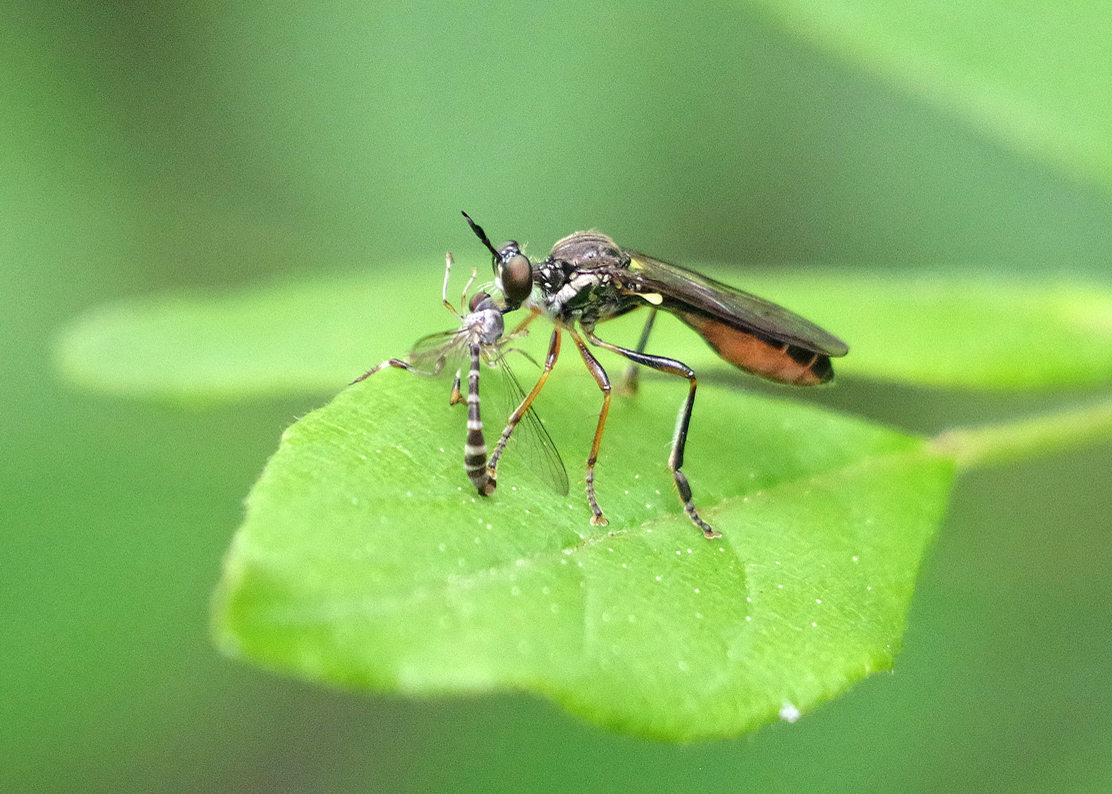
The BugLady was walking at Riveredge Nature Center one day in mid-June when she spied a small Robber fly perched on a leaf, hanging onto its prey. When she put the picture up on the monitor, she recognized the predator as a small (barely ½”) Robber fly named the Stripe-legged robber fly (family Asilidae). Then she tried to figure out what it was holding. It kind of looked like a midge, and that’s how she (uneasily) ended up labeling the picture. Then, as she often does, she entered her dragonfly list for the day at the Wisconsin Odonata Survey (https://wiatri.net/inventory/odonata/) website and sent her butterfly list to the Wisconsin Butterflies page (https://wisconsinbutterflies.org/). Mike Reese, who runs the site, is also interested in Tiger beetles and Robber flies, and he knew what the prey was. Many thanks, Mike.
First, the predator, the STRIPE-LEGGED ROBBER FLY
North America is home to a wide variety of alien/exotic/non-native plant and animal species. Along with famous invasives like Purple loosestrife, Garlic mustard, Emerald ash borers, and Spongy (Gypsy) moths (see https://sewisc.org/), we also have non-native species that keep their heads down and are not invasive – butterflies, daddy longlegs, orchids, and more. The Stripe-legged, aka the Glassy-winged, aka the European Longhorn robber fly (Dioctria hyalipennis) is one of two non-native Robber flies. The species name “hyalipennis” comes from the Greek word hyalo (“glass” or “clear”) and the Latin word pennis (“wing” or “feather”).
Their original haunts were sun-dappled shrubby/woody areas, parks, yards, hedgerows, and field edges in western Europe and northern Africa, but they found their way across the Pond and were first spotted around Boston in 1916. Today they are found throughout the northeastern quadrant of North America (plus, inexplicably, in Seattle and Denver). They’re not uncommon in the areas where they occur, and they’re said to be somewhat gregarious.
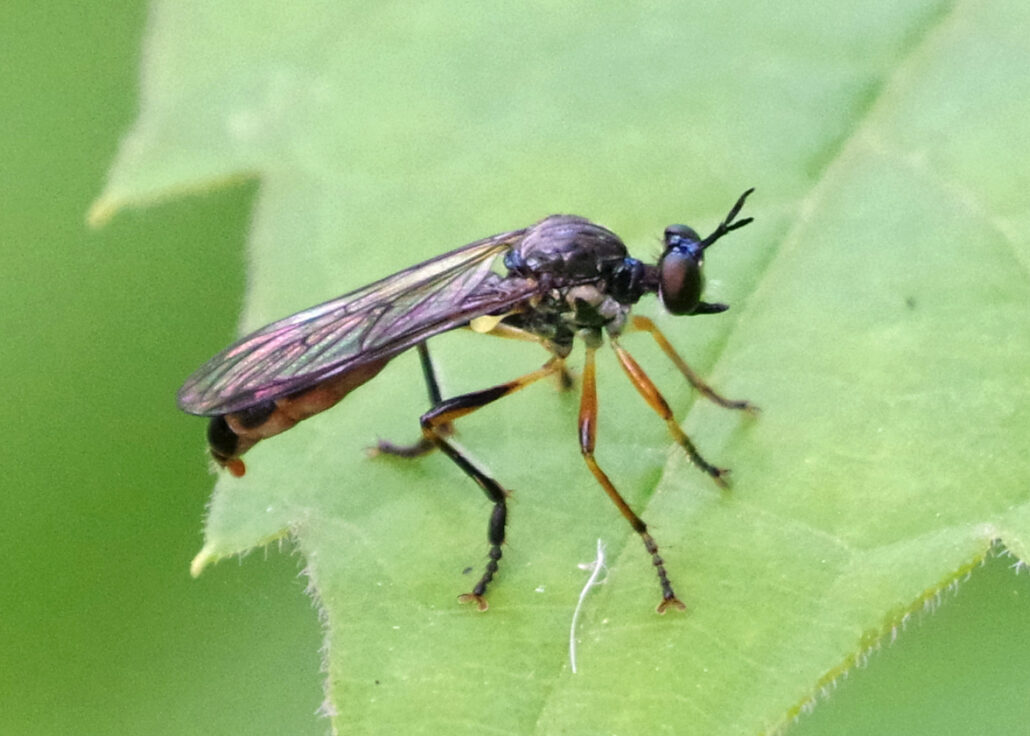
Like other Robber flies, they spot their prey from a perch and fly out to grab it. And, like other Robber flies, they may go after prey that’s almost as big as they are.
One source pointed out that as Robber flies go, Stripe-legged robber flies are not particularly spiney, but since many of the small insects they eat are soft-bodied, like flies, small moths, and leafhoppers, robust spines on the legs aren’t as critical. They also tackle pygmy grasshoppers, bees, and wasps. Matt Pelikan, who writes an excellent Nature column for the Martha’s Vineyard Times, describes it: “Perched glassy-winged robbers are constantly alert, and visibly track any object that flies near them, adjusting their stilt-like legs and pivoting their heads to keep the target in view. Fast-moving insects are left alone, but when a suitable target putters past, Dioctria launches and zeroes in on its victim. As with most robbers, a high percentage of attacks connect.”
He continues, “The process is too fast to watch. The robber grasps its victim and rams pointed mouthparts into its body, injecting a blast of enzymes that both paralyze the prey and begin to break down its tissues. Robbers, with spindly necks, surely don’t have neck muscles that allow them to “peck” their way through a victim’s exoskeleton; I surmise that they grasp the victim with their legs and pull it against their beaks, with the hairs and spines on a robber’s legs being there to assure a firm enough grasp to do this.
… It doesn’t take Dioctria long to drain a typical victim: after five minutes or so, the emptied husk is tossed overboard, and the robber fly resumes scanning for its next meal.
A Piper Cub in a family of fighter planes, the glassy-winged robber fly may be the shortest, lightest, least well-defended, and slowest-flying member of this group. You might think those traits would be disadvantages in a predator. But a lot of dead leafhoppers argue otherwise. Dioctria is perfectly adapted to find and catch a class of prey that is both abundant and vulnerable.”
And the Prey? A PAINTED PIXIE
When Mike looked at the picture, he identified the prey as another Robber fly – at ¼”-ish, the smallest one we have, a Painted Pixie (Beameromyia pictipes) (pictipes comes from “picti” – painted- and “pes” – foot). He went on to say that he has seen them around southern Wisconsin, and the BugLady takes off her hat to him – if anyone can spot a midge-sized Robber fly, it’s Mike.
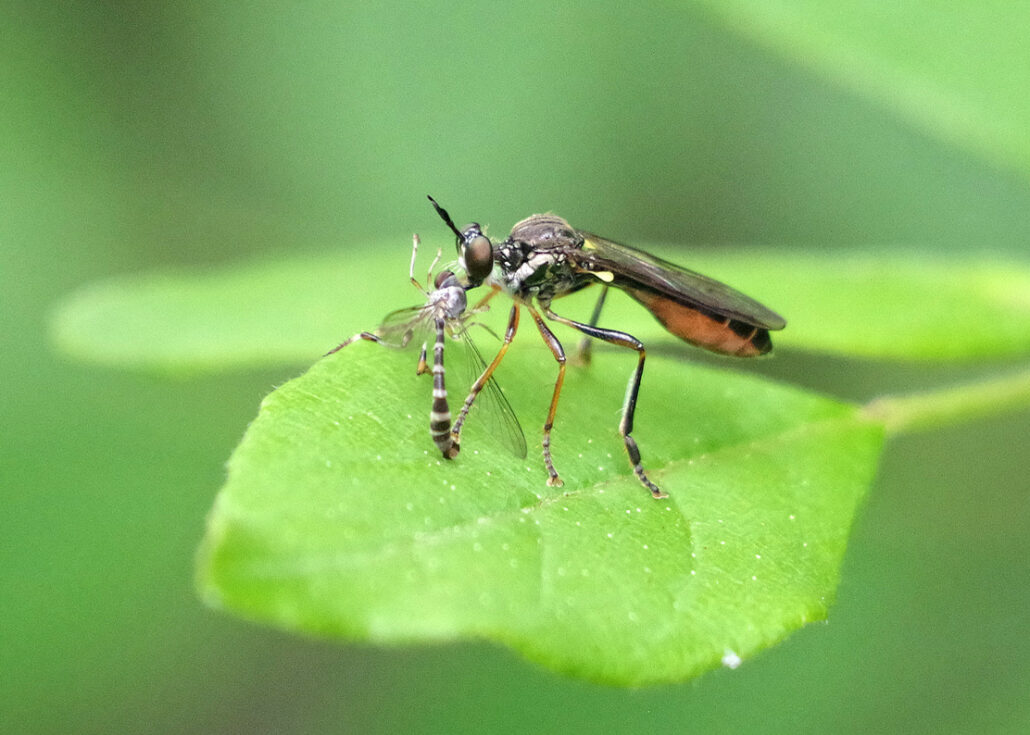
Sources generally conclude that there’s little information about the Painted Pixie because it’s rarely observed. So, the BugLady backed up a couple of notches taxonomically to its subfamily, Leptogastrinae. Species in the subfamily tend to be small and inconspicuous. Some species tweak the general Robber fly MO and hover before picking up prey that’s sitting on vegetation. Or spiders from their webs – the Leptogastrinae eat more spiders than other groups of Robber flies do. Here are some spectacular (sub)family pictures https://robberfly.org/leptogastrinae/
The genus Beameromyia is a very small genus with 15 species in North America and only 24 worldwide. Most of our species are found in the Southwest. These are tiny, slender, long-legged flies that have variously swollen hind legs. They’re found in the east and Midwest in the semi-open areas, where they feed on very small spiders and flying insects.
[Caveat emptor – one site that presented pictures and “facts” about the genus Beameromyia was, in fact, just plugging in generic Robber fly information, and stated that “As members of the Asilidae, these predatory flies are characterized by their robust build and predatory habits.”]
In a monograph on the revision of the classification of the subfamily published by the American Museum of Natural History in 1957, Charles H. Martin wrote that the range of
Beameromyia pictipes “seems to be a narrow belt extending from Kansas to Maryland.” Robber Flies of the Southeast lists their range as the Eastern and Midwestern US, where along with dappled woods and edges, their habitat includes old fields and grassy dunes
And the BugLady’s photograph of the two? Right time, right place, right toys.
Finally, a correction: alert BugFan Tod noted that in last week’s salute to spring, the BugLady misspelled the name of the Duskywing, writing “Juvenile’s” Duskywing instead of Juvenal’s. Juvenal was a Roman author of satirical poetry, and the BugLady has no idea how that connects with butterflies. Thanks Tod.
Kate Redmond, The BugLady
Bug of the Week archives:
http://uwm.edu/field-station/category/bug-of-the-week/