
by Kate Redmond
Bronze Jumping Spider
Howdy, BugFans,
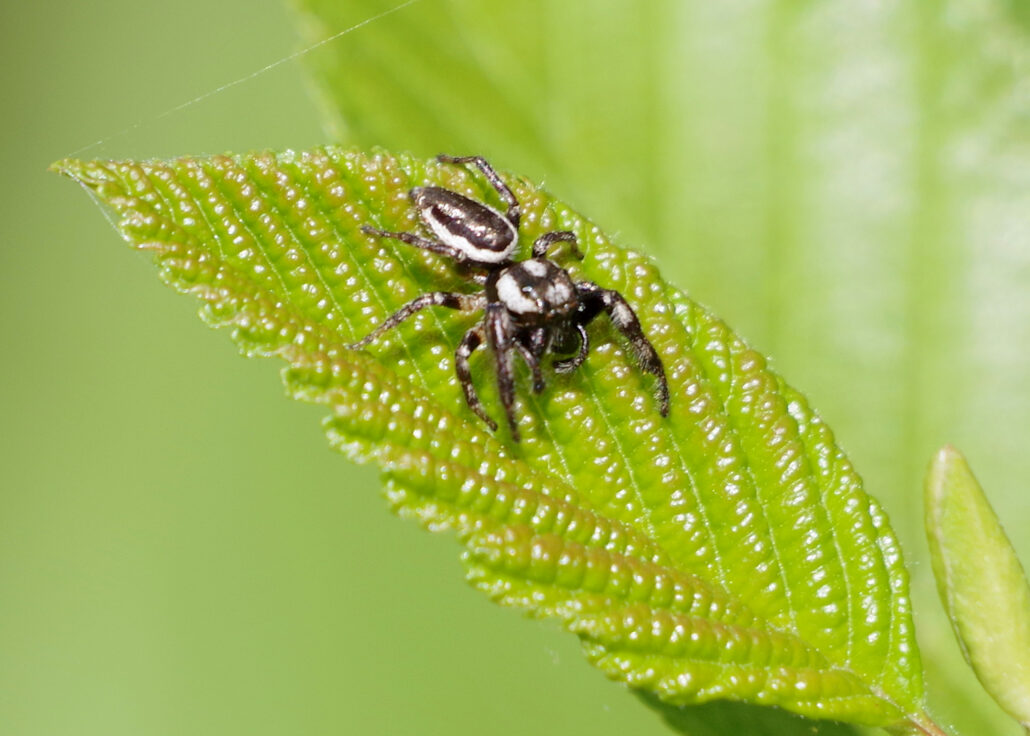
On a walk at Spruce Lake Bog in May, the BugLady spied this Bronze jumping spider (Eris militaris, in the family Salticidae) (thanks, Mike) sitting on an unfolding alder leaf. He spied her, gave her a firm look and then went on his way, apparently unimpressed.
Turns out that the Bronze jumper, aka the Bronze lake jumper (or Saltique militaire, if you’re in Quebec), can be seen across 80% of the country, plus Canada, making it one of the most widely-distributed Jumping spiders we have. It likes suburbs and countrysides, and it lives in sunny areas where there’s vegetation to sun on, to hide in, and to hunt in, and it’s sometimes found in leaf litter on the ground. It also likes agricultural areas, especially orchards, where it picks off crop pests.
The Bronze jumping spider is common enough and its contributions to agriculture are recognized enough so that the effect of pesticides on these spiders has been noted. Exposure to insecticides may subdue both their behavior and their personality, affecting spatial memory and inhibiting learning. Males may have trouble hunting, though they can still capture prey, while females may be too weak to catch prey.
Eris was the Greek goddess of strife and discord, an apparent allusion to the not-exactly-smooth movements of jumping spiders. The species name militaris (“soldier-like”) was chosen by Nicholas Hentz, the scientist who named it, because of the spider’s daring hunting behavior.
Males and females are dimorphic (“two forms”). Males (body about ¼” long) have a light cephalothorax (front section) and a darker abdomen https://www.bugguide.net/node/view/2012703/bgimage, and females (not much bigger) are the opposite https://www.bugguide.net/node/view/1333539/bgimage (and look a bit “teddy-bear-ish” to the BugLady). Their faces disarm even the spider-averse https://www.bugguide.net/node/view/2461050/bgimage.
They do not spin trap webs but, as their name suggests, catch their prey by jumping at it. Small bees, flies, and wasps are all fair game, and so are caterpillars, moths, crickets, leafhoppers, and other insects – and spiders – that they find on their journeys. They acquire their prey by spotting it (their vision is very good and they notice everything), creeping forward, closing the gap until they are 1 to 20 cm away, and then jumping at it by pushing off with their back pair of legs. As they start to jump, they fasten a line of silk called a dragline to catch them if their leap – or their prey – carries them over the side of whatever surface they’re on. A jump can cover 10 to 20 body lengths. They’re also known to leap into the air after a flying insect.
They carry their prey to a safe spot to eat – in the daytime, a sunny spot with good visibility. In the evening, they may opt for “carry-out,” bringing their immobilized prey to a leafy shelter where they will spend the night. They groom themselves after their meal.
In early evening, Bronze jumpers make simple shelters between leaves, often using silk. They are sun-lovers that bask in the sun when they emerge from their shelters in the morning, and that stay in their shelters when the weather is cool, cloudy, or rainy.
Bronze jumpers shelter under dead wood or loose bark or in man-made dwellings in fall, often in the company of other Bronze jumpers (they are not social, just tolerant), and they may overwinter there, in an insulated microhabitat lined with silk. They emerge, almost-mature, in spring, and romance ensues.
When boy meets another Bronze jumper, boy or girl (he can recognize members of his species more than four inches away), he “stands on tiptoe” and does a little dance, waving his front set of legs and sidestepping. If the object of his attention is a male or an immature female, it will depart, often chased by the dancer – it’s usually a flight, rather than fight, response, and males rarely come to blows.
His dance signals his fitness, and if a female is not interested, she may whack his waving legs with her legs. If she’s impressed, the pair may cohabit in a silk shelter for a while. She will produce and guard an egg sac.
The BugLady found this account in a Penn State Extension page about the Bronze Jumper under the heading “Medical Importance:”
“This species is not medically important. (Note: The original author of this publication had personal experience in this regard. While attempting to get the spider to look at the camera by using his index finger to get the spider’s attention, the male pounced upon the fingertip, bit it, and hopped off. The pain was immediate and surprisingly distracting. After only 15 seconds, the pain was gone and no other symptoms developed.”).
Kate Redmond, The BugLady
Bug of the Week archives:
http://uwm.edu/field-station/category/bug-of-the-week/