
by Kate Redmond
Chinese Mystery Snail
Howdy, BugFans,
When the BugLady was growing up near Brown Deer, Wisconsin, close to the Milwaukee River, she heard a story of some 1930’s entrepreneurs who imported Roman or Edible snails (Helix pomatia) with an eye toward some home-grown escargot. They housed the snails in cages on an island in the river (what could possibly go wrong?). Savvy BugFans are already writing the ending to this script.
Yes, the river did flood, and yes, their breeding stock was swept away. And yes, the story could be apocryphal, except for the fact that visitors to Kletzsch Park, about five miles downstream as the water flows, still report finding abundant, large snails (apparently, accidentally stepping on a big one is pretty dramatic/traumatic).
Fast forward decades to another day and another non-native snail (but the same river).
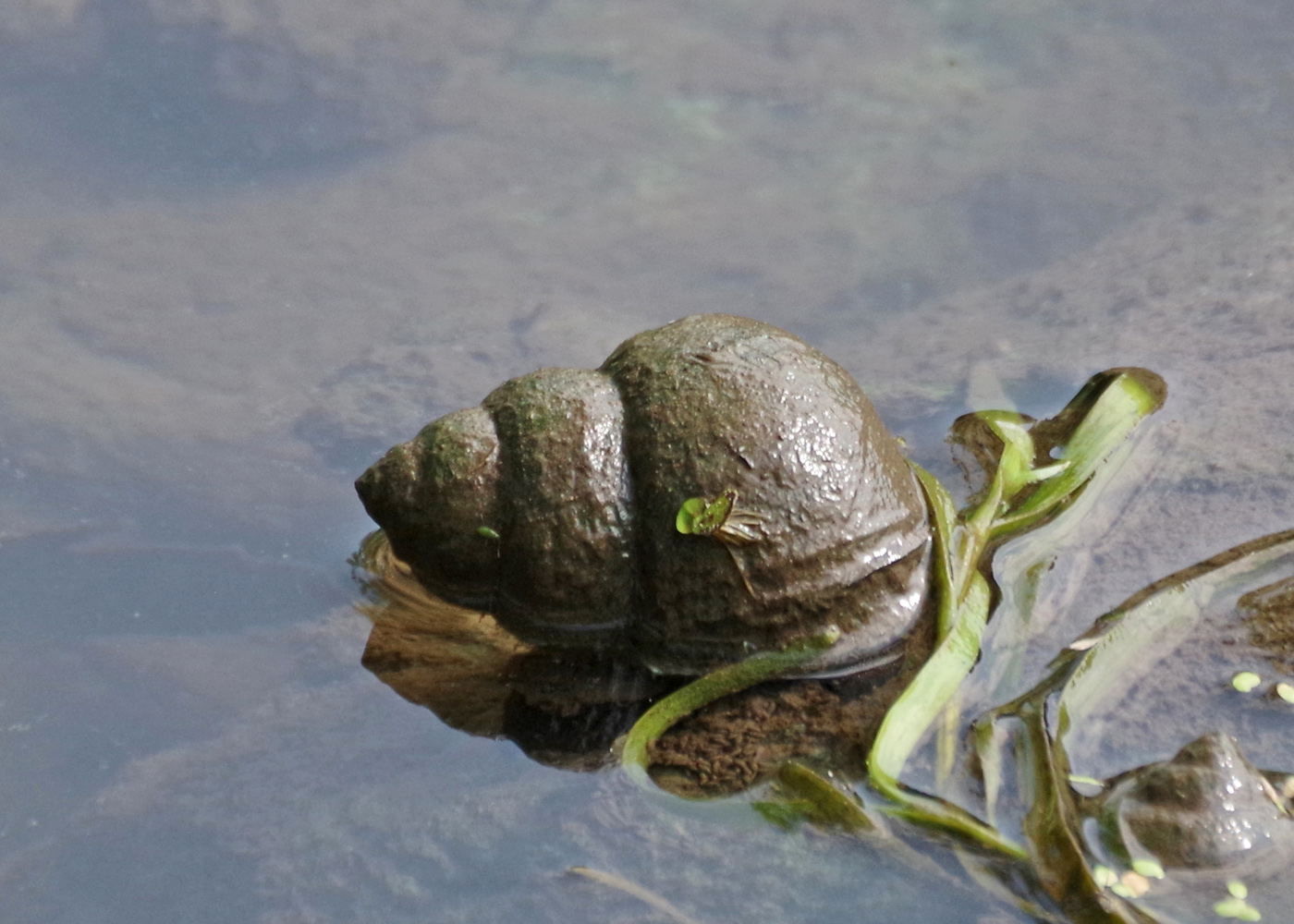
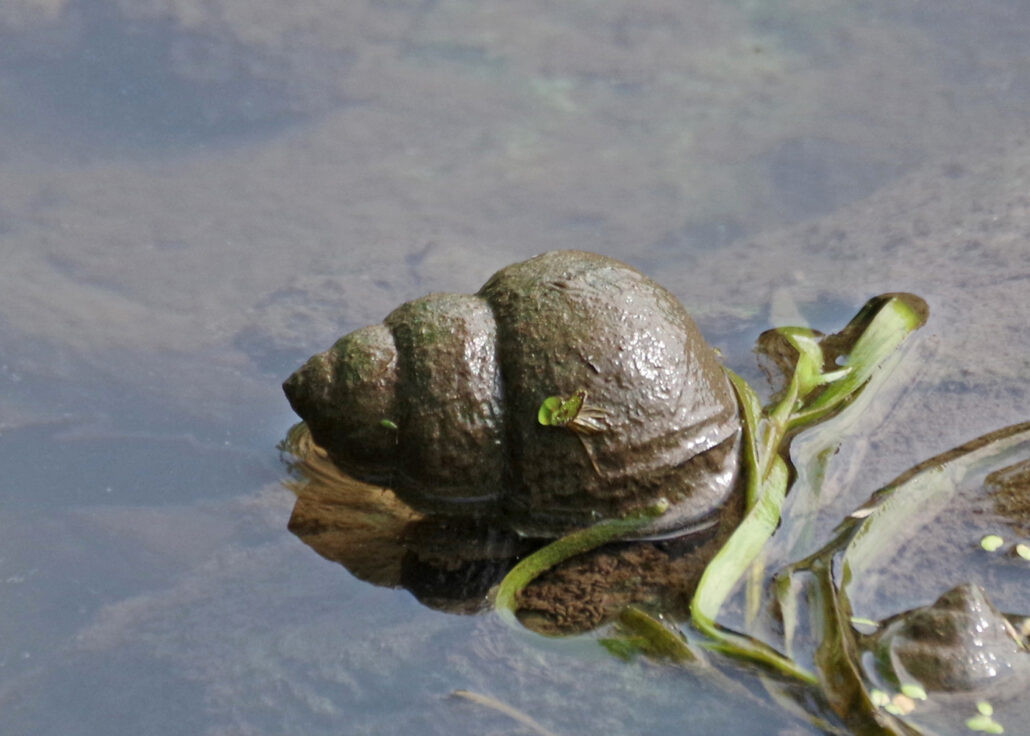
As the BugLady looks for dragonflies along the Milwaukee River at Waubedonia Park, far upstream from Brown Deer, she sees silt-covered, lunker (up to 3”), aquatic snails in the quiet bays along the river’s shore, and she’s been wondering if they were Chinese Mystery snails. Thanks to BugFan Jill, who sent the pictures to a snail guy who confirmed the identification.
Chinese mystery snails (Cipangopaludina chinensis – see following paragraph) are one of the largest species in the family Viviparidae, the River snails. These are gilled, freshwater snails that give birth to live young and that have an operculum, a tough, oval-ish trap door that is located on the snail’s muscley “foot” and that, when the snail pulls the foot into its shell, covers the opening snugly. They’re “right-handed” snails – when you hold them pointy end up, the shell’s opening is on the right side.
Their taxonomy is messy, due to conflicting names given to specimens that may or may not be the same species, in different areas. Says Wikipedia, “Literature cited in the USGS database regarding the Chinese mystery snail may employ the following names: Cipangopaludina chinensis, Cipangopaludina chinensis malleatus, Cipangopaludina chinensis malleata, Viviparus malleatus, Viviparus chinensis malleatus, Bellamya chinensis and Bellamya chinensis malleatus.”
They originated in the shallow waters of eastern Russia and Southeast Asia, where they are used for food, and they were imported to California in 1892 to be sold in Asian markets. From there they started their eastward trek, arriving in Massachusetts by 1915, and branching out to Lake Erie by 1968, and Minnesota early in the 21st century. They were also sold for the aquarium trade, and some of the Great Lakes introductions, like an aquarium release in the Niagara River in the 1930’s, were the result of people “freeing” aquarium snails.
They’re not picky about habitat. They do love a quiet pond or a very slow-moving river with a soft muddy/silty/sandy bottom to burrow into, but they’re also found in ditches, marshes, bays, and other wetlands. They’re very tolerant of changes in water temperatures and water levels, and of low levels of dissolved calcium in the water, even though they need calcium to build their shells.
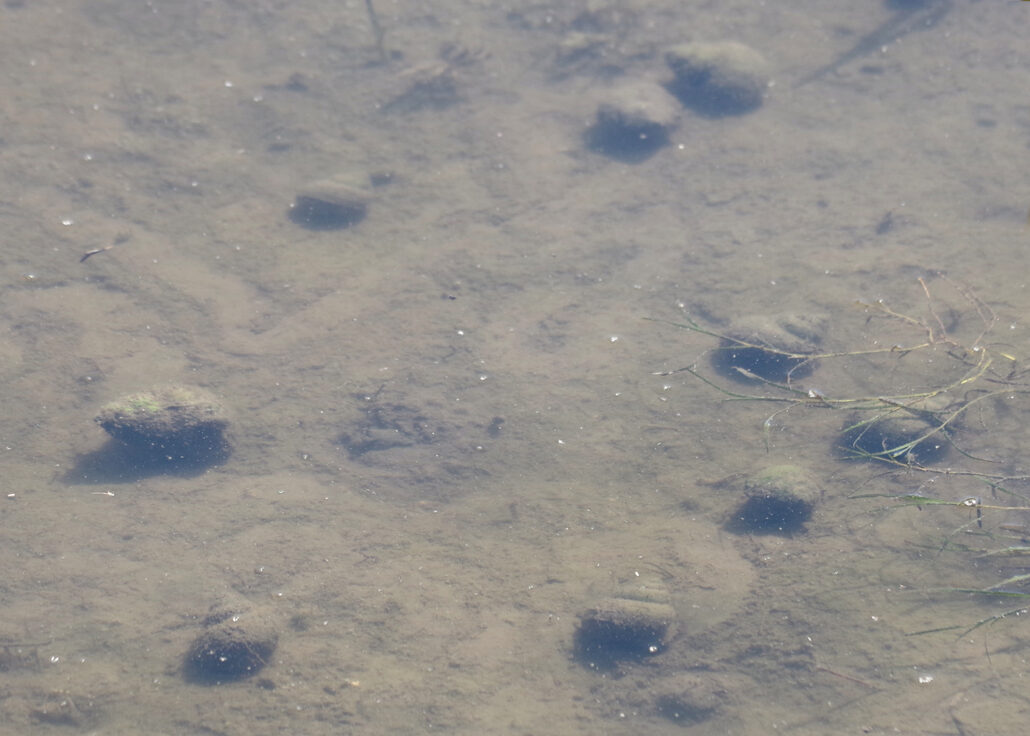
Their food habits explain why they’re considered invasive in some areas. Like other snails, they use hard radulae (spike-like “teeth”) to rasp algae and plankton off of underwater surfaces, but unlike other snails, they can also glean tiny tidbits out of the water by filter feeding, like a mussel. Their filtering effectively removes the tiny bits that other animals eat; they change the water chemistry by releasing lots of snail poop; and if native aquatic animals decline, that affects their predators, all of which may threaten biodiversity. Like the “zebra mussel effect,” the initial “Wow, look at how clear the water is!” may be followed by “Where did all that algae come from?” as sunlight penetrates deeper into the newly clear water. Despite these potential impacts, relationships between Chinese mystery snails, their habitat, and the other aquatic organisms in that habitat haven’t been widely studied yet.
Scroll down for a map of their range in Wisconsin – https://jvzlab.limnology.wisc.edu/ais/chinese-mystery-snail/.
Because of their tough shell and their ability to retreat into that shell and “close the door,” the larger snails don’t have many natural enemies (they coexist with the equally-alien, snail-eating Rusty crayfish). Of course, the reason they arrived on these shores in the first place was their edibility, so they could be/are harvested for restaurant kitchens, though there are too many of them for us to eat our way out of this. Caveat emptor: they host some parasitic worms that can kill waterfowl, and in Asia, they may transmit liver flukes to humans (but they aren’t known to do that here).
Here’s what they look like when they’re not covered with silt https://cceclinton.org/environment/invasive-nuisance-species/aquatic-invasives/chinese-mystery-snail.
Like all good invaders, Chinese mystery snails are very fertile. The embryonic snails develop in the female’s brood pouch, and a “newborn” Chinese mystery snail, complete with shell, may be the size of a grain of rice. Females may live as long as five years (males, three), and they bear more young as they age (larger snails have larger brood pouches and larger broods, but the young themselves are not larger). They reproduce from June through October and average 25 to 35 young per brood, and when they live in warmer water, they reproduce more frequently. According to the Fox-Wolf Watershed Alliance web page on Chinese Mystery Snails, “The “mystery” of these snails comes from their life histories. The females …….. give birth to live, fully developed snails that “mysteriously” and abruptly appear.”
Many of the aquatic invasives in Wisconsin have moved from lake to lake on boats, with early concentrations found around boat launches, which is why the DNR has washing stations at boat launches and encourages cleaning not only the hull, but any ropes, anchors, and other gear that may have been in the water. Unfortunately, Mystery snails have one more survival trick up their figurative sleeves. Most of the critters that hitchhike on boats don’t live long out of water – a few days at most – but a Chinese mystery snail, with its operculum tightly closed, can hang on for at least four weeks.
Remember, for all things Invasive in Wisconsin (and elsewhere), start with the Southeastern Wisconsin Invasive Species Consortium at https://sewisc.org/.
Kate Redmond, The BugLady
Bug of the Week archives:
http://uwm.edu/field-station/category/bug-of-the-week/