Bug o’the Week – Black fly – The Bug. The Legend.

Howdy, BugFans,

Here’s a slightly enhanced episode from 2012

Nobody’s on the fence about black flies.

Black flies are also called turkey gnats and buffalo gnats, and people who live in black fly country have a whole bunch of other names for them that can’t be repeated here.  Entomologists call them true flies (order Diptera) in the family Simuliidae.  There are more than 1,800 species in the family worldwide (100 in North America; 30 in Wisconsin), and most of them belong in the huge genus Simulium.  What do they look like? Their hump-backed thorax and down-tilted head makes buffalo gnat a good nickname https://bugguide.net/node/view/1808934/bgimage.  BFs are tiny (5 to 10 mm) and dark, with clear wings, many-segmented antennae, and big eyes (and teeth) (just kidding).

If you don’t have cool/cold rivers and streams, you don’t have black flies, and if you do have black flies, it’s a compliment to the quality of those running waters.  Black fly larvae like lots of oxygen and are not tolerant of warmer waters or pollution, a fact that was lamented in an Ohio Cooperative Extension Fact Sheet.  In the No-Good-Deed-Goes-Unpunished category, the black fly populations increased when Ohio streams were cleaned up.

Adult BFs live for about three weeks, laying 150 to 500 eggs either individually on the water’s surface or in clumps attached to rocks, branches, etc. in/above the water (larvae that hatch above the water line immediately drop into the stream).  BF larvae are superbly adapted for staying in place and feeding underwater without being swept away by the current.  The nether end of their bowling-pin-shaped body is equipped with little hooks that they sink into the surface of whatever they are sitting on https://bugguide.net/node/view/1673475/bgimage.  They can also make silk web that helps them to stick tight or to move slowly to another spot.  There usually are several generations per summer, with the final generation overwintering as eggs or as mature larvae that are poised to complete their transformation in spring.  The summertime larval period takes a month or so, but the pupal stage is only a few days long, spent inside a cocoon submerged in an open-ended basket woven by the larva https://bugguide.net/node/view/877917/bgimage.  Emerging adults float up to the water’s surface on bubbles of air.

BF larvae are passive feeders who expand a fringe/fan around their mouth in order to grab/filter out tiny critters and organic (living or once-living) bits that float past them.  It’s the adults’ feeding habits that provoke profanity (“Under certain circumstances, profanity provides a relief denied even to prayer.” Mark Twain).

Like other biting flies, males are blameless nectar feeders.  Females may also consume nectar, but they need that all-important blood meal in order to reproduce.  Using her sharp, piercing (sometimes described as “blade-like”) mouthparts, a female makes shallow slashes in her prey and then sponges up the blood that flows from its surface capillaries  https://bugguide.net/node/view/389265/bgimage.  Injecting a local anesthetic and an anticoagulant allows her to get the job done efficiently (and causes the subsequent itching and swelling).

Different species of BFs target different kinds of warm-blooded animals, including humans, and some travel a great distance to do so.  Purdue University’s Medical Entomology Department reports that only about six species of BF cause grief for humans in the eastern US (and not all species are prolific biters), though other species annoy simply by their clingy presence.  Dense populations of BFs may cause livestock to lose weight and milk production to falter, and here in Wisconsin, a project to reintroduce the endangered Whooping Crane as a breeding species hit a snag when swarms of bird-biting BFs prevented the cranes from bringing off young.

Adult BFs feed by day; they are strong fliers that dislike wind; they love the thin skin on your ears and neck, and your clothing is no barrier; they have temperature receptors on their antennae (the better to find you with, my dear); and they seem to like the color blue.  Your personal mix of CO2, sweat, shampoo, etc. may make you more – or less – apt to draw flies.

Much as she loves and practices irony and understatement, even the BugLady feels a little guilty for saying that BFs are a big pest.  BFs in the tropics are capable of spreading diseases and parasites, but in the North Country, they are the biting fly that drives people inside when they want to be out – gardening, fishing, canoeing, hiking, camping, or just walking leisurely from the car to the house with a bag of groceries.  Getting a few BF bites is irritating; getting a whole bunch can cause “Black fly Fever,” a flu-like reaction to the BF saliva, and people with BF allergies may end up in the hospital.  Even dense swarms of non-biting BFs are annoying, because they fly into ears, eyes, noses and mouths.  An article about BFs in the Philadelphia Inquirer in 1993 quoted a clergyman who traveled through the “northlands” (probably French Canada) in 1624 as saying that BFs inflicted “the worst martyrdom I suffered in this country.”

Lots of brain power has been devoted to BF control over the years, and websites, brochures and papers about control measures read like war games manuals.  It’s hard to zap the adults because they disperse away from their natal streams, and many pesticides should not be used in the watery habitats of the larvae because they kill other species indiscriminately.  Some folks feel that the common repellent DEET may actually attract BFs, but tar oil spread on exposed skin is supposed to be pretty good…..  One site recommends wearing an unpainted, aluminum hardhat coated with oil – the hardhat attracts BFs and the oil traps them.  A strain of Bt (Bacteria thuringiensis israelensis) has been successful on the larvae but is expensive and labor-intensive.  Mechanical methods include brush control and temporary damming of streams (still water carries less oxygen).  Fogging provides only temporary relief on small properties.  Out-foxing them by limiting outside activities to fly-free periods is best (they are said not to bite indoors), and a good antihistamine to treat the inevitable bites is a great Plan B.

As The Minnesota Conservation Volunteer (a dynamite publication) points out, black flies are valuable native pollinators of wild blueberries, but black flies’ biggest fans are their predators.  BF’s are an important fish food, and trout often intercept the emerging adults as they float to the surface.  Birds, amphibians, and fellow-insects like dragonflies also eat their share of the BFs that escape into the air.

Some folks embrace the BF.  Several towns in New England host Annual Black Fly Festivals (BFs are the unofficial State Bird of Maine).  Although Vermont’s Adamant Co-Op Black Fly Festival seems to have fallen by the wayside this year, its motto has been “More fun than is thought humanly possible.”  Press releases tell us to “Forget about fiddleheads, peepers, and maple sugaring.  Black flies are the real harbinger of spring in central Vermont” and past festivals have featured “Black fly balloons, Black fly Jeopardy, a Black fly fashion show (antennae optional), the Black fly parade, mugs, T-shirts, and live music by the Fly Swatters.”  Because, “after a long, cold winter here in Adamant, we need something to celebrate, and God only knows we have plenty of black flies.”  The schedule of events for the day concludes with: “4:00 – Grill closes. Festival ends.  Blackflies all die.”

Milo, Maine hosts a festival, as do several Canadian towns.  The Adirondack town of Inlet, NY features an Annual Black Fly Challenge bike race.  Many tourist-related businesses in the Adirondacks close for a month during the peak BF season, which they call “the Fifth Season.”

Go outside – feed the black flies.

On a related pandemic note – apparently, the pandemic has been keeping people off the trails that the BugLady walked today, because when she arrived, the mosquitoes had a noisy celebration.

The BugLady

Bug of the Week archives:
http://uwm.edu/field-station/category/bug-of-the-week/

Bug o’the Week – Pseudoscorpion

Greetings, BugFans,

“Closed for June,” but here’s a slightly spruced up episode from 10 years ago, part of a series on household bugs.  The BugLady recently found one of these little cuties in her bathroom.

Last week, the BugLady raced a storm to get the episode posted – the electricity went off 4 minutes after she sent it out.  This week, the leading edge of Tropical storm Cristobal has already arrived to drench Wisconsin (and blow it off the map), so she’s getting an early start.

The phylum Arthropoda (“jointed legs”) is HUGE and diverse; it includes the Crustaceans (fairy shrimp. daphnia, sowbugs. crayfish, crabs and horseshoe crabs), the Arachnids (spiders, daddy long-legs, scorpions, pseudoscorpions, mites and ticks), the millipedes and centipedes, and the insects.  The BugLady looks forward to seeing this exquisite little bathroom-dwelling arthropod during the warmer months, and she was pleased to discover that its life is as interesting as its appearance.

They have names that are substantially longer than the bugs themselves.  Pseudoscorpions like today’s star, the Book Scorpion, are in the family Pseudoscorpiones in the order Chelonethida/Pseudoscorpionida.  There are some 300 species of pseudoscorpions in North America (2500 worldwide), and they come in both indoor and outdoor models – the species that live outside are found under the cover of bark, leaves and soil.  They’ve been around for a while – fossil pseudoscorpions date back 380 million years.  They were mentioned by Aristotle and were listed as “land crabs” by Robert Hooke in his amazing 1665 book called Micrographia (no, not tiny handwriting – the other Micrographia https://en.wikipedia.org/wiki/Micrographia).

The common House Pseudoscorpion/Book scorpion (Chelifer cancroides), is one of the larger models, their bodies measuring 0.2” long (there’s a picture of one sitting cooperatively by a ruler https://bugguide.net/node/view/966500/bgimage).  That means that you could put the eraser of a #2 pencil over one (that actually means that you could put the eraser of a #2 pencil over two of them, with some appendages sticking out at the sides).  Pseudoscorpions are flat and wedge-shaped (kind of tick-shaped), and their color has been described as “rich mahogany.  They have 4 pairs of legs, on which they can walk backwards and sideways as well as forwards, and a set of “pedipalps”/pincers on long appendages that are located in front of the legs.  The pincers are armed with poison to subdue their prey and are also used for fighting, for defense, and to build nests. Nota bene – no scorpion stinger at the other end.  Pseudoscorpions are roughly tick-shaped, but they’re not ticks and are harmless (and even beneficial) to humans https://blogs.scientificamerican.com/running-ponies/how-book-scorpions-tend-to-your-dusty-tomes/.

With silk spun from glands on their jaws they make chambers for overwintering, for molting (a vulnerable time), and for brooding.  A spider’s silk glands are at the other end.  Most pseudoscorpions are eyeless, but long sensory hairs on their pincers suggest that they navigate through life by touch.  They practice phoresy – that is, they hitchhike on insects in order to get from Point A to Point B (the Wikipedia entry on Pseudoscorpions has a photo, and here’s a picture of one on an Eyed click beetle https://bugguide.net/node/view/23845.  Most of the specimens that get captured and turned in for identification are adults because, according to one source, older Pseudoscorpions are less agile and more likely to slide down whatever surface they are climbing up, and they find it harder to right themselves after flipping over on their back.  The BugLady can relate.

Book scorpions are predators.  Whether they are hanging out on the BugLady’s bathroom walls or between the pages of a book, they are looking for critters to eat.  Their menu includes flies, ants, clothes moths, carpet beetle larvae, mites, book lice, and other pseudoscorpions, and they reportedly like bedbugs.  All-on-all, nice little critters to have around.

These tiny, sightless critters have developed an elaborate life cycle.  It begins with a courtship dance that may last as long as an hour.  Males create a mating territory 1 to 2 centimeters square, possibly using pheromones (scents) to mark its area.  According to the Little Golden Guide to Spiders and their Kin by Levi and Levi, when a female enters his territory, the male waves his pincers, vibrates his abdomen or taps his legs.  The couple lock pincers and pull each other back and forth; he eventually guides her to a spermatophore (sperm packet) that he has laid on the ground, and she picks it up.  The female carries the fertilized eggs (about 2 dozen) in a silken sac/brood pouch attached to her abdomen; the young stay in the sac after hatching and consume a milk-like substance that she produces in her ovaries.  Even after they leave the sac, the young may continue to piggy-back on Mom for a while. Young pseudoscorpions molt several times over a year or so before becoming adults.  Adults may live for 3 years – quite a life span for such a small creature.

Fun Pseudoscorpion Fact from the Remarks section in the Pseudoscorpion write-up in bugguide.netI remember them being abundant in the chicken houses I was responsible for while growing up and I assume they must have been feeding on bird lice [Troy]

None are known to be parasitic but they feed on arthropods in bird and rodent nests. They are sometimes found on beetles or other large insects where they apparently feed on mites.

Kate Redmond, The BugLady

Bug of the Week archives:
http://uwm.edu/field-station/category/bug-of-the-week/

Bug o’the Week – Monarch Butterfly Rerun

Howdy, BugFans,

The BugLady saw her first monarch butterfly about 10 days ago, and today saw the first on her property.  Here’s a rerun from two years ago on the status of the monarch, with different pictures, and a few goodies at the end.  For up-to-date information, see https://monarchwatch.org/blog/category/monarch-population-status/.

It’s hard for us to wrap our minds around how populations of an organism that occurs by the millions (like the horseshoe crab, of recent BOTW fame) could be threatened.  And yet.

In the early 1990s, an estimated 400 million Monarch butterflies (by some accounts, 700 million) overwintered in the mountains west of Mexico City.  By 2010, that number had dropped, but it stabilized at around 100 million, though only 33 million were found in the winter of 2013-14.  This year’s population (winter of 2017-18) is estimated at 93 million; the biomass of Monarchs went, according to the Center for Biological Diversity, from covering 39 football fields to covering about one.  In the mid-1990’s, overwintering butterflies were found on about 44 mountainous acres; in 2013-14 on less than two acres; and this winter, on about 7.5 acres, down about 15% from last year.

The “Eastern Monarchs” that winter in the oyamel fir forests represent the entire migratory population this side of the Rockies.  Pacific monarchs, whose numbers are also in steep decline, migrate along the coast to California, and there are non-migratory populations along the Gulf Coast, South Florida, and South Texas.

Still, 100 million butterflies is a lot of butterflies, right?  Not when you consider the impossibility of what they do, which is to undertake a 2,000-plus mile migration, spreading out from a pinpoint in Mexico to cover two-thirds of the continent.  Monarchs weigh about one-half of a gram each, which means that a Quarter pounder is equivalent to about 225 Monarchs (the BugLady was told there would be no math).  They face the physical dangers of a trip that takes them from as far north as Canada all the way to Central Mexico, where they spend months in resting mode before perking up in late winter and meandering north.  The same individuals that left Wisconsin begin the return trip, but their offspring’s offspring tag home here in May.

They face predators, cars, habitat loss, agricultural pesticides, and the shifting seasonal temperatures and increasingly severe weather events precipitated by Global Climate Change (aka Global Weirdness.  There were three hurricanes and two tropical storms at the start of the 2017 fall migration period http://monarchwatch.org/blog/2017/09/15/forgotten-victims-of-harvey-the-pollinators/).  The fall migration of 2017 along the Atlantic Coast was late, with some butterflies lingering into late October and even early November, lulled by unseasonably warm weather, the late migrants left susceptible to storms and freezes.  For a rundown on Monarch mortality factors, see “The State of the Monarch,” an August, 2015 BOTW, at http://uwm.edu/field-station/the-state-of-the-monarch/).  The only cushion against mortality factors like that is to maintain a huge population.

The US Fish and Wildlife Service tells us that “nearly a billion monarchs have vanished from the overwintering sites since 1990,” and according to a recent article in USA Today, “A 2016 study by the U.S. Geological Survey concluded that because of ongoing low population levels, there is an 11% to 57% risk that the eastern monarch migration could collapse within the next 20 years.”

Not on our watch!

Milkweed has declined dramatically in agricultural areas in the Midwest, where the Monarch’s population strongholds are (the “Milkweed Limitation Hypothesis”).  Planting milkweed for caterpillars (and planting other nectar-bearing wildflowers for adults) as a part of grassland habitat restoration is a good start and it’s pretty and it can’t hurt.  Chip Taylor, of Monarch Watch, goes further, saying that “we need a comprehensive plan on how to manage the fragmented edges and marginal areas created by development and agriculture since it is these edges that support monarchs, many of our pollinators, and the many forms of wildlife that are sustained by the seeds, fruits, nuts, berries, and foliage that result from pollination.”  Late-blooming, nectar-bearing flowers fuel the fall migration and allow Monarchs to gain the fat reserves that will carry them through the winter.

Research strongly suggests that limiting the use of glyphosate pesticide use (and getting Climate Change turned around) hold out the greatest hope for Monarchs.  For two articles about recent studies, see https://academic.oup.com/bioscience/article/67/12/1080/4557606 and https://www.ncbi.nlm.nih.gov/pmc/articles/PMC5627118/ (there is math)

Finally, the Monarch is under consideration for Endangered Species protection, a decision that was to have been made by June, 2019 (https://www.fws.gov/savethemonarch/SSA.html).  It needs to be on that list so that legal protections will apply.  At the time this originally aired, the decision was expected within a few months, but the Fish and Wildlife Service extended their decision until the end of 2020 https://monarchjointventure.org/news-events/news/monarch-butterfly-esa-listing-decision-deadline-extended.

[Mildly political aside: And, of course, there needs to be an effective Endangered Species Act https://environment-review.yale.edu/biodiversity-brink-consequences-weakened-endangered-species-act.  Wonder what would happen if every school child drew pictures of Monarchs and sent them to their Congress-people and to the Fish and Wildlife Service?]

Bonus goodies:

An animated map https://maps.journeynorth.org/map/?map=monarch-adult-first&year=2020 (the BugLady does love a good animated map);

And a magical flight with a hummingbird drone https://www.youtube.com/watch?v=lWOySU_hAz0

Go outside – plant nectar-producing plants.

Kate Redmond, The BugLady

Bug of the Week archives:
http://uwm.edu/field-station/category/bug-of-the-week/

Bug o’the Week – Wildflower Watch –Marsh Marigold

Howdy, BugFans,

May is American wetlands month, so we’ll end it in the swamp, in the company of Marsh Marigolds, the flowers that turn newly thawed wetlands a riotous yellow from the last days of April through much of May.  Skunk cabbage and pussy willows may whisper the arrival of spring, but marsh marigolds crank up the volume.

The BugLady should have started this project two weeks ago when the marsh marigold was at its peak, but the truth is that despite the masses of flowers it produces, she seldom sees many insects on it, and the ones she sees are as likely to be resting as dining.  According to the great Illinois Wildflowers website (https://www.illinoiswildflowers.info/), “The nectar and pollen of the flowers attract flies and bees primarily. This includes Bombylius major (Giant Bee Fly), Syrphid [hover, flower] flies, Halictid [sweat] bees, honey bees, and others. Two leaf beetles are occasionally found on the foliage of Marsh Marigold: Plateumaris nitida and Hydrothassa [Prasocuris] vittata. It is possible that they eat the foliage. For other herbivores, specific information for Marsh Marigold is lacking. Because the acrid foliage contains toxic alkaloids and glycosides, it is usually avoided by mammalian herbivores.”

Here are some marsh marigold basics, adapted from an article the BugLady wrote for the newsletter of the Friends of the Cedarburg Bog in 2012:

  • Your Grandma probably called them “Cowslips,” which comes from an Old English word “cuslyppe “or “cu slyppe” for cow slobber or cow dung.

  • Thoreau called them “A flower-fire bursting up, as if through crevices in the meadow where they grow.”  He also said that “the flower has no scent but speaks wholly to the eye.”  He was wrong about the scent, but the flower’s faint odor is more easily detected by insects than by humans.

  • Early 20th century naturalist John Burroughs wrote that “they give a golden lining to many a dark, marshy place in the leafless April woods.

  • They’re not marigolds, and marsh buttercup would be the most accurate name for these members of the Buttercup family Ranunculaceae (Ranunculus is Latin for “little frog”). The scientific name, Caltha palustris, means “Cup of the swamp.”

  • Marsh marigold is found in damp-to wet ground around the world, growing in sunny places with saturated soil.  Forty years ago, it was hard to find a marsh marigold in bloom before the first week of May; now it often flowers in the last ten days of April.

  • The flower has no petals but is made up of five to ten shiny, yellow sepals (sepals are the usually-green, modified leaves that clasp the flower bud, protecting it before it blooms). The sepal’s yellow color is in a waxy coating that can easily be scraped off with your thumbnail – in a few of the pictures, you can see white spots where the color has been eaten away.

  • Marsh marigold is an abundant source of pollen and nectar that attracts more than three dozen species of early sweat bees, flower flies, and bee flies.  A bee’s-eye-view is vastly different than ours is, and its perception of UV light makes the yellow sepals look purple and turns the center, where the nectar is found, black.

What did the BugLady find on the flowers and leaves?

MINING BEES AND SWEAT BEES hard at work ensuring next year’s show.

A TEPHRITID FLY – Tephritidae is the (true) fruit fly family, as opposed to the pomace fly family Drosophilidae, home of those universal lab rats, the Drosophila.  Tephritid larvae develop within various plant parts.

A CRAB SPIDER having a Sistine Chapel (or an ET) moment.

MOTH FLIES – The BugLady has been seeing these tiny (1.5 to 4 mm), aptly-named flies (family Psychodidae) on the vegetation in wetlands recently.  Some moth flies live wholesome existences, and others live in sewers and feed on the by-products thereof.  These feed on nectar and on stuff they find in stagnant water; their offspring eat algae, fungi and bacteria suspended in the still waters of the swamp.  For the story of another group of moth flies, see https://uwm.edu/field-station/moth-fly/.

(PINK) SPOTTED LADY BEETLE – Ladybugs eat aphids and other tiny critters, both as larvae and as adults – you can find both stages feeding in aphid herds side by side.  Pink lady beetles prefer dampish habitats, and, according to bugguide.net, “Unlike most lady beetles, plant pollen may constitute up to 50% of the diet. This is the only North American lady beetle that can complete its life cycle on plant pollen.

A MALE CRAB SPIDER lurking.  Spoiler alert – the fly flew.

ANTS are unsung (and ineffective) pollinators.  Yes, they are all over the flowers, but since they are on foot, it’s hard for them to move pollen from one flower to another (unless it’s a cluster of flowers).  Plus, they groom their slick little bodies constantly.

BAG WORM – This little collection of plant material looks like a case made by a bag worm moth larva called Psyche casta https://bugguide.net/node/view/1098038/bgimage.  The BugLady often sees these on screens and siding and even on leaves, but never before on flowers.  Larvae make the shelters, enlarge the shelters as they grow, pupate in the shelters, and the wingless adult females receive suitors in the shelters, and lay their eggs there.

SYRPHID FLY – aka Hover or Flower fly.  A great group of often-exquisitely-marked bee mimics that feed on pollen and nectar.

MOSQUITO WITH MITE – Both male and female mosquitoes feed on nectar – males exclusively and females as a supplement.  This one is being fed upon by the nymph of a water mite that attached when the mosquito was in its aquatic, larval stage.

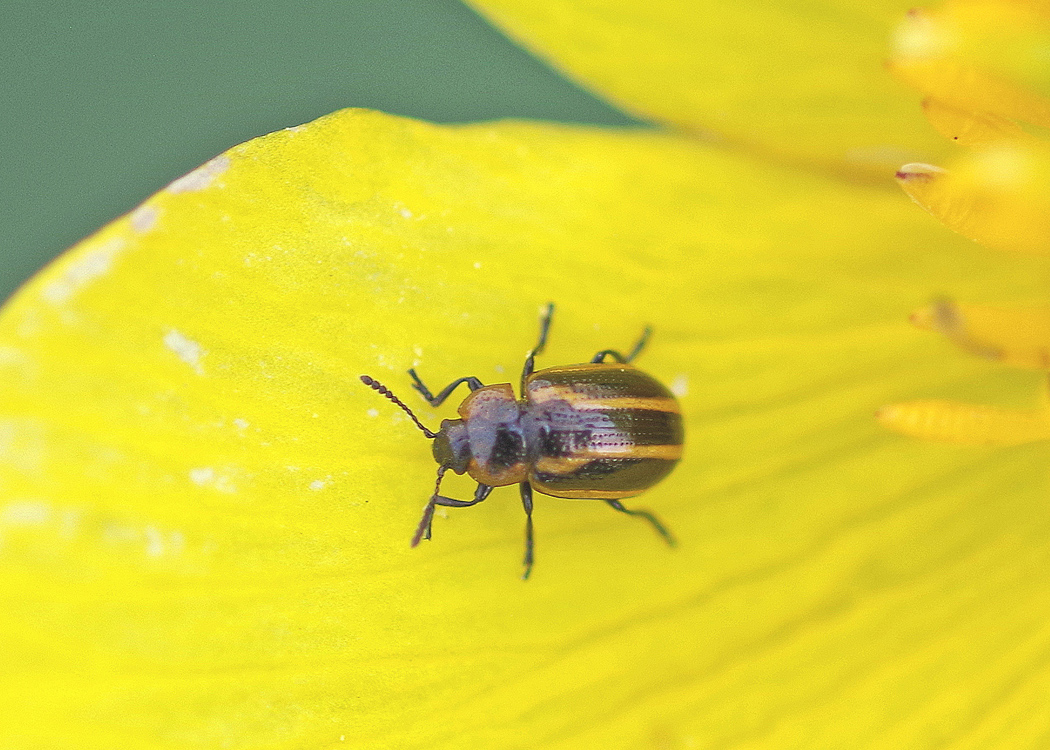
BUTTERCUP BEETLE Prasocuris vitata – A leaf beetle (Chrysomelid) that is a buttercup/marsh marigold specialist https://uwm.edu/field-station/buttercup-beetle/.

PLATEUMARIS NITIDA – The BugLady’s first thought was “what’s a Donacia (a water lily leaf beetle https://bugguide.net/node/view/1470040/bgimage) doing in a marsh marigold thicket, far from the nearest water lily?”  Then she looked up the second beetle mentioned in the Illinois Wildflower site.  It turns out that some members of the genus Plateumaris are Donacia look-alikes and marsh marigold is listed as the host plant of at least one species.  The beetle’s gleam is due to physics, not pigments.  While looking for info about this beetle, the BugLady came across this nicely illustrated paper about the feeding behaviors of leaf beetles   https://www.researchgate.net/publication/240671564_Feeding_behavior_of_leaf_beetles_Coleoptera_Chrysomelidae.

Also seen were a plume moth https://bugguide.net/node/view/1322782/bgpage, a soldier beetle, several more spider species, and a mining bee, and a clever shelter built by a spider that bent a yellow sepal over and anchored it with silk.

FYI – BOTW will, as usual, be Closed for June, so that the BugLady can go out and photograph the heck out of the local nature areas.  She will post tasteful and timely reruns.

Kate Redmond, The BugLady

Bug o’the Week – Festive Tiger Beetle

Howdy, BugFans,

The BugLady has been enjoying the company of these lovely beetles on her walks over the prairie at Riveredge recently (no, despite the recent rash of Riveredge-based episodes, she does not own stock in Riveredge or even get free maple syrup – it’s just a very cool place to walk – and witness a little beetle hanky-panky).

The beetles live along a sandy trail, and as you walk toward them, they fly up in front of you for a few feet, often landing at the path’s edge where sparse grass begins.  At just under a half-inch long, they’re not huge – the BugLady was showing them to someone one day, and they had thought the beetles were flies.

Tiger beetles used to be considered a separate family, but now they’re classified as the subfamily Cicindelinae in the ground beetle family Carabidae, a huge family with about 34,000 species worldwide, some 2,500 of them in North America.  According to bugguide.net, there are 117 species of tiger beetles north of the Rio Grande (and almost as many subspecies – more about that in a sec).  The BugLady has said it before – someone is sure having fun naming these beetles.  Festive tiger beetles (Cicindela scutellaris) are in the tribe Cicindelini (Flashy tiger beetles) and in the genus Cicindela (Temperate tiger beetles).

They are famous for their boldness – after a short flight, tiger beetles often land and turn to face their stalker https://bugguide.net/node/view/894153/bgimage – and for their speed (there’s a reason why many tiger beetle pictures are of the beetle’s rear).  They can hit 5 mph on all sixes; Jim McCormac, in his excellent Ohio Birds and Diversity blog says “they move in impossibly quick bursts, as if propelled by small explosives.” http://jimmccormac.blogspot.com/2009/04/tiger-beetles.html.

Festive tiger beetles are considered one of the most widely-distributed species of tiger beetles, present in the US east of the Rockies (except, oddly, in the Appalachians) and across southern Canada from Alberta to Quebec.  They’re found in sandy, relatively unshaded habitats – paths, edges, and swales – away from water.

Tiger beetles have been discussed in these pages before (https://uwm.edu/field-station/tiger-beetles-revisited/), and a festive tiger beetle’s biography follows the general tiger beetle template.  Briefly, it’s a two-year life cycle (but it’s not synchronized, so various stages are present each year).  According to the University of Michigan Animal Diversity Web account of Festive tiger beetles, “Females lay about 50 eggs in dry sand or sandy soils. Each egg is deposited into its own hole, about 5 to 10 mm deep. Larvae develop to the 3rd instar stage in their first summer and hibernate over the winter. In the following spring they become active and begin feeding, then pupate in June and July. They emerge as adults in August, often after a soaking rain. Adults overwinter in a burrow and are sexually mature when they emerge the next spring.”  The BugLady was surprised to see this beetle in May – she’s accustomed to chasing them in September – but she learned that they’re typically seen in late spring and then again at the end of summer.

The well-camouflaged larva lurks at the mouth of a vertical tunnel of its own creation https://bugguide.net/node/view/1480242/bgimage (the female’s choice of a soil type for her eggs is critical), waiting for small, unwary pedestrians to pass by.  Having nabbed some prey, they retire with it to the bottom of their lair.  Adults are carnivores, too, chasing ants and other invertebrates.  Adults are eaten by spiders, robber flies, and a few birds and mammals, and larvae by wasps, ants, and some beetles.

Festive tiger beetle are diurnal, and ground temperatures in their habitat can swing between extremes, but the beetles have strategies for that.  Overheated beetles may shelter under vegetation or may tunnel shallowly into the sand, and they may also stay underground at night, when the sand’s surface cools.  They aestivate (from the Latin for “summer”), disappearing during the hottest months.  Like some other insects, they bask in the sun to increase their internal temperature when they’re chilly, and they stand “on tiptoe” to get away from the heat https://bugguide.net/node/view/1062656/bgimage when they’re hot.

According to Eric Eaton at bugeric.blogspot.com, “The metallic nature of tiger beetles is structural, rather than the result of pigmentation. Layers in the exoskeleton reflect various wavelengths of light.”  Even though brightly-colored, the patterns on the adults elytra break up their body shape visually and can make them hard to spot.

Not only are Festive tiger beetles considered one of the most widely-distributed species of tiger beetles, they are also among the most variable species of tiger beetles, and that’s because entomologists have described a bunch of subspecies.

What’s a subspecies?  Within a species’ range, especially if it covers a wide geographic area, populations may take on a unique appearance, lined up in a continuum across their range.  They’re the same species genetically– they could still interbreed more-or-less successfully (for now) if they met up with each other, though they might not recognize each other.  They may be on the way to becoming distinct species.  In appearance, (phenotype) they’re different, due to environmental factors – different enough that scientists give them an extra name that indicates their separateness.  Our Upper Midwestern Festive beetle is Cicindela scuttelaris lecontei, aka C. s. lecontei.

The folks at the Animal Diversity Web list these subspecies and ranges (there may be a mix of subspecies in an area), and the BugLady added pictures from bugguide.net.  Remember – at present, this is a single species.  .

  1. s. scutellaris(Festive tiger beetle). West of the Missouri River.  https://bugguide.net/node/view/1722649/bgimage, and https://bugguide.net/node/view/1479472/bgimage;

  1. s. flavoviridis,(Chartreuse tiger beetle).  Central northern Texas.  https://bugguide.net/node/view/1504640/bgpage;

  1. s. lecontei(Leconte’s tiger beetle)– that’s us!  Throughout the northeast and Midwestern states.  https://bugguide.net/node/view/1635202/bgimage, and https://bugguide.net/node/view/747313/bgimage;

  1. s. rugata(Rugate tiger beetle). From eastern Texas to western Arkansas.  https://bugguide.net/node/view/623060/bgimage;

  1. s. rugifrons(Festive tiger beetle). Along the Atlantic seaboard from Massachusetts to the Carolinas. https://bugguide.net/node/view/1059359/bgimage, and https://bugguide.net/node/view/659944/bgimage;

  1. s. unicolor(Unicolored tiger beetle).  Southeastern Coastal Plain and scrubinto Missouri and Tennessee.  https://bugguide.net/node/view/569015/bgimage and https://bugguide.net/node/view/894148/bgimage;

And C. s. yampae (Yampa tiger beetle).  Found only in northwestern Colorado.  https://bugguide.net/node/view/1631754/bgimage.

If you want more than the Cliff’s Notes version, see https://animaldiversity.org/accounts/Cicindela_scutellaris/

Can’t get enough of these great beetles?  Here are a few picture collections: https://whyevolutionistrue.wordpress.com/2015/08/13/readers-wildlife-photos-207/, and

http://bugeric.blogspot.com/2015/04/springtime-tiger-beetles.html, and http://www.wvdnr.org/publications/PDFFiles/tigerbeetlebrochure.pdf, and our home town tiger beetles https://wisconsinbutterflies.org/tigerbeetle/family/35-tiger-beetles.

Kate Redmond, The BugLady

Bug of the Week archives:
http://uwm.edu/field-station/category/bug-of-the-week/

Bug o’the Week – Thin-legged Wolf Spider

Howdy, BugFans,

The BugLady likes spiders, and she can even hail a number of species by name when she meets them, but she’s never applied herself to their taxonomy, and she jokes that maybe she shouldn’t be identifying them all by herself (to which BugFan Mike graciously replied that maybe nobody should be).

Sources agree that she’s allowed to be confused by wolf spiders (family Lycosidae) vs nursery web spiders (family Pisauridae https://bugguide.net/node/view/1603298/bgimage).  Both can be mottled brown with long, striped legs, and neither spins a trap web.  In his bugeric blogspot, Eric Eaton says that wolf spiders are most likely to be seen on the ground and nursery-web spiders on vertical surfaces, but the BugLady usually sees the spectacular Dolomedes fishing spider on boardwalks and dock railings https://uwm.edu/field-station/dark-fishing-spider/.  If you get up close and personal, you’ll see that the eyes in the two families are arranged differently (scroll down to the diagrams at https://bugguide.net/node/view/1967 and https://bugguide.net/node/view/1963).  Wolf spiders are famous for having tissue in their eyes that reflects light at night https://www.backyardnature.net/yucatan/spideyes.htm and https://www.inhs.illinois.edu/outreach/spotlight/na/shining-spide/.

If she is lucky enough to see a female that’s carrying an egg sac, then she knows what she’s looking at!  Nursery web spiders carry their egg sacs in front, with their jaws, and wolf spiders carry them to the rear, attached to the spinnerets, often raising their abdomen as they walk, to avoid damaging the sac.

The BugLady was curious about how an egg sac is made and was thrilled to find this description in the University of Michigan’s excellent BioKids series: “After mating in May and June, female thin-legged wolf spiders begin constructing an egg sac. They first spin a circular disc of web from their spinnerets on the ground. They make it larger and lay their eggs in the center. They spin a covering disc on top of the eggs, connecting it with the bottom disc, to form a sac and use their mouthparts, called chelicerae, to detach the sac from its surroundings. Fresh threads are laid over it and females carry it under their abdomen by their spinnerets into the summer. The average number of eggs per sac is 48, though this number is highly affected by the size and health of the female parent.”  http://www.biokids.umich.edu/critters/Pardosa_mackenziana/

The story of egg sac transport has a different ending in each family, too.  Nursery web spiders install their egg sac in a shelter that they spin in vegetation, and they hang around outside it to guard the eggs until they hatch and the spiderlings disperse.  Wolf spiders lug the egg sac around until it hatches, whereupon the tiny spiders climb up onto Mom’s abdomen (stacked several layers deep, if she was prolific) and she carries them for a week or two longer (a Mother’s Day connection).

Anyway, the BugLady was enjoying the boardwalk at the ephemeral pond in late summer when a small, leggy spider emerged from between the boards with an egg sac on its rear, and on subsequent visits she photographed the species again.  BugFan Mike confirmed her guess that they were Thin-legged wolf spiders (TLWS) in the genus Pardosa (thanks, Mike), but to ID them to species, you need to look at their “naughty-bits.”  There are more than 100 Pardosa species from the Rio Grande through Canada (500 worldwide) and the genus contains a number of “species groups” – groups of very similar-looking (to us), closely-related, yet distinct (to each other) species.  Eaton says that “Pardosa has long spines that are almost perpendicular to the axis of the leg itself.  The hind pair of legs is long, and it is often easier to see the spines on that rear pair.”  They’re found around water and in fields, leaf litter, and woods, and some are habitat generalists, which is unusual in spiders.

TLWSs have good eyesight that allows them to see movement, but they are “sit-and-wait” predators of small, ground-dwelling invertebrates rather than an active stalkers.  Apparently they use vibrations as well as visual cues while hunting, and they also have sensory hairs on their legs that help them find prey and that detect chemicals and odors, including pheromones left by females.

Lorus and Marjory Millne, in the Audubon Society Field Guide to North American Insects and Spiders, tell us that Pardosa “hunts over a limited territory and often basks in the sunkeeping warm and ready for a quick pursuit of potential prey” (most wolf spiders are nocturnal).

Based on the biographies that she found of a few TLWS species (the BugLady is assuming that there is some similarity in lifestyle across the genus) courtship dances occur on sunny days (here’s a cool video of a Russian male TLWS approaching a female with love on his mind https://www.youtube.com/watch?v=Inl3KoiZxJc).  Males will face off against each other and even fight over a female.

She produces eggs pretty quickly after mating – usually she makes only one egg sac, but she may eventually make another one.  Her spiderlings will hatch and feed, and will overwinter half-grown, in suspended animation, restarting in the spring.  If she makes a second egg sac, it will have fewer eggs, but each egg will include more food so that the second brood is not disadvantaged by its later start in life.

She carries the sac until the eggs are mature and then helps her young exit by tearing the sac open with her jaws.  When they leave their perch on her abdomen, the tiny spiders often spread to new territories by ballooning (this episode was written in fall, but spider flight may take place any time https://uwm.edu/field-station/spider-flight/).

People like to assign plusses or minuses to animals, and the BugLady often finds these assessments in the course of her research (as one of the BugLady’s English lit teachers once said, “Man is the measure of all things”).  The BugLady tries not to “rate” bugs, but she might make an exception in the case of the murder hornet https://www.smithsonianmag.com/smart-news/invasion-murder-hornets-180974809/.  Yes, TLWSs are beneficial because some of their prey consists of “pest” insects (so judge-y), but to a TLWS, a meal is a meal is a meal, so they also partake of “good” insects, too.  As one author implied – they come so close to getting the Stamp of Approval.  Get over it.

Kate Redmond, The BugLady

Bug of the Week archives:
http://uwm.edu/field-station/category/bug-of-the-week/

Bug o’the Week – Midland Clubtail Dragonfly

Howdy, BugFans,

The BugLady has been checking the Wisconsin Odonata Survey website religiously (http://wiatri.net/inventory/odonata/) to see if the dragonfly season has commenced, and she is pleased to announce that it has!  Keep the site in mind on your spring and summer ramblings and share your sightings.  Observers started reporting Common Green Darners on April 26 (https://uwm.edu/field-station/common-green-darner-rest-story-family-aeshnidae/), and the first Variegated Meadowhawk was logged on April 30 (https://uwm.edu/field-station/variegated-meadowhawk/).  The BugLady is more than ready.

As their name suggests, clubtails (family Gomphidae) have clubbed tails (but sometimes just barely).  The club is formed by three segments at the end of the abdomen that are flared to various degrees – males have larger clubs, club size varies by species, and in some species, clubs are pretty dramatic https://bugguide.net/node/view/184077/bgimage, and https://bugguide.net/node/view/186075/bgimage.

As a group, clubtails are medium-sized (1 ¾” to 2 ½” long) with green, blue or gray eyes that do not touch on the top of the head https://bugguide.net/node/view/403422/bgimage, and with clear, unpatterned wings and a striped body (the Wisconsin Odonata survey tells us that “Clubtail species are very similar to each other in some aspects, careful inspection is needed to identify them.”).  They tend to perch on the ground and on rocks and lily pads.

The BugLady has been kind of easing into the Clubtails, starting with the local, fairly club-less Dusky, Ashy, and Lancet Clubtails and moving on to the Lilypad, Midland, and Arrow Clubtails.  Seeing the more exotic members of the group will require some road trips.

Depending on how the spring progresses, she’ll have to wait about a month to see a Midland Clubtail (Gomphurus fraternus) (formerly in genus Gomphus); she usually stalks them as they bask on trails near the river in early June.  Their range is “V-shaped,” stretching from Maine to Tennessee to Manitoba, centered around the Great Lakes https://explorer.natureserve.org/Taxon/ELEMENT_GLOBAL.2.114745/Gomphurus_fraternus.

Midland Clubtails are big, beautiful, sturdy dragonflies. For tips on identification, see: http://www.dragonfliesnva.com/My%20Documents/KevinPDF/pdf/identify/species/MidlandClubtail-FINAL.pdf.

They’re are powerful flyers and avid hunters that can grab other dragonflies out of the air.  In his 1901 report Aquatic Insects in the Adirondacks, J. G. Needham wrote “This vigorous species seems to prefer the larger bodies of water.  The imago [adult] is a very strong flyer.  It skirts the edges of streams with dashing sweeps which seem to proclaim it master of the situation.  I have several times seen it feeding on other dragon flies as large as Mesothemis simplicicollis [now Erythemis simplicicollis, the Eastern Pondhawk].”  There’s a picture in Kurt Mead’s Dragonflies of the North Woods of an immature female Midland Clubtail that nabbed an immature male, and Mead says that they’re agile enough to capture butterflies, too.

For their eggs Midland Clubtails prefer moving water – sunny, well-oxygenated rivers and large streams with some vegetation, a moderate-to-fast current, and a fine sand, mud, or clay bottom, but they’re also found at the edges of large lakes with waves.  The female has no ovipositor and can’t insert her eggs in vegetation, so she uses waves or water currents to wash them from the tip of her abdomen, sometimes partially submerging in order to accomplish this.  Many Gomphids enclose their eggs in a gelatinous wrap that glues them to rocks and logs.

Their chunky naiads https://programs.iowadnr.gov/bionet/Inverts/Taxa/813 are burrowers.  Needham wrote of the genus “The nymphs form the most important part of the bottom fauna in all clear waters.  They are active burrowers, taking their prey either on or beneath the surface of the bottom silt.  They are very rapacious, and will eat almost any living animal small enough to be held by their powerful, grasping labia.  Many species spend two or three years in the aquatic, naiad/nymph stage.

Midland Clubtails are, overall, yellower in the north part of their range, and darker at the southern edge of their range.  In 1958, the species was divided into two subspecies, Gomphurus fraternus fraternus and G. f. manitobanus, separated by differences in size and color and, to some extent, geography.  Overall, G. f. manitobanus is smaller and paler, with more extensive yellow markings http://www.naturenorth.com/dragonfly/list/Gomphus_fraternus.html, and its range has been thought to be limited to north-central Canada.  But, according to Gary Paulson in Dragonflies and Damselflies of the West “Populations on the Red and Assiniboine Rivers in southern Manitoba named as separate subspecies of G. f. manitobanus, smaller and paler than elsewhere, with yellow stripe down tibiae and prominent dorsal yellow spots on S9-10.  These attributes may occur elsewhere on the Great Plains. “

The larger and darker Gomphurus fraternus fraternus has a generally more southern and eastern range.  The two overlap in eastern Manitoba.

The BugLady found an interesting paper that documented a period of oxygen depletion and pollution in Lake Erie during warm weather in the mid-1950’s.  This led to a die-off of burrowing mayflies (whose naiads are also aquatic), and within five years, the once-abundant Midland Clubtails that preyed on them were gone.  John Muir nailed it – “When we try to pick out anything by itself, we find it hitched to everything else in the Universe.”

Enjoy this spectacular collection of pictures: https://www.naturemanitoba.ca/news-articles/focus-dragonfly.

Kate Redmond, The BugLady

Bug of the Week archives:
http://uwm.edu/field-station/category/bug-of-the-week/

Bug o’the Week – Red-tailed Mining bee

Greetings, BugFans,

The BugLady visited Riveredge Nature Center recently looking for adventure, and she found it even before she hit the trails.  A dozen or so mining bees were flying around over a dirt bank near a bench – they were either nesting there or thinking about it (she came back a week later, and nesting was well-established).  Mining bees are solitary, ground-nesting bees in the family Andrenidae, a large family with about 3,000 species, almost half of which are in the genus Andrena (there are 450 Andrenas in North America).

Most of them are small (a half-inch-ish), fuzzy, black and tan/black bees with a striped abdomen (or not).  There are some gorgeous exceptions like this spectacularly orange Milwaukee mining bee, (Andrena milwaukeensis), a woodland bee that was discovered in 1903 by a Milwaukee entomologist https://bugguide.net/node/view/1690382/bgimage.  Andrena genus members have hair on their faces between the eyes and antennae (like a mini crew-cut), and they have long hairs on the upper sections of their back legs where they stash pollen (pollen-carrying equipment is called scopa/scopae, from the Latin for “broom”).  Pollen also sticks to hairs on the rest of their body.

Mining bees are important native pollinators.  Like bumble bees, they are “buzz pollinators – the vibration caused by their buzzing loosens pollen from a flower, and the difference in electrostatic charges between the bee and the pollen causes the pollen to stick to them.  Many species specialize on particular groups of flowers.  They are present throughout the growing season, but they’re famous for being among the earliest pollinators out of the box (they often emerge before the flowers do and bask on sunny surfaces until they warm up enough to fly).  Azalea, waterleaf, dogwood, violet, hawthorn, spring beauty, cranesbill, trout-lily, cherry, and golden alexanders mining bees kick off the wildflower season; and evening primrose, aster, sunflower, coneflower, and blazing star mining bees finish it off.  There are also vernal pool, miserable, frigid, unpolished, mournful, lonely, neighborly, well-armed, and nude mining bees.

[Nota Bene – BugFan Andrea recently asked the BugLady a question about Cellophane bees, aka Plasterer bees (family Colletidae) https://bugguide.net/node/view/1605422/bgimage, small bees that were not on the BugLady’s radar.  They’ve got an interesting story and she needs to figure out the secret handshake for distinguishing the slightly-smaller mining bees from the almost-honeybee-sized cellophane bees so she can tell it.  Bugguide.net calls them “Virtually indistinguishable from some of the Andrenidae mining bees.”]

Female mining bees excavate tunnels in soil and sand that they waterproof and make into nursery cells, each provisioned with a ball of pollen and nectar for their offspring.  For mining bee basics, see https://uwm.edu/field-station/mining-bee-rerun/.  They’re not social, like honey bees, but they tolerate other bees tunneling nearby.

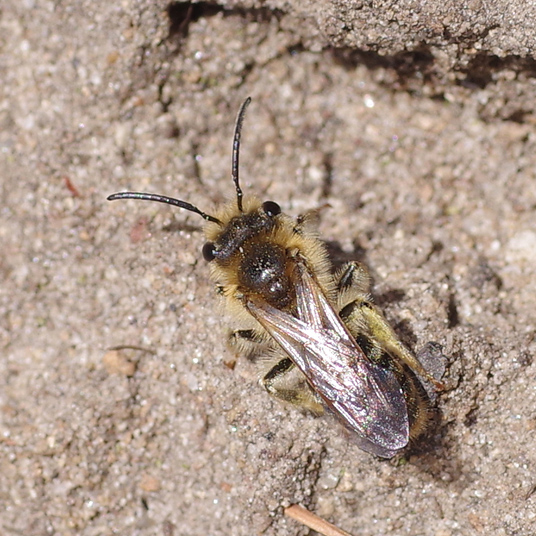
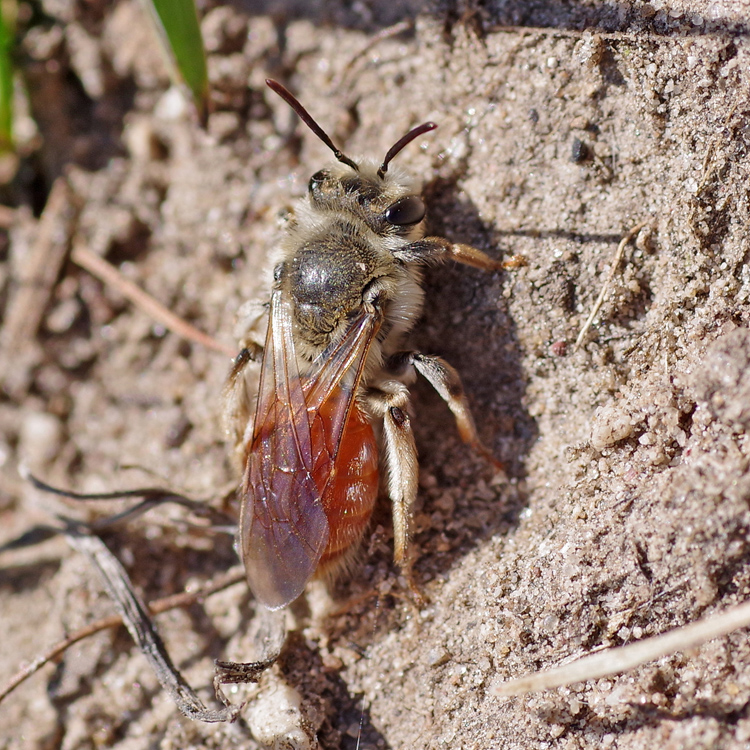
Turns out that there were more than one species of mining bee at Riveredge that day – a spectacular little bee with a red abdomen, and some generic-looking mining bees to be named later (or maybe never, as bugguide.net says, “Identification to species level usually requires an expert.”).  They didn’t like each other much, and at first the BugLady thought that the red interloper might be a cuckoo/blood bee.

A few years ago, she photographed a small bee with a red abdomen, a sweat bee (family Halictidae) in the genus Sphecodes, the “blood bees” or cuckoo bees (https://uwm.edu/field-station/sphecodes-sweat-bee/).  Blood bees (named for their color) are kleptoparasites that wait until another female sweat bee prepares a chamber for her eggs, and then move in and insert their own egg.  Sometimes there’s a dust-up between the blood bee and the tunnel’s rightful owner.  This recent Riveredge bee looks similar to a Sphecodes bee https://bugguide.net/node/view/973711, but because the blood bee doesn’t collect food for her larvae, she doesn’t have/need scopae.  The Riveredge bee was pretty hairy, stem to stern, and the BugLady thinks it’s a “Red-tailed Andrena” (Andrena erythrogaster).

RTAs are (new vocabulary word) “oligolectic” – they are an oligolege of willows – which means that they specialize in willows, and the pollen balls formed by female RTAs are made of willow pollen.  Makes sense, because willows bloom early and prolifically (see this episode from March of 2012, that freakishly early, warm spring https://uwm.edu/field-station/pussy-willow-pollinators/).  Males RTAs patrol plants, keep an eye on the nesting sites, and mix it up with other bees; they likely encounter females on willows and mate there.  RTAs dig their tunnels in bare-ish sites that have some vegetation/debris on top to hide the nest holes and shelter them from rain, and they can be found in mixed-species groups.

The BugLady, who is accustomed to finding scant information about the insects she researches, was delighted to come across a paper published in the Illinois Natural History Survey Biological Notes in 1988 called “Observations on the Bionomics of the Bee Andrena {TyIandrena) erythrogaster Ashmead (Hymenoptera: Andrenidae)” by Eugene R. Miliczky.  For those of us who don’t exactly hit the ground running in the morning, the BugLady offers Miliczky’s description of emerging RTAs:

“’Prior to leaving on foraging trips, bees spent variable lengths of time sitting in their nest entrances.  Especially long periods were spent there before the first departure of the day and on days with poor weather. Usually a bee sat just below ground level, facing outward with her antennae directed forward at a slight, diverging angle. Over the next several minutes or up to an hour’ or more, the bee gradually emerged from the nest a step or two at a time. Often she moved her head from side to side prior to a short advance. Not infrequently a bee retreated down her burrow for a few seconds to a minute or more.     Very small (2—3 mm) beetles and ants passing the entrance were at times sufficient to induce a hasty retreat. At other times, the bee backed slowly and methodically down the burrow for no apparent reason. Eventually, however, the bee emerged completely.

Sometimes a female returns from her foraging trips with pollen and sometimes with nectar, and she probably provisions only one egg chamber each day.  Eggs hatch in eight to ten days, and when an RTA larva emerges into its sealed chamber atop its bed of pollen, it simply inclines its head downward into the center of the cache and starts to feed.

So in the end, the BugLady found out the part of the “Who?” “What?” and “Why” of her mining bee encounter, but the rest will have to wait for another day.

Here are some pictures of Red-tailed Andrenas and of unidentified mining bees enjoying the earthen bank and the willows and a spring day.

Kate Redmond, The BugLady

Bug of the Week archives:
http://uwm.edu/field-station/category/bug-of-the-week/

Bug o’the Week – Tufted Bird-lime Moth

Howdy, BugFans,

The BugLady was visited by another moth recently, this time a Tufted Bird-lime/Tufted Bird-dropping Moth/Cherry Agate (Cerma cerintha) that appeared in her bathroom and, later, in her kitchen.  It’s a lovely little moth with a one inch-ish wingspan, in the Owlet moth family Noctuidae.

Noctuids are called Owlet moths because of the way the light reflects off the eyes of the (often drab) adults.  Many of the moths are nectar feeders and are pollinators; many of the caterpillars are omnivores, relishing both foliage and their fellow invertebrates, and sometimes are cannibalistic.  These are the fruit worms, cutworms, and armyworms that feed on the leaves of agricultural crops.  Caterpillars of many Noctuid species have chemical defenses, gleaned from the foods they eat, and others use camouflage, mimicry or spines to protect themselves.  Adults have tympanal organs (“ears”) that allow them to detect bat radar.

Depending on whose field guide you have, TBLMs are in the subfamily Acronictinae, or in the subfamily Eustrotiinae.  About the confusion, Sogaard, in Moths and Caterpillars of the North Woods says “The taxonomy of the superfamily Noctuoidea (which includes…… Noctuidae) is in disarray.  It will likely take a decade or more of work before the smoke clears from a truer, more stable taxonomy.”  About the Eustrotiinae, David Wagner, in Caterpillars of Eastern North America, says “members of this subfamily were formerly classified with the bird-dropping moths (subfamily Acronictinae).  Eustrotiines are a heterogeneous (unnatural) assemblage without any shared diagnostic adult or larval characters.”  You get the picture.  There are three members of the genus Cerma; here’s an even fancier one https://bugguide.net/node/view/926560/bgimage.

TBLMs are found in the US east of the Great Plains and across southern Canada east of Manitoba.  Wagner says that they favor “barrens, fields, sandy openings, and woodland edges.”  They are fairly common, but their lifestyle hasn’t been studied much.

TBLM caterpillars eat the leaves of fruit trees in the rose family, especially cherries and hawthorns. West Virginia blogger/photographer “Squirrel” (squirrelsview.blogspot) observes that the moths are found around fruit trees, and so are fruit-eating birds, so the bird poop strategy is a good one.  Their camouflage is so good that, Sogaard says “I once brought a specimen home from the lighted side of a building only to find myself fooled by a bird dropping!

Young caterpillars start out green (nice series here – https://bugguide.net/node/view/681356/bgimage) and then develop a carmine stripe https://bugguide.net/node/view/825207 that provides effective disruptive coloration https://bugguide.net/node/view/968746/bgimage.  They have a pretty impressive rear set of prolegs (“fake,” hydraulic legs for grasping).

There are two generations of TBLMs in the south, but probably only one here in Wisconsin.  The BugLady couldn’t find much about their reproduction, only that a mature caterpillar creates a pupal chamber by chewing a tunnel into wood, turning around, and sealing the entrance with wood chips and silk, making it, says Wagner, “virtually undetectable.”

Two cool things about Tufted Bird-lime Moths:

First, Wagner, et al tell us in Owlet Caterpillars of Eastern North America, that “upon disturbance, caterpillars of the Cherry Agate…..may shake rapidly from side to side.  Cerma caterpillars will wriggle violently if handled and are quick to hurl themselves from their purchase.”

Second, female Noctuids summon males with chemical scents called pheromones, and males preform courtship “dances.”  Males of many nocturnal species of moth, including the Noctuidae, produce scents that are disseminated by various configurations of “scent brushes” that are associated with eversible glands.  When a female emits pheromones to call to males, the males respond by approaching the female from upwind and sending out their own perfume.  This, in some species at least, prompts the female to stop calling.  His scent may serve to confirm a species match as well as to turn her head.  In the lovely science language of a century-plus ago, “Scent fans are the perquisite of the males of many of the Noctuina whose eyes shine at night like those of the barn owl as they winnow the dewy flowers” (A.H. Swinton, 1908).

And, for the BugFan who has everything, a TBLM mousepad is waiting for you on the internet.

Kate Redmond, The BugLady

Bug of the Week archives:
http://uwm.edu/field-station/category/bug-of-the-week/

Bug o’the Week – Speed-dating the Spiders – Eastern Long-legged Cobweaver

Greetings, BugFans,

First, a short detour into the world of the non-flowering:

The BugLady’s message to people who are pining for the wildflower season to begin is this: Get thee to a wetland and watch the non-flowering plants.  Mosses, especially, are going crazy these days, their green leaflets (the gametophyte part of the plant) bristling with the stalks of sporophytes, topped by variously-shaped spore capsules.  They’re happier now than when the canopy above leafs out and casts them into shade.  Ground-hugging liverworts are covered by reproductive pits and umbrellas, and any day now, cinnamon ferns will push up through the dead leaves and dried fronds that top the wetland hummocks.  It’s beyond life-affirming.

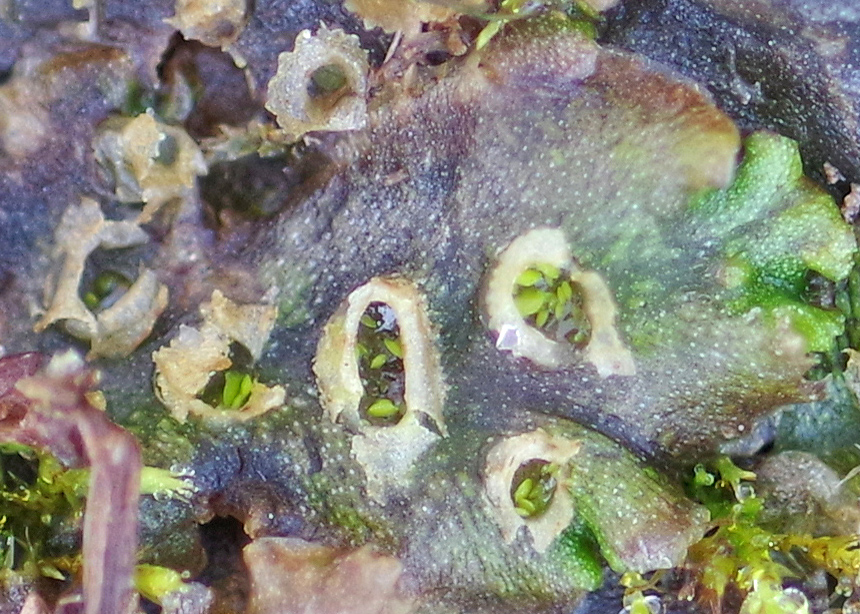
On a recent wetland walk, the BugLady noticed some moss that was growing on a very rotten stump.  Stiff leaves at the tips of many of the moss plants had formed a cup-shaped rosette.  Turns out that these are called gemmae cups (cups for gemmae), and they’re part of the moss’s reproductive strategy.  According to Dr. Jessica Budke, Herbarium Director at the University of Tennessee-Knoxville, “The moss makes little discs of plant tissue inside the cups called gemmae. These gemmae are moved away from the parental plant via a splash-cup dispersal mechanism. It sounds high tech, but really is just using the power of rain. When rain droplets land in the cup the gemmae are dislodged and can be carried in the water as it splatters away from the moss plant. The gemmae may not be dispersed very far, but it is far enough that this structure is advantageous for the plant to have. This is a form of asexual or clonal reproduction. The plant has made a mini copy of itself that can grow into a new moss plant.

So, gemmae, the little “eggs” in the Easter basket, are like tiny buds that are ready to grow if they land on a favorable substrate when they’re washed from the gemmae/splash cup.    Apparently, Four-tooth moss (which this moss probably is) likes to grow in the company of more Four-tooth moss.  One researcher found that sparse populations were more likely to use gemmae, which land and grow close to the parent moss, while dense thickets of the moss are more likely to reproduce via spores, which travel through the air away from the clump.  This may be a strategy to stabilize their punky substrate.  The BugLady also found gemmae cups on some lichens.

Without further ado, the spider.

It is, almost certainly Theridion frondeum, the Eastern long-legged cobweb spider (BugFan Mike’s “best guess” is way better than the BugLady’s).  It’s a small, dainty spider in the Cobweb spider family Theridiidae.  Theridiidae is a large family (maybe 2,500 species globally and 234 in North America) whose numbers include the Common house spider, of former BOTW fame (https://uwm.edu/field-station/common-house-spider/) and the notorious Black widow spider.

The BugLady didn’t find a huge amount of info about this particular species, but there’s lots about the family.

Theridiidae are also called Cobweb spiders (because of their web style), and Tangle web spiders and Comb-footed spiders.  Comb-footed because most species have a bristly comb near the tip of the rear set of legs that is used to draw silk from the spinnerets and, said one source, to roughen the surface of the silk a bit.  Tangle-web because of the creative ways some species deploy sticky silk (remember, not all spider web silk is) (sticky).  They’re found in woods, fields, edges and buildings across North America, more in the eastern half than in the west.

As usual with spiders, there’s some variation in color and pattern, and females are larger than males.  See https://www.marylandbiodiversity.com/viewSpecies.php?species=6577.

As usual with spiders, courtship is cautious.  The BugLady found some tantalizing tidbits about male Theridids using nuptial feeding to show females what a great catch they are.  Some family members secrete chemicals from various knobs on their head, and the female imbibes the liquid during courtship (although it’s not actually known what benefit she receives from it).  Others are kleptoparasites – stealing prey from the webs of other spiders and presenting it to their prospective mates.

Females place as many as 250 eggs in egg sacs that they stash in sheltered places, like a folded leaf.  She stays with the egg sac until her young hatch and disperse.  Here are two good picture series: https://bugguide.net/node/view/684363/bgimage and https://bugguide.net/node/view/363186/bgimage.

It’s a big family, and there’s lots of variety in the webs.  These are not the tidy, two-dimensional, spiral webs of the orb weavers – these are (mostly) tangled, messy, “cob-webby,” tent-like structures.  Lines made of sticky “gumfoot silk” may stretch from leaf to leaf or reach all the way from the web to the ground; when tripped by unlucky (pedestrian) prey, the line releases from the ground, hoisting the prey into the air (picture Wile E. Coyote stepping into a rope trap attached to a sapling).  The vibrating line alerts the resident spider that dinner is on the way.

When they catch an invertebrate (and they’re considered good biological controls of agricultural pests), they use the combs on their back legs to pull out a bunch of sticky web to wrap it in; and after their prey is immobilized, they bite and paralyze it (lots of spiders that build trap webs do it the other way around – bite, then wrap).  Most spiders don’t use sticky web for this purpose, but the stickiness allows Theridids to take on prey that’s much bigger than they are.  When they’re not subduing prey, the spiders hang head-down in their webs or rest in a woven hiding place.

Unique things that some Theridids do:

  • In some species, Mom allows her offspring to live in her web briefly, and in some species, she even feeds them predigested food until their first molt, the only spider family that has this level of maternal care.
  • In some species, males stridulate (make sound via friction), rubbing teeth under the front edge of the abdomen against ridges on the rear of the carapace (the top of the cephalothorax).
  • Spiders in some genera, including Theridon, are mildly social and will build communal webs.
  • Some camouflage the webs by sticking bits of plant material to it.

The BugLady saw a long, fresh strand of spider silk, recently, trailing in the air from its attachment on a twig the other day.  Perhaps a newly-hatched spiderling drifted in from parts unknown.

And the road slugs are out and about.

Kate Redmond, The BugLady

Bug of the Week archives:
http://uwm.edu/field-station/category/bug-of-the-week/

Become a Member

Take advantage of all the benefits of a Riveredge membership year round!

Learn More