Bug o’the Week – And now for Something a Little Different V – To Sleep, Perchance to Dream

New Year’s Greetings, BugFans,

In the spirit of New Year’s Day entertainment, this is a rerun, an article that the BugLady wrote for the January, 2009 BogHaunter, newsletter of the Friends of the Cedarburg Bog.

The BugLady, Wisconsin born and bred, is not particularly a winter person (though her camera does prod her to suit up and go outside periodically).  Winter is monochromatic and still, and then there are the flash-frozen fingers and feet.  It’s a really tough period for wildlife to weather, too, and they emerge from it stressed, hungry, and at their lowest populations of the year.

Most bird species deal with the season by migrating.  Temperature isn’t the issue – birds, after all, invented down jackets.  They migrate because their summer food sources aren’t available in winter, and many of the birds that remain adjust their diet to include more plant material (incidentally, Googling “birds, hibernation” and “birds, torpor” is instructional).  Birds that do stay, stay silently; other than the call notes of crows, jays, and chickadees, the soft “yank-yank” of nuthatches, and the polyglot utterances of starlings, the winter landscape is a quiet one.  Bird song, after all, is designed to advance breeding, a summer pursuit.

Invertebrates are cold-blooded, and with body temperatures that very nearly match the temperature of the surrounding air or water, their winter options are few.  Outside of a handful of insects that migrate, some form of “sleep,” with cells protected by “antifreeze” from the damage caused by freezing and thawing, is the only alternative to death.  Insect eggs, larvae, pupae, and even adults spend the winter in “diapause,” a state of suspended animation during which development ceases.

When it comes to mammals, the term “hibernation” is applied too loosely.  Winter sleep – the “period of adaptive winter inactivity” – is a continuum.  At one end are the very few true hibernators, and at the other end are a group of mammals that may “hole up” briefly during really severe stretches of weather but that are otherwise active throughout winter.  In the middle are a variety of light and heavy sleepers.  Whatever the duration of the nap, its purpose is to minimize the number of calories burned.

True hibernators put on an impressive layer of fat in late summer and fall, retire to a den, and then lower their metabolism, heart rate, breathing, and body temperature.  Hibernators sleep so deeply that they are hard to rouse.  Woodchucks are true hibernators whose spring awakening is driven not by a call to forecast our weather but by the imperative to reproduce (the BugLady just read in Wikipedia that yearling woodchucks may be called “chucklings”).

Jumping mice (Zapus sp.), 13-lined ground squirrels and some species of bats are also true hibernators. The respiration of a 13-lined ground squirrel drops from about 150 breaths per minute to a single breath every five minutes, and its heartbeat goes from 350 beats per minute to five.  The debate continues about bears, whose body temperature drops relatively little and whose sleep is fitful, but who, for over half a year, may not eat, drink or eliminate.  “Torpor,” a short (sometimes just overnight) drop in temperature and metabolic rate in order to conserve body heat, energy and fat reserves, might be a more accurate term.

Deep sleepers” achieve torpor for a longer part of the winter.  They may be roused easily because their body temperature doesn’t drop very much or because they don’t put on a thick layer of fat and so must get up periodically to eat.  Chipmunks are classic heavy sleepers.  The BugLady’s chipmunks probably enter the winter with 25 pounds of birdseed stashed below-decks, and they may start their winter sleep in a nest of shredded grass piled on top of a mound of seeds.

Much of the food a chipmunk collects is cached in its underground tunnel system, which includes a room that serves as nest chamber, store room and bedroom, and, often, additional store rooms and a separate room for a latrine.  Because chipmunks are not well insulated, they must wake for a meal every few days.  By the end of winter, their grassy nest may be on the chamber’s floor, and if the cold lingers and they run out of food, they will emerge to forage while there’s still snow on the ground.

Light sleepers disappear for part of the winter but leave their tracks across the landscape during mild winter days and nights (many light sleepers enjoy the benefits of our bird feeding activities and of the warm motors of cars) (the BugLady’s mechanic loves her – she lets him keep all the mice he finds, free).  Skunks often hibernate in communal dens during the worst of winter – in some cases, up to a dozen females may cohabit with a single male, while other males may stay active and solitary all winter.  Raccoons and possums also den up during deep winter (pity the poor opossum, a southern mammal that is a relatively recent and ill-adapted arrival to God’s country, whose thin ear tips freeze and crack off during especially brutal winters).  The diet of all three of these omnivores includes a higher percent of small rodents in cold weather.

Squirrels trade their tree-top summer nests for leaf-lined winter lairs in hollow trees.  The nuts they store during the fall are fair game for any foraging animal, and the vast majority of nuts are found, but squirrels don’t bother to recover acorns that their noses tell them have rotted.  Squirrels are well adapted for short sleeps in severe weather.  Curled up with that bushy tail acting like a blanket, they can sit out a few days of harsh weather.

Deer (whose drab, winter coats are made up of hollow hairs that trap body heat), mice, voles, and cottontails stay active, as do muskrats, which live below the ice.  And what of foxes, coyotes, weasels, shrews, and other carnivores?  Most are active throughout the winter because they aren’t adapted for sleep, and there is still food available for them.  Watch for their tracks in the snow, too.

The BugLady read a neat story in the snow at Riveredge Nature Center the other day.  She found a snow-covered, sawed tree trunk lying across a thickety area.  There was a row of tracks along the length of the log where a coyote took the path of least resistance.

Kate Redmond, The BugLady

Bug of the Week archives:
http://uwm.edu/field-station/category/bug-of-the-week/

Bug o’the Week – The 12 Bugs of Christmas

Season’s Greetings, BugFans,

As always, we pause to celebrate (while humming seasonal songs and drinking eggy, adult beverages), the Twelve Bugs of Christmas (plus one) – a baker’s dozen of bugs, many of whom have already starred in their own BOTWs but who posed nicely for the BugLady this year.

Acmaeodora pulchella – The BugLady is no fan of symmetry, and she likes that the lack of it in this picture creeps up on you.  The bookend beetles are called Spotted/Yellow-marked flower beetles (Acmaeodora pulchella) (“pulchellos” being Latin for “beautiful”), in the metallic wood borer family Buprestidae.

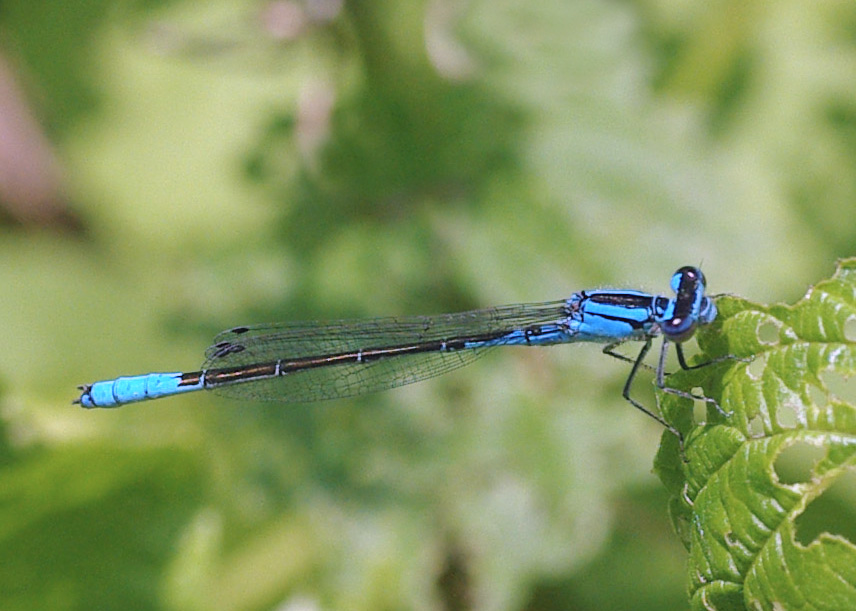
Azure Bluet Damselfly – Azure – “bright blue in color, like a cloudless sky.”

Praying mantis – There are some bugs that seem, well, just a little improbable, and there are some bugs that are really easy to anthropomorphize.  Praying mantises check both boxes.  Remember, the spelling of their name comes from their devout posture, not from the predatory aspect of those raptorial front legs.  This graceful youngster was photographed in southern Ohio.  Here’s a praying mantis bedtime story for your enjoyment https://thedragonflywoman.com/tag/mantids/.

Racket-tailed Emerald dragonfly hangs from a twig like a small ornament

This Bald-faced hornet nest is 10 feet off a trail that the BugLady uses pretty often, and she walked past it without noticing it until fall, when some leaves dropped off the shrub and revealed it, like a present being unwrapped.  That’s the down-side of Bald-faced hornets – you can get pretty darn close to their paper abode before you see it, and they defend it vigorously (and, no, pitching rocks at it from a distance is not an alternative for the curious – they will find you).

Crab spider – There are two nifty bits of camouflage going on here.  First – the eternal wonder of a crab spider finding just the right spot to sit.  Second, – the “fly” that this spider has snagged is actually a beetle named Ripiphorus (of previous BOTW fame https://uwm.edu/field-station/its-a-beetle-really/).  The BugLady has no idea why it would be an advantage to look like a fly.

Orange Sulphur Butterfly – Occasionally (and, in the BugLady’s case, mainly by accident) the planets line up and you get something like this – an almost-in-focus Orange Sulphur coming in to feed on New England aster.

Red-belted bumblebee – Although she is not very good at identifying them, the BugLady surely loves taking pictures of bumblebees.  There were lots of sightings this summer of the federally-endangered Rusty-patched Bumblebee (more about that in a future BOTW).  The BugLady’s walks are going to take a whole lot longer if she’s checking the rear ends of every bumblebee she finds!

Virginia ctenucha moth – This striking moth was just starting to unfurl its wings.  Here’s what the finished product looks like https://bugguide.net/node/view/1536346/bgimage.

Pine tree Spur-throated Grasshopper – Grasshoppers can be tough to identify and even tougher to photograph, and the BugLady has never really been a grasshopper person.  Pine tree spur-throated grasshoppers, like this beauty, could convert her.

Sign-reading Grasshopper – That being said, she hopes that this Differential grasshopper finishes reading and moves on before it becomes a statistic.

DOR in Ohio – The BugLady found this foursome in the middle of a country road in Ohio after a dark and stormy night.  The main attraction is a shiny, green, road-kill Japanese beetle.  It’s being attended by a scavenging millipede and a daddy longlegs, both of whom are there for the free (and tenderized) protein.  The fourth member of the quartet?  Those tiny red ornaments on the daddy longlegs’ legs are mites that are acting like ticks (“So, naturalists observe, a flea/Has smaller fleas that on him prey;/And these have smaller still to bite ’em,/And so proceed ad infinitum…..” Jonathan Swift).

Monarch Caterpillar, contemplating the miraculous road ahead of it https://uwm.edu/field-station/pupal-cases/.

May your holiday season be bursting with warmth and family and friends and festivities and music.

Kate Redmond, The BugLady

Bug of the Week archives:
http://uwm.edu/field-station/category/bug-of-the-week/

Bug o’the Week – And now for Something a Little Different IV – Life in the Pukak

Howdy, BugFans,

The BugLady is entertaining deadlines for two different newsletters plus BOTW, so please enjoy this article, borrowed from the winter issue of the BogHaunter, the newsletter of the Friends of the Cedarburg Bog, whose current winter issue is one of the BugLady’s deadlines.

Snow – or the lack of it – plays a significant role in the lives of animals in the Bog. An inch of snow makes it hard for ground-feeding birds like turkeys to find food, but that same inch allows mice and shrews to tunnel, hiding them from hawks, owls, and foxes. Three or four inches throw a blanket over plants and small animals but still let in sunlight. A fox can move easily in six inches of the white stuff; any deeper and it must bound, using more energy. Just as hunting success becomes more critical, hunting gets harder. A foot of snow blocks almost all of the available light from above. The drifts that immobilize deer, restricting them to the cedar thickets, act as step ladders that let cottontails feed on twigs that are normally out of reach.

shrew tunnel

Weather reports are based on data collected in a louvered box about five feet above the ground, but the vast majority of animals never get five feet off the ground – they live a scant few inches above and below the soil’s surface, and what matters to them is the air at ground level.

The microclimate that forms between the snow and the ground is called the subnivean layer, but the Inuit call that zone the pukak. Snow is an effective insulator because of the air that is trapped between the small snow particles; and like a bird’s down feathers, these air spaces are warmed by heat from beneath (from the soil, in the case of snow). These snow-lined air-spaces are constantly changing – solidifying as water vapor diffuses through the snow; compacting; melting and enlarging. The result is an insulating layer that keeps the temperature below the snow at about 32 degrees, while the air above the snow bank may be 30 or more degrees colder. It literally is a blanket of snow.

red squirrel tunnel

A subnivean layer needs an uneven landscape with some plants at ground level to keep the snow from settling flat on the earth. There is no pukak zone on the ice-covered lakes in the Bog – their surfaces are too smooth – but the hummocky sedge habitat that makes up much of the Bog is ideal. In mountainous areas, the subnivean layer keeps the snow from being “glued” to the landscape and is a factor in avalanches. By the time the snow is a foot deep (some sources say 6”), the air temperature of the pukak is stable – chill but not frigid; warm enough even for some plants to stay marginally green.

But the pukak isn’t just an exercise in physics, it’s the winter home of animals like mice, voles, moles, and, yes, red squirrels (the largest pukak-dweller), plus hardy insects and other invertebrates. These animals modify the “warm” air spaces further, creating mazes of trails that allow them to live and feed under the snow. Spring snow-melt reveals hidden pathways and seed caches, the grassy residential domes of voles (Microtus), and the trunks of small trees that the voles have girdled. .

vole house

The down-sides of pukak-living are several: it can be restrictive – no new food is introduced into the system, air quality can suffer, and it’s pretty dark. And even under the snow, the inhabitants of the pukak are not safe. Predators like shrews and weasels follow their prey into their tunnels; foxes and coyotes cock their heads and listen first, then pounce on the snow to break through to the ground. Oxygen and carbon dioxide filter readily through the snow, and the tunnels made by shrews, mice and voles provide additional avenues for gas exchange. According to folklore, voles deliberately cut “windows” in the snow’s crust to vent carbon dioxide that’s given off by respiration and by decomposing plants, but researchers conducted a series of experiments that suggest that while the concentration of CO2 may be high in some areas of the pukak, the voles don’t seem to care.

Northern plants are adapted to take advantage of snow cover, too, and they may suffer when snowfall is light. A textbook example occurred in the Bog during the winter of 2003-2004. After a dry fall, January, 2004 was bitter cold and snow-less, and by February, the frost extended deep into the ground. Although the tamaracks did leaf out in spring, their roots had been frozen and their needles soon turned brown. Twenty percent of the Bog’s tamaracks died.

Skimpy snow accumulation is hard, too, on the small, pukak-dwelling animals that depend on the climate that develops in the subnivean zone.

To discover the pukak for yourself, pick a spot with undisturbed vegetation (lawns are too uniform) and make a person-sized clearing in the snow, all the way to the ground. Lie down in it and use a flashlight to get a vole’s-eye-view of the tunnels and caverns in the airspace below the snow. To experience conditions within the pukak, make a quinzee/Quinzhee (from an Athabascan word meaning “a small snow mound shelter”). Gather enough snow to make a head-high mound about ten feet across, pack it down well, and let it settle for an hour or so. Then hollow out a living space in the middle, leaving the walls and ceiling one foot thick. It’s not an igloo – igloos are made by piling blocks of snow in a circle.

For great information about the ecology of winter, try Winter World, by Bernd Heinrich.

The first day of winter is upon us, but remember – even though we get cranky about short winter days and lengthening nights, the Winter Solstice was/is celebrated because it marks the turn-around point when days start (very slowly) getting longer.

Kate Redmond, The BugLady

Bug of the Week archives:
http://uwm.edu/field-station/category/bug-of-the-week/

Bug o’the Week – European Earwig

Salutations, BugFans,

People respond to insects intellectually, aesthetically, and viscerally.  Intellectually, earwigs are fascinating insects; viscerally – Ick!!  Earwigs are Stealth Insects, and it creeps the BugLady out when masses of earwigs scramble away as she picks up a flower pot or flips up the cover of the garage-door-opener keypad or opens her mailbox (though they feed the jumping spiders that also live in the mailbox).

What follows is a major overhaul of a general earwig BOTW that appeared in December of 2008, with lots of fun, new Earwig Facts but few new pictures (aesthetically/photographically, the BugLady seems to be pretending they’re not here).  Thankfully, contributors to bugguide.net are not https://bugguide.net/node/view/1390134/bgimage.

What’s in a name?  Earwigs are classified in the Order Dermaptera (“skin-wings”) a reference to their short, smooth forewings.  Their common name may come from the old English superstition that they crawl into the ears of sleeping people in order to bite them, an occurrence that one entomology book dismisses as “rare.”  (!!!)  Bugguide.net says that the name came from the Old English “ear-wicqa” meaning “ear crawler.”  This notion was reinforced by the fact that earwigs used to shelter in the powdered wigs that 18th century English gentlemen and gentlewomen stored on wig stands, presumably ready to hop aboard the next time the wigs were put on.  They (allegedly) have no interest in entering or laying eggs in your ear canal or, according to another Old Wives’ tale, in eating your brain.  Eric Eaton and Ken Kaufman, in their “Field Guide to Insects of North America,” attribute the name “earwig” to a corruption of “ear-wing,” a reference to the wing shape of some species.

According to bugguide.net, Dermaptera (not Dermoptera – the Flying Lemurs) once included roaches, mantids, grasshoppers, crickets, and more, but today it’s a small order with about 1,800 species worldwide and only a few dozen in North America (many of which are introduced – earwigs are world travelers).  Earwigs have been around for a long time (208,000,000 years or so) and the only place where they won’t drop out of your mailbox is Antarctica.

They favor places that are warm and humid, and they love to tuck themselves into dark nooks and crannies in the heat of the day.

Earwigs max out at just under 1 ½ inches long, not including pinchers (there’s an Australian species that’s 2” and an extinct earwig that measured 3”), with a flattened body, and most come in shades of black/brown/reddish brown.  Some species are wingless, some just have two, short, leathery forewings https://bugguide.net/node/view/1024883/bgimage, and some have four wings, the second pair folded like mini fans under the forewings.  Forceps-like appendages (cerci) decorate the rear, more prominently on males than on females, giving them a scorpion-like appearance that they cultivate by arching the cerci upwards when they are perturbed https://bugguide.net/node/view/198816/bgimagehttps://bugguide.net/node/view/1560064/bgimagehttps://bugguide.net/node/view/1160497/bgimage.  They can, indeed, pinch with those cerci, which are used for protection and during reproduction, and the four-winged species also use their cerci to assist in folding the soft, flying wings under the forewings after a flight.  The species of earwigs that do fly generally do so under protest, but they’re pretty handy on foot.

The COMMON or EUROPEAN EARWIG (Forficula auricularia) is in the earwig family Forficulidae and is the sole member of its genus in North America and is the only earwig species found in Wisconsin.  This Old World native was first recorded in North America (Seattle, WA) in 1901 and has been in Wisconsin for less than 50 years.  It likes temperate, not tropical, climes.  The BugLady often sees them on common milkweed.

EEs measure a bit less than ¾” without the cerci.  Their short wing covers do conceal flying wings https://bugguide.net/node/view/313235/bgimage.

They have simple/incomplete metamorphosis, looking like mini-adults (but much cuter) when they hatch https://bugguide.net/node/view/101474/bgimage, and then shedding, growing wings, and adding antennal segments https://bugguide.net/node/view/1253959/bgimage until adulthood.  See earwig stages here https://bugguide.net/node/view/376287/bgimage.

In fall, male and female pair up (he woos her by waving his cerci around, and he will use them to fend off rivals), and they excavate an underground nest for the eggs.  The female lays 30 to 50 eggs in a heap, kicks the male out, and then overwinters with the eggs https://bugguide.net/node/view/42241/bgimage.  As in many other earwig species, EEs have maternal instincts, which is uncommon among arthropods.  She protects her eggs from predators and parasites, cleans and grooms them with her mouth to prevent the growth of fungi, and as hatching nears, spreads the eggs out in a single layer.  After they emerge, she feeds her offspring regurgitated morsels and cares for them for until they can fend for themselves https://bugguide.net/node/view/16853/bgimage.  Females live for about a year; males, at the mercy of the elements, don’t make it through the winter.

EEs are awash with chemicals as nymphs and adults.  Both stages are preyed upon by the usual vertebrate suspects (birds, toads, snakes, etc.), against which they protect themselves by releasing a nasty-smelling chemical (this chemical defense mostly goes unnoticed by invertebrate predators).  Earwigs use aggregation pheromones (chemical perfumes) to attract other earwigs, and the nymphs use pheromones to induce their mothers to care for them.  Another chemical, found in adults, seems to kill microbes and nematodes (for a nematode refresher course, see https://uwm.edu/field-station/nematodes/).

A shout-out to the excellent University of Michigan series “Biokids – Kids’ Inquiry of Diverse Species” (http://www.biokids.umich.edu/critters/) for their thorough, well-documented species write-ups.  Sometimes the BugLady is tempted simply to supply a link and say “Here – read this.”  About the European Earwig’s other sensory capabilities, they say, “They also communicate with their forceps, both in mating and as a threat. European earwigs pick up these odors [pheromones] mostly with receptors on their antennae. Their antennae also have touch hairs which help them understand their environment. Finally, they have compound eyes which help them perceive their environment.

Like many other species of earwig, EEs are harmless nocturnal, omnivorous scavengers whose chewing mouthparts allow a diet that includes organic debris, other insects, and plants https://bugguide.net/node/view/698997/bgimage.  Sure, they sometimes cause damage to agricultural crops, where their nibbling ruins the appearance of fruits and vegetables, but they make up for it by stalking aphids, which are responsible for far more damage than earwigs are.  A tachinid fly was imported to parasitize EEs, and apparently, they’re also susceptible to soil nematodes, mites, yellow jackets, ground beetles, cannibalistic earwigs, roundworms, and certain parasitic fungi https://bugguide.net/node/view/1388837/bgimage.

Google “earwig,” and the Exterminator sites pop up in droves (along with the usual sites that fret about earwig pinches (unlikely) and bites (incredibly unlikely)).  The BugLady was distressed by a site called Pest World for Kids (“Brought to you by the National Pest Management Association”), which promises that “Parents and kids can both find more facts and information on earwig control at the official NPMA website,” and that “We don’t allow any pop-up advertising or any third party external links, so children can play and learn freely.”  Their clickable “Pest List: Bugs A to Z” consists of the following species: “ants, bed bugs, bees, beetles, birds, cockroaches, dust mite, earwigs, fleas, flies, gophers, lice, mice, mosquitoes, moths, opossums, pill bugs, rats, spiders, stink bugs, termites, ticks, and voles.”

As the twig is bent, so grows the tree” (Alexander Pope) (probably).

And so, as we approach Holidays and Holydays of all persuasions, the BugLady leaves you with Visions of Earwigs Dancing in your Head (but not literally).

Kate Redmond, The BugLady

Bug of the Week archives:
http://uwm.edu/field-station/category/bug-of-the-week/

Bug o’the Week – Red Cocklebur Weevil

Howdy, BugFans

The BugLady (who loves finding weevils) found this one in Ohio, but it does live here in God’s Country and throughout eastern North America.  With about 83,000 species worldwide (3,000 in North America), the very-diverse weevil family, Curculionidae, is one of the largest animal (not just insect  animal!) families.  Weevils can be recognized by their cute little snout (rostrum) https://bugguide.net/node/view/176670/bgimage and their “elbowed” antennae.  Plant-chewing mouthparts are located at the end of the snout.

Red cocklebur weevils are in the subfamily Dryophthorinae (of previous BOTW fame https://uwm.edu/field-station/two-weevils/), whose members are often described as “football-shaped” and who some entomologists have promoted to full family status.  RCWs (Rhodobaenus quinquepunctatus) are also called (not surprisingly, Latin Scholars) Five-spotted billbugs.

The two other genus members in North America north of the Rio Grande are the excellently-named R. tredecimpunctatus https://bugguide.net/node/view/1491131/bgimage, the 13-spotted/Ironweed curculio (which is also called cocklebur weevil and which has a more extensive range across America than the RCW), and R. pustulosus (no common name, but do Google “pustulosis”) https://bugguide.net/node/view/1439311/bgpage, which sneaks over the border from Mexico

RCW’s are about one-third if an inch long and can vary from pale https://bugguide.net/node/view/123754/bgimage to medium https://bugguide.net/node/view/1089167/bgimage, to a pretty dark/melanistic phase https://bugguide.net/node/view/74037/bgimage, but the black diamond on the red pronotum (the prominent, saddle-shaped structure that covers all or part of the thorax of some insects) is standard equipment.  The beetles are red and black, Mother Nature’s warning colors, but the BugLady couldn’t find anything cautionary about the RCW.

There’s not much information out there about how the RCB lives its life.  Here’s a nice life history picture series https://bugguide.net/node/view/1464062/bgimage.

Almost all weevils are vegetarians, and some are very specific feeders, but the RCB’s menu is a bit more varied.  Adults feed from the leaves and stems of ragweed, thistle, cocklebur, Joe Pye weed, wild sunflower, ironweed, and rosinweed (all members of the Aster/Composite family), and larvae bore into the roots and stems of the same plants https://bugguide.net/node/view/72277/bgimage.

Kate Redmond, The BugLady

Bug of the Week archives:
http://uwm.edu/field-station/category/bug-of-the-week/

Bug o’the Week – Speed-dating the Spiders III, the Orchard Spider

Salutations, BugFans,

The BugLady photographed this pretty, little, spider in the wilds of Ohio in June, and then found more in Wisconsin in August.  When BugFan Mike ID’d it for her, he said “I love it because it is one of the few WI spiders I can also see in Panama!  It should get more common here with global warming.”

There are a number of spiders that are called “orchard spiders;” this one is officially known as Leucauge venusta (Leucauge comes from the Greek for “with a bright gleam” and venusta is Latin for “beautiful”).  It’s in the Long-jawed orbweaver family Tetragnathidae (we have visited the family before in the form of long-jawed orbweavers in the genus Tetragnatha https://uwm.edu/field-station/long-jawed-orbweavers/).  There are more than 150 species in the genus Leucauge worldwide, and as a group, they like the tropics.

The genus was named by Charles Darwin, who was also the first to collect one (it’s the only spider that has that double distinction), but then the original specimen was lost.  See https://www2.gwu.edu/~magazine/archive/2011_research_fall/feature_pdf/gwr_fall12_feat2.pdf for a nifty article about it (N.B. the BugLady was momentarily confused by the way this article scans, but she figured out that when you get to the second page, read the middle column straight through the green font to the bottom, then read the column to its right.  The text under the partial picture on the left stands alone).

Yes, they’re are found in orchards, but you’re equally likely to see their horizontal webs on low vegetation in woodlands (especially dampish woodlands) from southern Canada well into Central and South America.  The horizontal orientation helps them to catch jumping as well as flying insects.

Orchard spiders (aka Venusta orchard spiders) are long-legged and small – the bodies of females are a little larger than a third of an inch and males are a little smaller; females have green legs, and males’ legs vary.  One source described them as coming in neon colors – their bodies are striped with green and gold and silver and black, and another gave a nod to their photogenic appearance.  There are some dynamite pictures of them on the Web, like this very green individual https://bugguide.net/node/view/1152832/bgimage, and https://bugguide.net/node/view/1105893/bgimage, and this male – https://bugguide.net/node/view/954204/bgimage, and this collection from the Maryland Biodiversity project https://www.marylandbiodiversity.com/viewSpecies.php?species=6567&showHidden=1, and, a Scanning Electron Microscope (SEM) shot https://fineartamerica.com/featured/orchard-spider-david-m-phillips.html).

Like males of many other species, the male orchard spider courts carefully, recognizing the lady by her chemistry (odor), and softening her up and assessing her interest by sending specific vibrations to her through her web.  Females subsequently attach an orange-ish egg sac (which may hold several hundred eggs) to a nearby twig or place it in a leaf shelter.  Adults die by the first frost, and the eggs hatch, but the spiderlings overwinter within the shelter of the sac, disperse by ballooning in the spring, and begin making their own webs.  Young spiders make smaller webs, closer to the ground, than their elders.

They are eaten by a variety of mammals like shrews and bats, and by many species of songbirds.  Orchard spiders are parasitized by a wasp whose larvae attach themselves to the spider’s exterior and feed on it from the outside (ectoparasites).  Scroll down to the “Friends and Foes” section for a picture and a description of the larvae’s modus operandi https://sites.google.com/site/islandecologyuncw2015/impacts-of-terrestrial-fauna/orchard-spider.

Scientists have analyzed their web-spinning patterns down to the last twist and turn.  Adults make a web that is about a foot across, horizontal or slightly tipped, averaging (according to Eric Eaton’s bugeric blog) “30 radii (spokes) and 60 spirals.”  He goes on to say, “The orchard orbweaver is shy, and drops from its web straight to the ground if it feels threatened, often disappearing into the leaf litter and undergrowth.”  Spiders are often found suspended, belly up, from the center of the web.

Interesting spider fact: according to the University of North Carolina’s Barrier Island Ecology project, not only are spiders in general important biological controls on pest insects (although, alas, to a spider, beneficial insects taste as good as the unwanted ones), but mixing spider venom with a kind of plant protein produces a natural pesticide that is bee-friendly!

Kate Redmond, The BugLady

Bug of the Week archives:
http://uwm.edu/field-station/category/bug-of-the-week/

Bug o’the Week – Buffalo Treehopper

Howdy, BugFans,

Even though she’s never exactly sure which species she’s looking at, the BugLady is always tickled when she finds one of these pointy little bugs.  Here’s what you need to know about the improbable-looking buffalo treehopper – that it can fly and hop as well as walk, and that in Germany it’s called the “Büffelzikade” (“buffalo cicada”).  The rest is lagniappe.

We’ll get the taxonomic confusion out of the way first: Buffalo treehoppers are in the treehopper family Membracidae and in the much-worked-over genus Ceresa/Stictocephala.  A bugguide.net expert contrasts the current species placement in their guide pages with “the [former] fragmented classification, whereby our Ceresas got scattered among as many as four genera (Hadrophallus, Spissistilus, Stictocephala, Tortistilus).”  Ceresa and Stictocephala seem to be synonymous in many species; and number of species have gone through several complete name changes – Ceresa alta is also known as Stictocephala alta and in the past has been called S. bisonaS. bizoniaS. bubalus, and C. bubalus.  The BugLady has (maybe) pictures of Stictocephala/Ceresa alta and Stictocephala/Ceresa taurina here, but as biologist William Keeton once said, man is the only species that worries about the fine points of classification; the rest of the organisms know who they are.

Adult treehoppers have an enlarged area behind their head that looks like a shield over the head, thorax, and first part of their abdomen.  The design of this area can get pretty fancy (http://grist.org/list/the-brazilian-treehopper-is-the-creepiest-raddest-insect-you-will-ever-see/), while another species with a far simpler blueprint, known as the Thorn treehopper, https://bugguide.net/node/view/16468/bgimage is known to inflict harm on people who walk on it barefoot.  Some species of treehoppers are colorful and gregarious and are protected by ants in exchange for the honeydew they excrete; others, like buffalo treehoppers, are solitary and well-camouflaged.

Treehoppers have been around for a very long time – fossil treehoppers found in amber have been dated to 40 million years old.

Buffalo treehoppers measure less than a half-inch long and are humpbacked and variously horned, supposedly reminiscent of their much larger namesakes (here’s a glamour shot of one species http://blogs.discovermagazine.com/zenphoto/index.php?album=ancient-leviathan/treehoppers&image=ceresa-taurina.jpg).. And their excellent, spiny nymphs look like mini-dragons https://bugguide.net/node/view/278721.  Buffalo treehoppers are mostly a New World, tropical bunch, and they’re widespread across North America, but a few species have stowed away and spread to parts of Europe, North Africa, and Asia, where they are unappreciated.

In their adult and immature stages, buffalo treehoppers feed on plant sap that they get by puncturing the stems of woody and non-woody plants with their strong “beaks” (and they can do minor damage to both in the process).  They may begin their lives on woody plants, where Mom uses her sharp ovipositor to make shallow slits in twigs and to deposit her eggs (https://bugguide.net/node/view/142270/bgimage).  When the eggs hatch, the nymphs find their way to more succulent, herbaceous vegetation (Ceresa taurina moves from apple to aster, and Ceresa alta, from elm and apple to sweet clover).  They molt five times on the way to adulthood https://bugguide.net/node/view/654981/bgimage.

In summer, when love is in the air, males attract females by emitting a sound that is inaudible to the human ear due both to its volume and to its frequency.

Writing in the “Thirtieth Annual Report of the College of Agriculture and Life Sciences at Cornell University and the Agricultural Experiment Station” (1917), W.D. Funkhauser tells us that “Eggs are laid in the bark of stems two or three years old.  Egg slits are peculiar, being curved and parallel and so close together that the wound between them does not heal and thus considerable injury may be done to the twig.  … six or eight eggs are laid in the slit.  The eggs winter over and hatch in May.”

The slits can cause twigs to look rough and scaly, and multiple slits can weaken them; Funkhauser tells us that “Not only are the egg slits large enough to cause material mechanical damage, but the puncture allows the easy ingress of fungi and of other insects.”  Buffalo treehoppers are also suspected vectors of some plant viruses.

They don’t have a lot of enemies – the eggs are parasitized by a few small wasps.  The BugLady’s picture of a Buffalo treehopper on some leaves was taken when she startled a damselfly that had grabbed the treehopper, wrestled it to the ground, and then ended up dropping it (for which the BugLady apologized) (but she couldn’t quite picture how a damselfly would approach the treehopper’s hard and slippery exterior.).

Treehoppers were featured a few years ago in a BOTW about Two-marked treehoppers https://uwm.edu/field-station/two-marked-treehopper/ (with a bonus picture of a buffalo treehopper).

Kate Redmond, The BugLady

Bug of the Week archives:
http://uwm.edu/field-station/category/bug-of-the-week/

Bug o’the Week – Two-lined Spittlebug

Greetings, BugFans,

Isn’t this a spiffy little bug (and, yes, the word “bug” is correct, for a change, because it’s in the bug order Hemiptera)!

First, the names:

Two-lined spittlebugs (Prosapia bicincta) are in the family Cercopidae, aka the Froghoppers.  Why?  Because their main mode of transportation is jumping, and they do it well – some can leap almost three inches straight up and more than 100 times their own body length in a single bound (that takes care of the “hopper” part, but the BugLady still doesn’t think they look very froggy – in fact, the adults are more reminiscent of cicadas).  For the physics of it, see http://www.nbcnews.com/id/26960608/ns/technology_and_science-science/t/froghopper-bugs-incredible-leaps-explained/#.W9iC9NVKjIU.

Spittlebugs get their name from the nest of bubbles produced by the nymph (immature bug).  Like aphids, spittlebug nymphs feed on juices that they access by poking their piercing-sucking, beak-like mouthparts into plant tissue.  Plant sap is sugary, but not overly so, and so they have to take in a lot of it to get enough calories.  What to do with the rest?  It goes out the other end, where the clever spittlebug adds some “glandular secretions” (OK – mucopolysaccharides, polypeptides, and acid proteoglycans) and repurposes it.

As the excess liquid exits, the nymph pumps its body up and down, which aerates the liquid (shaken but not stirred?), and then the nymph spreads the foam over its body.  The bubbly mass has gathered names like “cuckoo spit,” “frog spit,” and “snake spit,” especially from the young at heart.  The BugLady (and a whole lot of other people) have been telling folks for years that the soft-bodied nymph does this to provide a high-humidity home for itself, as well as for insulation and camouflage.  Some scientists suggest that the foam may help with electrolyte regulation, and that along with predators, the nymph’s disguise may discourage parasitoids, and pathogens like fungi and bacteria, but that it is not an efficient humidifier.

TLSBs lead small and unobtrusive lives, except when they occur in large numbers, and then they are considered (minor) pests.  The nymphs target grasses, including turfgrass, and can cause wilting.  Adults feed on the same food in the same manner (they add the leaves of some woody plants to their menu), and they can damage leaves by injecting a chemical that damages chlorophyll in a small area, resulting in wilt and in mottled white patches on the leaves (“froghopper burn”).

Adults feed on the same food, but they have lost the ability to make bubbles – see the video of an adult froghopper dripping honeydew (the article also has a nice picture of a nymph) http://bugoftheweek.com/blog/2016/1/10/froghoppers-and-spittlebugs-here-and-there-cercopidae-and-aphrophoridae).  They are not, however, defenseless; they are aposematically colored, both above and below, with red and yellow – Mother Nature’s warning colors.

Like ladybugs, lightning beetles, and others, TLSBs can initiate “reflex bleeding” – in their case, from the pads of their feet https://bugguide.net/node/view/115927/bgimage (note the classy, red ventral side of the bug).  This liquid (insect blood is called hemolymph) has been labeled “sticky,” “smelly” and “distasteful,” and it deters but doesn’t completely discourage predators.  The substance may work because it startles the predator and allows the froghopper time to hop, but one source said that when ants come in contact with it, they stop bugging the bug and start grooming themselves.

TLSBs are eaten by other animals.  The eggs are most vulnerable, and nymphs are, too, if their nest is destroyed.  Some songbirds, spiders, and assassin bugs dine on the adults.

It’s a pretty bug in a 1/3” package https://bugguide.net/node/view/1238314/bgimage, whose colors may be very intense https://bugguide.net/node/view/688929/bgimage, even face to face https://bugguide.net/node/view/436556/bgimage.  There’s an all-black form, too https://bugguide.net/node/view/1506375/bgimage.  One source said that you can ID them in flight because of their red undercarriage, which is visible when they fly.  Sure.

Females attract males via pheromones, and they mate throughout much of the summer.  Eggs are laid in the soil or in hollow plant stems, and there the TLSB overwinters.  The nymphs prefer to live in heavy thatch; they like damp, not drought.  They feed for a month as nymphs before they climb up on a grass stem and shed their final, nymphal skin along with its now-dry, bubbly covering.  Here are pictures of a newly emerged (eclosed) adult and of its recently-vacated skin (exuvia) https://bugguide.net/node/view/691740/bgimage.

TLSBs are found all over the eastern half of the country, west to Kansas and Oklahoma, but they are most common in the Southeast.

Kate Redmond, The BugLady

Bug o’the Week – Thyreodon atricolor Wasp

Howdy, BugFans,

Thyreodon atricolor (no common name), one of the BugLady’s “Nemesis Bugs,” is a big, beautiful wasp that flies tantalizingly through dappled, woody edges, preceded by those fabulous, yellow antennae.  It seldom stops, and when it does, it often perches in the shade.  The BugLady is gratified to see that lots of the shots submitted to bugguide.net are also out of focus, but here’s an excellent series: https://bugguide.net/node/view/1377346/bgpage.

It’s in that huge family of solitary wasps, the Ichneumonidae (incorrectly called “Ichneumon flies” in olden days) – wasps that make their living as parasitoids of other arthropods, mostly insects.  And they’re in the subfamily Ophioninae, which Wikipedia defines as “koinobiont endoparasites of larval Lepidoptera.”  Wikipedia also tells us that the Ophioninae are uncommon among the ichneumons because of their ability to sting vertebrates (bugguide.net says that they have a “short, very sharp ovipositor” that can penetrate human skin).

A little Science.  “Endoparasites” do their dirty work in the interior of their host – the exterior is reserved for “ectoparasites.”  “Koinobiont” (vocabulary word of the day, but don’t ask the BugLady to pronounce it) refers to their practice of allowing their host to continue its development as they feed within it – most koinobionts are endoparasites.  Conversely, “idiobiont” parasitoids, which tend to be ectoparasites, cause the development of their hosts to cease once they are on board (they’re riding around on the outside of their host, after all, and don’t want it to be too active and brush them off).  In either case, the host is kept alive as long as it serves the parasitoid, which administers the coup de grace when it’s time to pupate.  Sometimes, to add insult to injury, the parasitoid pupates within the dead body of its host.

There’s not a lot of information out there about this species.

Like all good ichneumons, the very-distinctive Thyreodon atricolor has a look-alike.  Its name is Gnamptopelta obsidianator (https://bugguide.net/node/view/1119216/bgimage), and about it, a bugguide.net expert says, “I also have a feeling most of the Gnamptopelta images in the guide are misidentified Thyreodon.”

Most ichneumons are very specific in their choice of a host for their eggs.  Thyreodon atricolor is a big wasp, and she targets big caterpillars, those of the Northern and the Southern Pine Sphinx and the Blind Sphinx.

In an article written in 1912 called “The Ichneumon Flies of America Belonging to the Tribe Ophionini,” Charles W. Hooker summarizes what was then known about what transpires when wasp meets host: “Trouvelot describes the oviposition of Eremotylus macrurus as follows: ‘When an Ichneumon detects the presence of a worm she flies around it for a few seconds, and then rests upon the leaf near her victim ; moving her antennae very rapidly above the body of the worm, but not touching it, and bending her abdomen under the breast, she seizes her ovipositor with her front legs and waits for a favorable moment, when she quickly deposits a small, oval, white egg upon the skin of the larva. She remains quiet for some time and then deposits another egg upon the larva, which only helplessly jerks its body every time an egg is laid’ [N.B. – no matter how blameless the rest of his life might have been, Trouvelot will forever be remembered as the French entomologist who imported gypsy moths to the US – on purpose – to develop a domestic silk industry].

Dr. Felt adds that ‘A few days later they hatch and the larvae eat their way under the skin of their victim, feeding on the fatty portions of the host at first, but later most of the tissues are devoured. The miserable victim of these parasites drags out a weary existence and usually perishes in the pupal state, rarely before. As a single victim will provide food for the development of but one or two parasites, the weaker ones perish.’”

When the host larva is mature and has created a pupal chamber, the wasp larva goes into a feeding spurt that finishes off its host; then it chews its way out and pupates in the readymade chamber of the caterpillar.

Hooker continues “Nothing is known of the food, mating habits, etc., of the adults, but it is possible that they feed on decaying animal and vegetable matter, since Dr. Ashmead states that they are attracted to such substances. Morley states that ‘many kinds of Ophioninae, including the big red Ophion luteus, are freely attracted by sugar. No insect is more fond of sweets, and none more indifferent to bright colored flavorless objects than the Ichneumons. The common Ophions may often be taken around evergreens where they seem to be attracted by the resinous juice.’”

Kate Redmond, The BugLady

Bug of the Week archives:
http://uwm.edu/field-station/category/bug-of-the-week/

Bug o’the Week – Giant Water Bugs Revisited

Greetings, BugFans,

Not long ago, an email correspondent reported seeing a giant water bug in a parking lot, so the BugLady decided to refresh a BOTW episode from 2009 with some new content and lots of cool links.

Giant Water Bugs are “true bugs” in the Order Hemiptera and the family Belostomatidae.  It’s not a huge family – about 160 species worldwide, 19 of them in North America.  They are large, brownish, flat, oval insects with impressive front legs (yes, there is a superficial resemblance to those other “water bugs” – the cockroaches, but they are not related).  GWBs come in several size groups; the BugLady originally learned them as the “Smaller GWBs” (genus Abedus), about 1 ½”, and the “Giant GWBs” (genus Lethocerus and Benecus) which, at 2 ½+” (https://bugguide.net/node/view/684943/bgimage), dwarf their smaller cousins – and many other insects.

In her venerable book The New Field Book of Freshwater Life, Elsie B. Klots reports that a hand-held GWB (more about that “hand-held” idea later) may squeak a little and may smell like apples.  Another source said that they often smell fishy.

GWBs are “climber-swimmers” that live in shallow waters, both still and slowly moving, with plenty of vegetation.  They hang head down on aquatic plants, close enough to the surface to reach it with the short, retractable breathing tubes that protrude from the tip of their abdomen (it’s not a stinger).  They use the tubes to pull atmospheric air into their tracheal system, but additional air, for use on longer dives, is stored in a space under their wings.  They use their front pair of legs to capture their prey, and the second and third pairs are adapted for swimming – flattened and fringed with hairs that effectively increase their surface area.

Like most other aquatic true bugs, GWBs are classified, niche-wise, as “piercer-predators,” which means that they grab their prey, stab it with a short, sharp beak, inject poisonous enzymes (produced in salivary glands near the beak) to immobilize it and liquefy its innards, and then slurp the softened tissue out (https://bugguide.net/node/view/677969/bgimage).  They may grab their prey as it swims past, or they may pursue it actively. The largest of the GWBs will go after an astonishing range of prey, including other aquatic insects, small frogs, tadpoles, fish (https://bugguide.net/node/view/1421659/bgimage), small snakes, and even little fuzzy ducklings.

Stories of their voraciousness are legend:

  • They have been known to bite larger prey and then “ride” them until the prey succumbed to the effects of the poison;
  • a captive GWB ate more than 2 dozen tadpoles.  In 24 hours;
  • another captive GWB ate a 3-inch trout, several young frogs, tadpoles, snails and various fish fry in an unspecified period;
  • in A Guide to Common Freshwater Invertebrates of North America, J. Reese Voshell, Jr. tells of a GWB that was found struggling on the ground with a woodpecker (!!!), its legs wrapped around the bird’s bill and its beak sunk into the bird’s head (Voshell did not relate the final outcome).

They also dabble in cannibalism (https://bugguide.net/node/view/256111/bgimage).

Ducks and herons eat GWBs, and the BugLady saw a program on PBS which showed people in Asia dipping them in batter and deep frying them – a batter-fried bug with six batter-fried legs hanging down (the BugLady can provide a picture if needed).  Entomophagy.

“Giant GWBs” of the genus Lethocerus lay their eggs on vegetation just above the water line and then Dad sticks around to guard them (“ferociously,” says one source), climbing up the plant stem to shield them from predators and bringing water to keep them moist (https://bugguide.net/node/view/458320/bgimage).  A female may lay 150 eggs in her lifetime, but predation and cannibalism will account for most of them.

For males of the two genera of “Smaller GWBs,” eggs come as “carry-out” – a female will glue as many as 100 of them to his back (https://bugguide.net/node/view/570135/bgimage) and then cruise off to find another partner with less “baggage.”  Mr. Mom spends the next week or two protecting the eggs, exposing them alternately to water and air, and stroking them with his hind legs.  This stroking may be a way to keep water circulating over them, but an alternate explanation is that he is scraping them gently to clean off a fungus that is lethal to the eggs.

How did this behavior come about?  Robert L. Smith studied the Belostomatidae and wrote about them in a chapter of The Evolution of Social Behavior in Insects and Arachnids (1997). He tells us that paternal care in insects is rare (found in only about 150 of the approximately one million species) and that most of the examples come from the family Belostomatidae.  And that the practice isn’t optional – most unattended eggs die.  He theorizes that as the small, ancestral GWBs grew large enough to tackle vertebrate prey and adapted to fill that niche, their eggs increased in size, too.  It was hard for large aquatic eggs to absorb enough oxygen from the water, but they lacked the protection against desiccation that terrestrial insect eggs have.  Ovipositing above the water surface solves the oxygen exchange problem, but adult supervision is required to moisten the eggs (and guard against predation).

When males do the brooding, it frees the females to feed, which allows them to lay “better” eggs.  Simply put, it “costs” the male less to brood than it does the female (though there are down-sides – https://thedragonflywoman.com/2009/10/26/tradeoffs/ and https://thedragonflywoman.com/2009/11/04/gwbattack/).

Writing in the journal Psyche in 1925, H. B. Hungerford describes how the eggs hatch, “The hatching process is very interesting. I was fortunate enough to be watching an egg through the binocular when the cap at the cephalic end of the egg popped loose and the nymph began its emergence. The cap was forced up by a bubble confined by a delicate transparent membrane. After the cap was raised by the bubble-like device the head of the bug slowly advanced into the space delimited by the membrane of the bubble which then burst and rumpled up about the opening of the egg shell. This was not the post-natal molt, for when the bug was nearly out of the shell it was still enshrouded by a delicate garment that embraced each limb separately and was shed as the last rite in the hatching process.” (now watch this video of eggs hatching https://www.youtube.com/watch?v=xiRDfD89J1A) (thanks, BugFan Chris).

The nickname “Toe-biter” suggests the nature of their relationship with humans.  While GWBs (generally) are not “attack-insects,” they don’t back down from a confrontation, either.  If mishandled, they will stab their handler.  Excruciatingly.  When the BugLady explains this to kids with whom she is scooping for aquatic critters, some kid always asks if the enzyme would dissolve your thumb (like you would hang onto it that long).  A naturalist friend told the BugLady that once, after she explained these facts of life to a school class she was leading, all of the kids “got it,” but one of their chaperones just couldn’t resist.  An ice pack was required.

Another nickname is “Electric light bug.”  These are strong, nocturnal fliers that are attracted to lights.  To rescue one, adopt the “snapping turtle protocol” – pick it up by the end of the abdomen https://bugguide.net/node/view/1088691/bgimage or around the middle https://bugguide.net/node/view/578267/bgimage, put it in a container, and transport it to water.  Beware: they may play possum when handled and later revive to surprise their over-confident captor (https://bugguide.net/node/view/1069798/bgimage).

Addenda:

Nice pictures, as always, at the wonderful “Backyard Arthropod Project,” http://somethingscrawlinginmyhair.com/2015/03/18/predatory-water-bug-nymph-with-water-mites/, “A Field Guide to the North Side of Old Mill Hill, Atlantic Mine, MI.”

For more about paternal care, see https://thedragonflywoman.com/2009/10/02/gwbparents/

Just when you thought it was safe to go back in the water!

Kate Redmond, The BugLady

Bug of the Week archives:
http://uwm.edu/field-station/category/bug-of-the-week/

Become a Member

Take advantage of all the benefits of a Riveredge membership year round!

Learn More