
Bug o’the Week – Gulf Fritillary – a Snowbird Special

Bug o’the Week
by Kate Redmond

Gulf Fritillary a Snowbird Special

Howdy, BugFans,

Life is busy – here’s a not-so-Golden Oldie, from the BugLady’s favorites list.

First of all, it’s a stunning butterfly https://bugguide.net/node/view/1734606/bgimagehttps://bugguide.net/node/view/1926994/bgimage (the BugLady’s picture doesn’t do it justice – the original slide, taken in Texas, was fine, but the scanned slide, not so much).  Second, unlike many of BOTW’s featured bugs, there was an abundance of information about this species, some of which sent the BugLady traipsing happily down a few rabbit holes.

This is not your grandfather’s fritillary (unless your grandfather is a Southerner).  Gulf Fritillaries are in the Brush-footed butterfly family Nymphalidae, along with a whole bunch of familiar Wisconsin butterflies, and they’re with the fritillaries in the subfamily Heliconiinae (which used to be its own family).  But, unlike our familiar fritillaries https://bugguide.net/node/view/2164671/bgimage, they’re in the tribe Heliconiini, aka the Heliconians or Longwings, many of which occur in tropical climes and have long, slim, spectacular wings https://bugguide.net/node/view/1480877/bgpagehttps://bugguide.net/node/view/1478862/bgpagehttps://bugguide.net/node/view/309768/bgimage

The larvae of many Heliconians feed on parts of passion vines and leaves, and the adults eat the nectar, fruit and sap of a number of plants, and many make or save toxic chemicals for defense.  Adults often spend the night in communal roosts https://bugguide.net/node/view/6260/bgimage (a group of butterflies is called a roost or bivouac).  

The Gulf Fritillary (Agraulis vanillae) (Dione vanillae in some books) is also known as the Passion butterfly because of its caterpillar host plant, and the Online Guide to the Animals of Trinidad and Tobago refers to it as the Silver Spotted Flambeau.  Carl Linnaeus gave it the species name “vanillae” based on a life cycle painting of the butterfly on a vanilla plant done by the amazing 18th century naturalist/painter Maria Sibylla Merian, but the species doesn’t use vanilla plants.  If you’re not familiar with her, here she is https://en.wikipedia.org/wiki/Maria_Sibylla_Merian

Its range is described as Neotropical, which covers the ground from central Mexico and the Caribbean to southern South America.  In North America it is most common across our southern tier of states and the West Indies, and is harder to find as you travel north http://mothphotographersgroup.msstate.edu/species.php?hodges=4413.  It’s one of the most common butterflies in some parts of Florida, where it has multiple generations per year; it was introduced to Southern California in the late 1800’s and is established there; it’s also established in Hawaii; and it has been recorded in Guam.  Gulf Fritillaries fly north in spring, breeding across the Southeast, and move back south again in fall, with Florida seeing dramatic migrations in both directions.   

It has a wingspan of two-and-one-half to almost four dazzling inches; females are larger than males and may have darker markings https://bugguide.net/node/view/666672/bgimage.

Courtship is exotic.  As a male and female circle each other in the air, he calms her flight response by releasing aphrodisiac courtship pheromones from “hair pencils” on his abdomen, and after she perches, he may hover above her, dusting her with more pheromones.  He perches beside her, they shift to face each other at a 45-degree angle, and he claps his wings open and closed, enveloping her antennae with each clap, delivering more pheromones from structures on the top side of his front wings and letting her know he is the same species (butterfly eyesight isn’t that great).  For Gulf Fritillaries, it’s “Ladies’ Choice” – females actively pick the males they mate with, so he really has to sell it. 

Rabbit hole #1: If she accepts his advances, his sperm packet, delivered when they mate, includes what’s called a nuptial gift.  The BugLady has written about nuptial gifts in spiders, katydids, tree crickets, and dance flies, but she had no idea that some butterflies produce them (they’re an energy-intensive investment for the male).  The sperm packet includes nutrients that will help her form eggs.  In the case of one of the European Comma butterflies (Polygonia c-album), the spermatophores are edible, containing both food and sperm, and the female, who mates with multiple males, can rate a male by the quality of plants he ate as a caterpillar (nettle is preferred) (Toto, I don’t think we’re in Kansas anymore). 

She lays her eggs, one by one, on or near a passion vine (purple passionflower has the best flower ever https://en.wikipedia.org/wiki/Passiflora#/media/File:OQ_Passion_flower.jpg), usually on the top surface of a leaf.  When they hatch, the caterpillars eat their egg shells – and sometimes neighboring eggs – and then start in on the leaves, often feeding in small groups. 

In the far southern US, Gulf fritillaries are in the air all year long, producing multiple generations.  They are said to overwinter only as adults, but one researcher concluded that after passion vines die back in Florida in early winter, caterpillars can survive in diapause (dormancy – they halt development and resume when conditions improve).  They can also enter diapause in the chrysalis stage, though temperatures under 30 degrees are not good for them (or for most Floridians).  Here’s a nice series of a caterpillar forming a chrysalis https://bugguide.net/node/view/1589936/bgimage

Gulf Fritillaries are well-defended.  Adults can produce stinky fluids when alarmed.  The vegetation of many passion vine species is chock full of chemicals including glycosides that release cyanide when eaten, alkaloids, and strychnine and nicotine relatives, making their caterpillars a bad choice for predators.  And if that weren’t enough, the caterpillars are spiny https://bugguide.net/node/view/2047275/bgimage

Rabbit hole #2 was peripheral and was kind of like when you find out that deer eat baby birds (yes, deer eat baby birds, and so do chipmunks). 

In order to produce mating pheromones and “build” nuptial gifts, male butterflies in some species in the subfamily Danainae (the Milkweed and Glasswing butterflies) may want to boost their alkaloid load.  They can get extra alkaloids by scratching toxic leaves with claws on their tarsi (feet) and sipping the resulting sap, but researchers in the Sulawesi area of Indonesia noticed that some Danaine upped the ante by ingesting chemicals from caterpillars that had been feeding on plants in the dogbane family (which is closely related to milkweed).  Seven species were observed scratching dead or dying caterpillars and sipping the fluid (researchers don’t know if the scratching part had contributed to the dead and dying part).  They went after healthy caterpillars too (“subdued them,” said the researchers), to harvest the toxic chemicals that the caterpillars sequester from their food plants for their own protection.  In their defense, it may be that the butterflies were attracted to leaves that were already scratched and oozing, and the caterpillars were just in the neighborhood.  Scientists had to coin a new term for this unique practice – “Kleptopharmacophagy” – literally “stealing chemicals for consumption.” 

One of the researchers, Yi-Kai Tea, referred to caterpillars as “essentially bags of macerated leaves; the same leaves that contain these potent chemicals the milkweed butterflies seek out.” Fortunately, our iconic Monarch has not (yet) been implicated in this behavior, which is a good thing because the BugLady wouldn’t be able to look one in the eye.

The great Roger Tory Peterson once said that a good birder always looks twice.  In his 1970 book Butterflies of Wisconsin, Ebner dismissed some early Gulf Fritillary records as “rather dubious,” and the Wisconsinbutterflies.org website lists it as a rare stray to the state.  Gulf Fritillaries are pretty distinct, but if you glance at a large fritillary and are about to write it off as another Great Spangled Fritillary https://bugguide.net/node/view/1990523/bgimagehttps://bugguide.net/node/view/1887246/bgimage, give it a second look, just to be sure. 

Kate Redmond, The BugLady

Bug of the Week archives:
http://uwm.edu/field-station/category/bug-of-the-week/

Bug o’the Week – The Twelve (or so) Bugs of Christmas

Bug o’the Week
by Kate Redmond

The Twelve (or so) Bugs of Christmas

Season’s Greetings, BugFans,

It’s time to celebrate a dozen (or so) of the beautiful bugs that posed for the BugLady this year (and that have already graced their own episodes).

This GREAT SPANGLED FRITILLARY on the aptly-named butterfly weed.

EUROPEAN MANTIS – the BugLady intercepted this mantis as it was attempting to cross the road and moved it to a friendlier spot.  The tiny bulls-eye in its tiny armpit tells us that it’s a European, not a Chinese mantis.  Both are non-native, invited to God’s Country by gardeners who buy them and release them as pest control (alas, to a mantis, a honey bee looks as tasty as a cabbage worm). 

When fall freezes come, they die, leaving behind ooethecae (egg cases) that look like a dried blob of aerosol shaving cream https://bugguide.net/node/view/2248160/bgimage).  Eggs in ooethecae can survive a mild winter here but not a Polar Vortex; they hatch in spring https://bugguide.net/node/view/73199/bgimage.  Every fall, The BugLady gets asked if it’s possible to keep a pet mantis alive in a terrarium over the winter.  Short answer – No – its biological clock is ticking pretty loud.

GRAY FIELD SLUG – it was an unusually hot and muggy day, a day when the cooler air above the Lake did not quite reach inland (15 yards) to the BugLady’s front door.  She glanced out and saw a gray field slug extended at least six inches on the storm door.  For more info on gray field slugs, see https://uwm.edu/field-station/bug-of-the-week/gray-field-slug-2-25-2019/.

CANDY-STRIPED LEAFHOPPER – when a spectacular insect picks an equally spectacular perch.  What a treat!

A BROWN-MARMORATED STINK BUG shared the hawk tower with the BugLady on a cool day in late October.  They’re a huge pest in the East because they eat orchard crops in summer and hole up/stink up in your house/closets/attics/coat pockets/boots in winter, and they’re becoming more numerous here.  Remember – not every brown stink bug is a BMS – look for the pale stripes on the antennae and on the legs.

ORANGE SULPHURS are very common, and they don’t put on airs, they’re just quietly beautiful.

TACHINID FLY – when the BugLady thinks about Tachinid flies, she pictures the bristly, house-fly-on-steroids species that frequent the prairie flowers in late summer, but tachinid flies also come in “tubular.”  The larvae of this one, in the genus Cylindromyia, make a living by parasitizing some moths and grasshoppers and a few species of predatory stink bugs (for which efforts they are not appreciated, because the predatory stink bugs are busy preying on plant pests).  The adults, which are considered wasp mimics, feed on nectar. 

EBONY JEWELWINGS are frequent flyers on these pages.  The spectacular males usually have a metallic, Kelly-green body, but some individuals, in some light, appear royal blue.

SHAMROCK ORBWEAVER – the BugLady loves the big Argiope and Araneus orbweavers – tiny when they hatch in spring https://bugguide.net/node/view/1141628/bgimage, they grow slowly throughout the summer until they reach a startling size.  Most go through the winter in egg cases – some hatch early but stay inside and ride out the winter in the case, eating yolk material and their siblings, and others hatch in spring.  They emerge from the egg sac, and after a few days, balloon away in the breezes.  Page through https://bugguide.net/node/view/11644/bgimage to see all the colors Shamrock orbweavers come in (and see why, like the Marbled orbweaver, they’re sometimes called Pumpkin orbweavers).  

SKIMMING BLUET – note to self – ask insects to pose on the very photogenic leaves of Arrow Arum. 

RED-VELVET MITE – the BugLady is frequently struck by the fact that the weather data we rely on was measured by instruments inside a louvered box that sits five feet above the ground, but the vast majority of animals – vertebrate and invertebrate alike – never get five feet off the ground in their lives.  The weather they experience depends on microclimates created by the vegetation and topography in the small area where they live.  Red velvet mites search for tiny animals and insect eggs to eat; their young form temporary tick-ish attachments to other invertebrates as they go through a dizzying array of life stages (OK – prelarva, larva, protonymph, deutonymph, tritonymph, adult).  Read more about them here https://uwm.edu/field-station/bug-of-the-week/red-velvet-mite-again/.

BUSH KATYDID – what child is this?  A nymph of a bush katydid (Scudderia). 

ANTS WITH APHIDS – while shepherds watched their flocks at night……  Some kinds of ants “farm” aphids and tree hoppers, guarding them from predators, guiding them to succulent spots to feed, and “milking” them – harvesting the sweet honeydew that the aphids exude from their stern while overindulging in plant sap.

And an EASTERN PONDHAWK in a pear tree.

Whatever Holidays you celebrate, may they be merry and bright and filled with laughter.

Kate Redmond, The BugLady

Bug of the Week archives:
http://uwm.edu/field-station/category/bug-of-the-week/

Bug o’the Week – Wildflower Watch – Swamp Milkweed

Bug o’the Week
by Kate Redmond

Bug o’the Week Wildflower Watch – Swamp Milkweed

Howdy, BugFans,

The BugLady is already fantasizing about warm, sunny days in a wetland, photographing Swamp milkweed (and dragonflies), because she loves its color, and she loves being in wetlands, and because it’s a very busy plant, indeed!

Also called rose or red milkweed (there are a couple of species of southern milkweeds that are also called red milkweed), white Indian hemp, water nerve-root, and water silkweed, Swamp milkweed prefers damp soils and full sun near the water’s edge.

Indians, and later, the European settlers, used it medicinally (a tea made from the roots was reputed to “drive the worms from a person in one hour’s time”).  It was used with caution – its sap is poisonous – and the cardiac glycosides that protect Monarchs also deter mammals from grazing on all but the very young plants.  The fibers in its stem were twisted into rope and twine and were used in textiles.

Its flowers are typical milkweed flowers – a corona of five parts (hoods) with curved petals below and curved, nectar-secreting horns above.  The flowers are tricky – sticky, golden, saddlebag-shaped pollinia are hidden behind what one author calls a trap door (a stigmatic slit).  Insects walk around on the flower head, and when one of their feet slips through the slit by chance, a pollinium sticks to it.  When the bug encounters a stigmatic slit on the next plant it visits, the pollen is inadvertently delivered.  A quick-and-dirty, pick-up and delivery is what the plant had in mind; but, like the story of the raccoon (or was it a monkey) that reaches into the jar for a candy bar and then can’t pull its fist out of the small opening, sometimes the insect’s foot gets stuck to pollinia inside the trap door.  Insects that can’t free themselves will die dangling from the flower, and insects that escape may be gummed up by the waxy structures.  Look carefully for pollinia in the pictures.

Milkweeds support complex communities of invertebrates – their nectar attracts ants, bugs, beetles, flies, butterflies, moths, bees, and wasps, plus predators looking for a meal.  Here are some of the insects that the BugLady sees on Swamp milkweed.
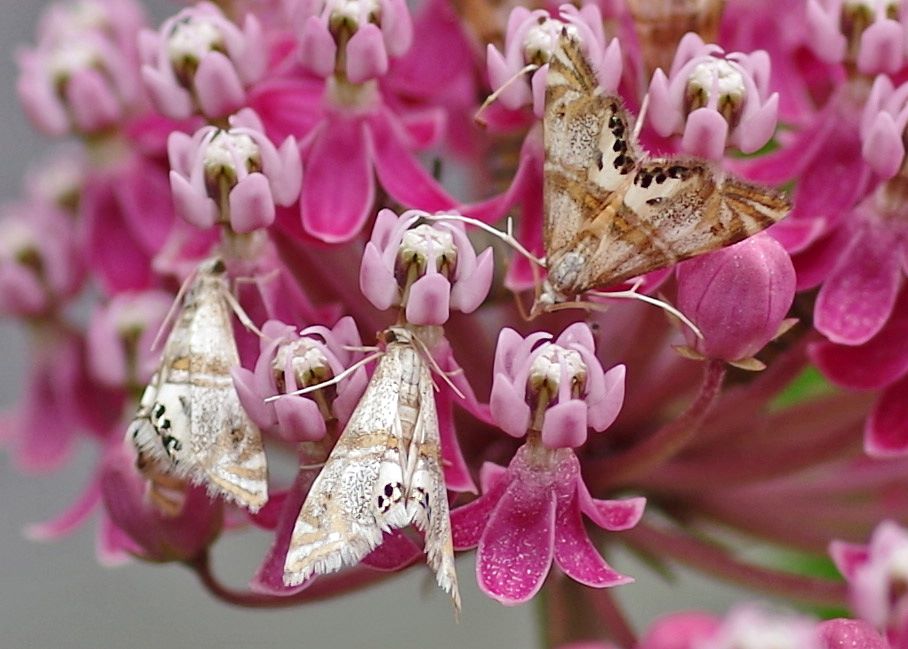
TWO-BANDED PETROPHILA MOTHS (Petrophila bifascialis) are delicate moths that lead a double life.  By day, they sit sedately on streamside vegetation.  By night, the female crawls down the side of a rock into the water – sometimes several feet down – to deposit her eggs on the stream bottom, breathing air that she brings with her, held against her ventral surface (“Petrophila” means “rock-lover”).  Her larvae eventually attach themselves to a rock and spin a net to keep themselves there, feeding on diatoms and algae that they harvest from the rock’s surface with their mandibles. 

MULBERRY WING SKIPPER – A small (one-inch-ish wingspan) butterfly of wetlands with an arrow or airplane-shaped marking on its rich, chestnut-brown underwings (the upper surface of its wings looks completely different https://bugguide.net/node/view/34033/bgimage.  Adults fly slowly through low vegetation, where females lay their eggs on the leaves of sedges. 
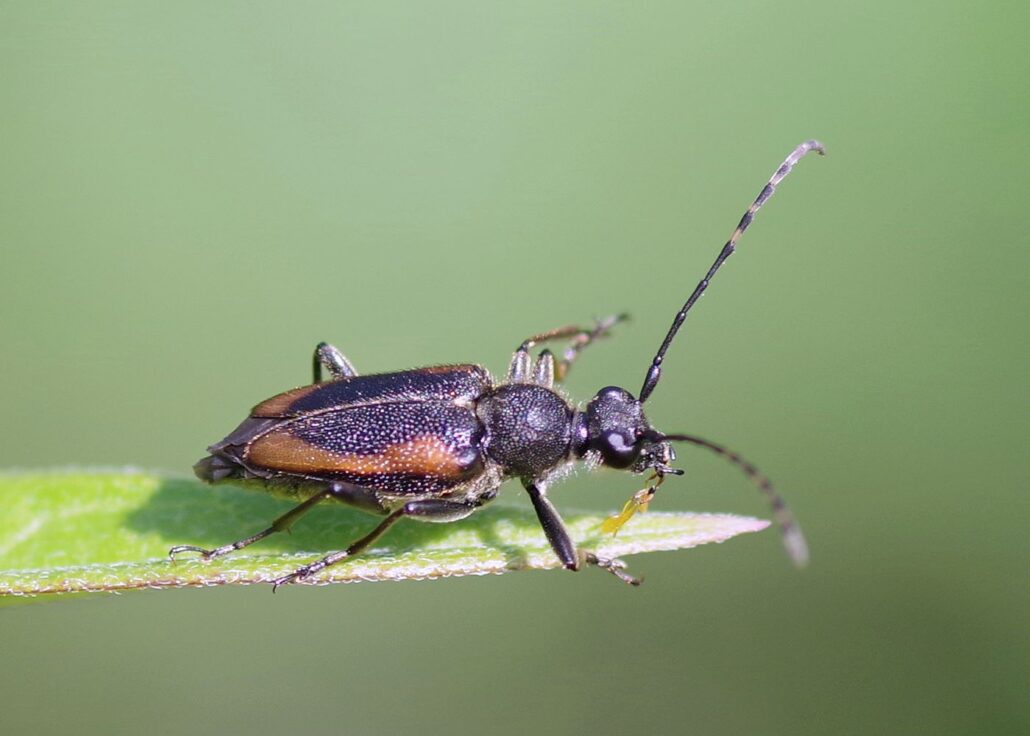
FLOWER LONGHORN BEETLE BRACHYLEPTURA CHAMPLAINI (no common name), on a Swamp milkweed leaf.  Other than a “present” checkoff in a variety of natural area insect surveys, there’s just about nothing online about this beetle, and not much more in Evans’ book, Beetles of Eastern North America.  It’s a long-horned beetle in the Flower longhorn subfamily Lepturinae, a group that feeds on pollen in the daytime.  This one has pollinia on its mouthparts.

AMBUSH BUG – The dangling bee in this picture did not fall victim to the sticky pollinia (though it has plenty of them on its legs).  A well-camouflaged ambush bug snagged it as it visited the flower. 

SOLDIER BEETLE – These guys drive the BugLady crazy.  They’re lightning beetle mimics, and they’re pretty good at it, and she always overthinks the ID.  She doesn’t know why they’re imitating the closely-related lightning beetles – alarmed lightning beetles discharge poisonous blood/hemolymph from their leg joints, but alarmed soldier beetles do, too. 

CRAB SPIDER –This Goldenrod crab spider tucked itself down between the milkweed flowers and ambushed an Odontomyia soldier fly https://bugguide.net/node/view/417289/bgimage.

LARGE MILKWEED BUG – What a beauty!  Large milkweed bugs are seed bugs – they feed by poking their beaklike mouthparts through the shell of a milkweed pod and sucking nutrients from the seeds.  They don’t harm the plant (just the seed crop), and they don’t harm monarch caterpillars, either.  Like other milkweed feeders, they sport aposematic (warning) colors to inform predators of their unpalatability.  Large milkweed bugs don’t like northern winters and are migratory – like monarchs, the shortening day lengths, the lowering angle of the sun, and increasingly tough milkweed leaves signal that it’s time to go, and they travel south to find fresher greens.  Their descendants head north in spring.

MONARCH CATERPILLAR – Common milkweed and Swamp milkweed are Monarch butterflies’ top picks for egg laying. 
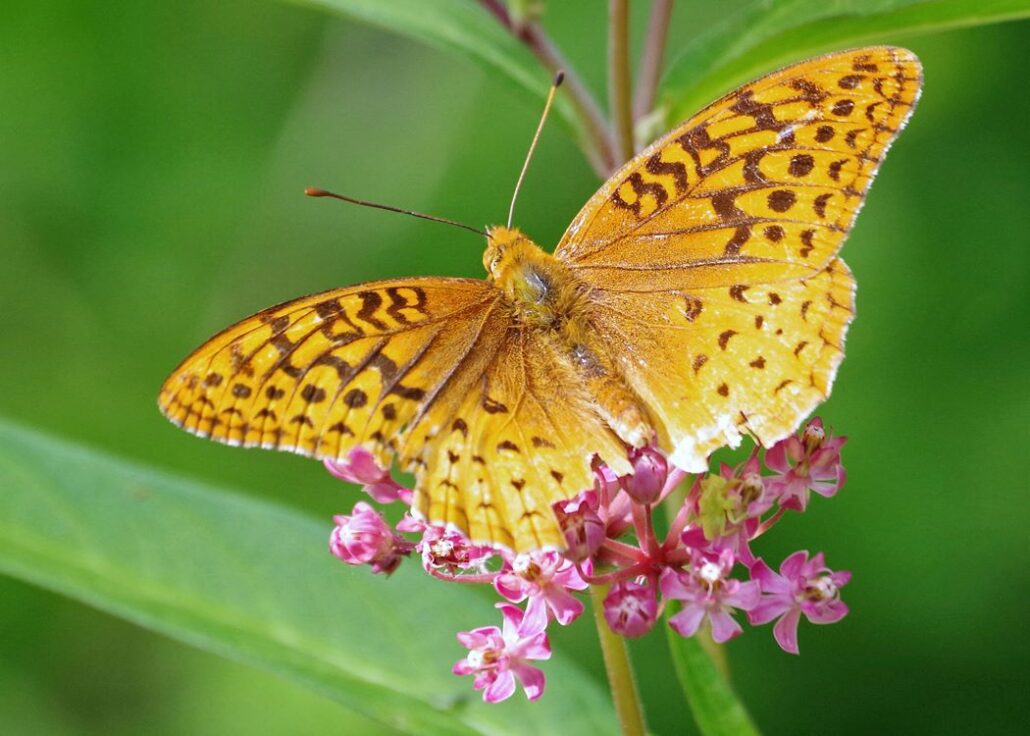
GREAT-SPANGLED FRITILLARY – The other big, orange butterfly.  Adults enjoy milkweeds and a variety of other wildflowers, and their caterpillars feed on violets – if they’re lucky enough to connect with some.  Females lay eggs in fall, near, but not necessarily on, violets, and the caterpillars emerge soon afterward.  They drink water but they don’t eat; they aestivate through winter in the leaf litter and awake in spring to look for their emerging host plants.

GIANT SWALLOWTAIL – A southern butterfly that seems to be getting a foothold in Wisconsin.  The book says they are annual migrants that produce a generation here in summer and that their caterpillars can’t tolerate Wisconsin winters, but the BugLady has seen very fresh-looking Giant Swallowtails here in May that didn’t look like they had just been on a long flight.  Their caterpillars are called Orange Dogs in the South, because their host plants are in the Rue/Citrus family Rutaceae.  In this neck of the woods, females lay their eggs on Prickly ash, a small shrub that’s the northernmost member of that family. 

CINNAMON CLEARWING MOTH – A nectar-sipper but, since it doesn’t land, not a serious pollinator.

NORTHERN PAPER WASP – Butterflies love Swamp Milkweed, and so do wasps.  The Northern paper wasp is the social wasp that makes a smallish (usually fewer than 200 inhabitants) open-celled, down-facing, stemmed nest https://bugguide.net/node/view/1411890/bgimage.  “Northern” is a misnomer – they’re found from Canada through Texas and from the Atlantic well into the Great Plains.  Her super power is chewing on cellulose material, mixing it with saliva, and creating paper pulp.  She may be on the swamp milkweed to get pollen and nectar for herself or to collect small invertebrates to feed to the colony’s larvae.  Curious about Northern paper wasps?  See https://bugeric.blogspot.com/2010/09/wasp-wednesday-northern-paper-wasp.html.

Also seen were ants, leafcutter bees, sweat bees, Great black wasps, Great golden digger wasps, Red soldier beetles, Fiery and Broad-winged Skipper butterflies, and Thick-headed flies.  

Kate Redmond, The BugLady

Bug of the Week archives:
http://uwm.edu/field-station/category/bug-of-the-week/

Become a Member

Take advantage of all the benefits of a Riveredge membership year round!

Learn More