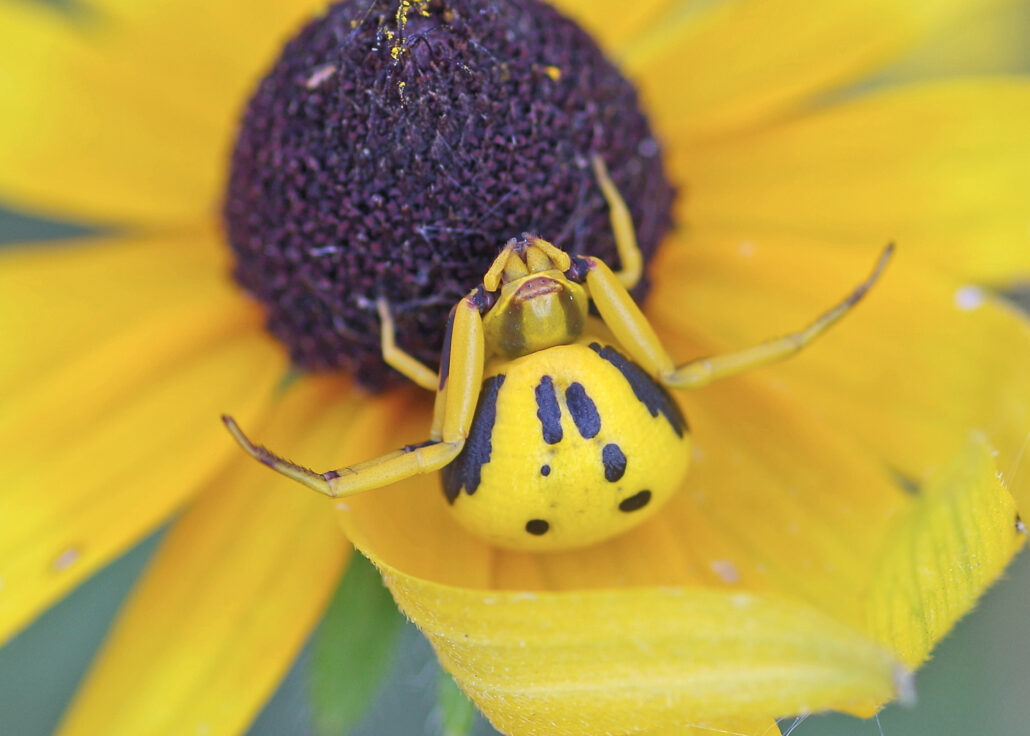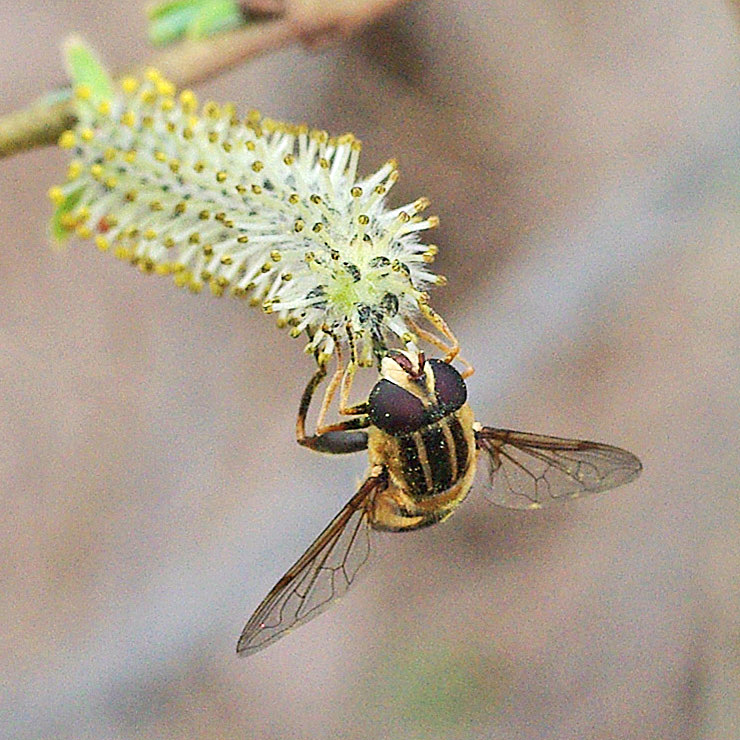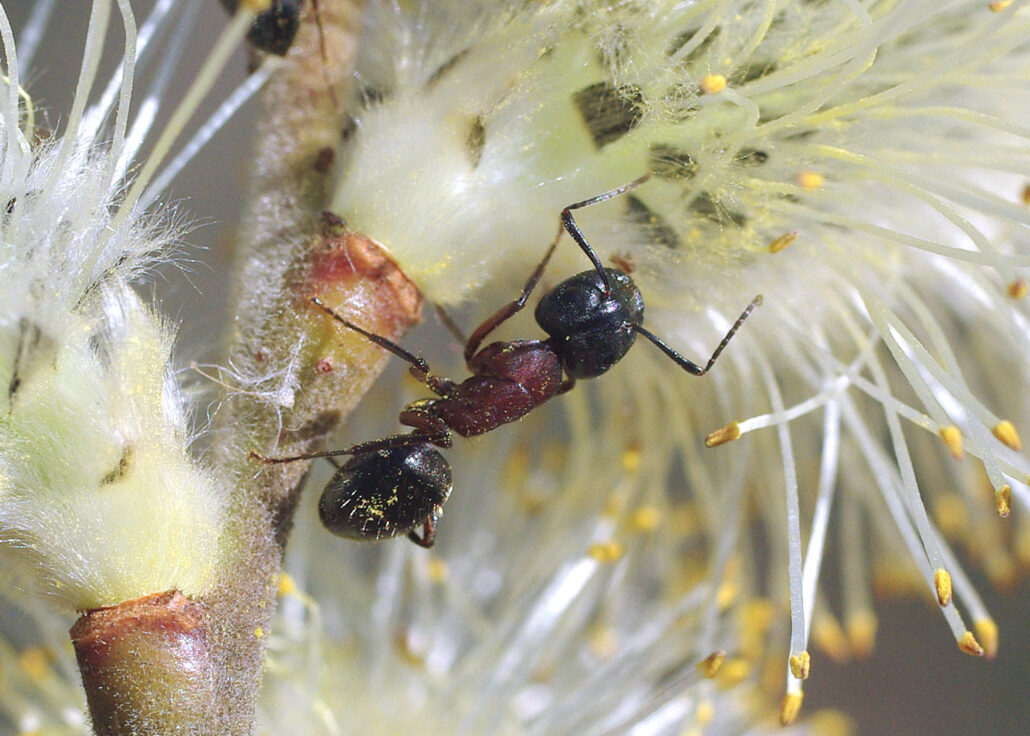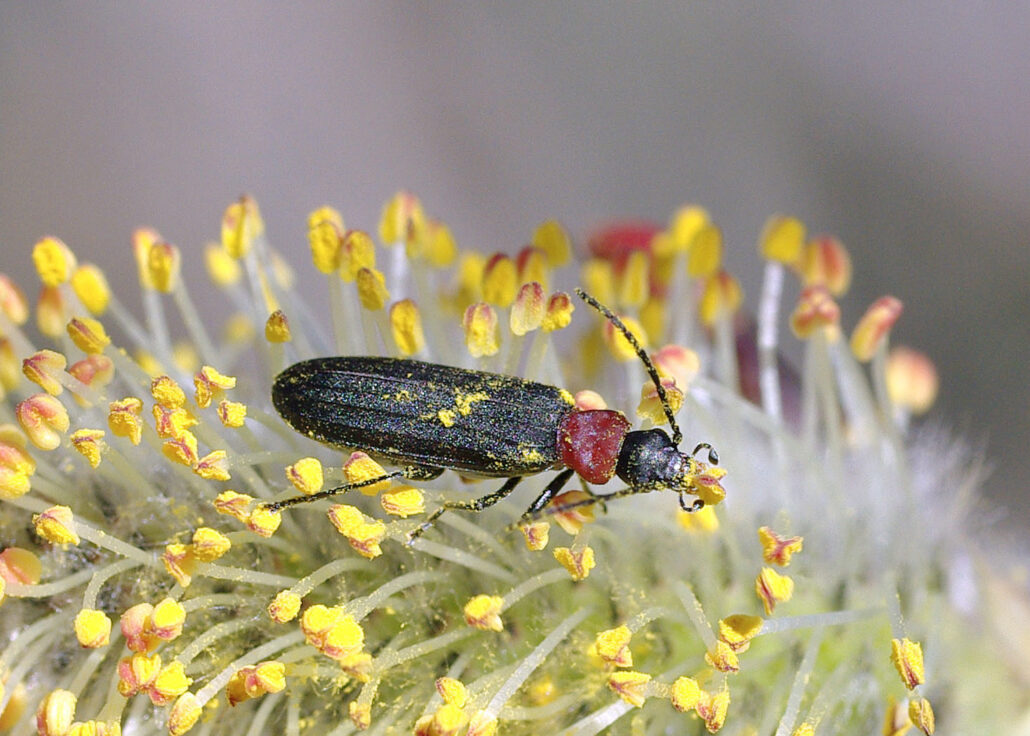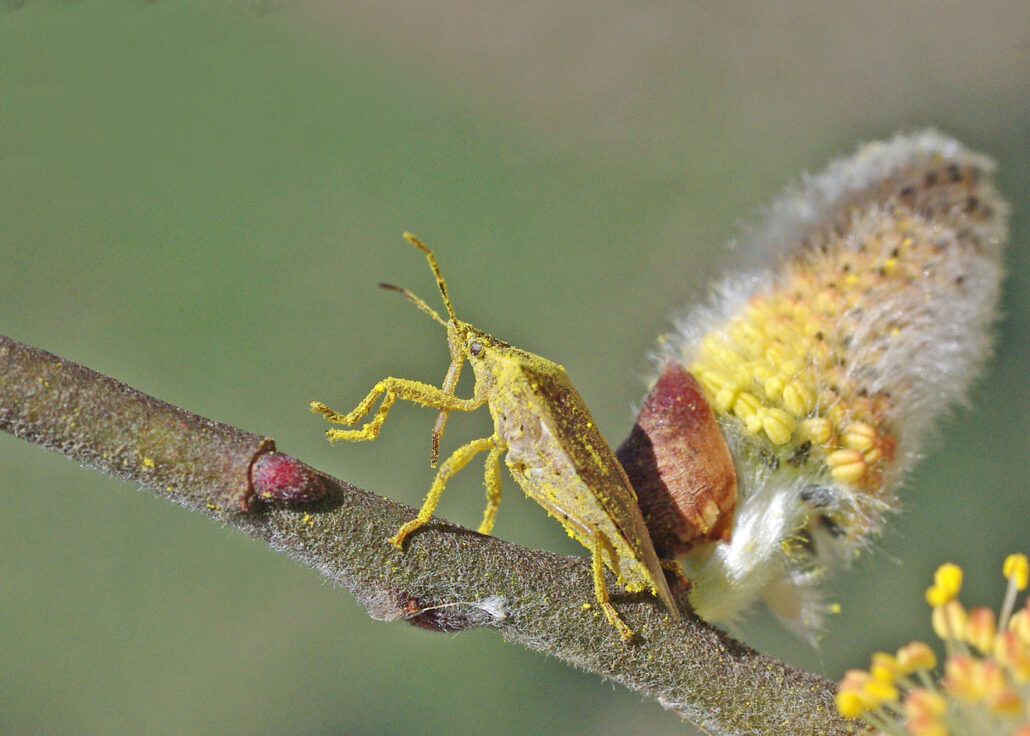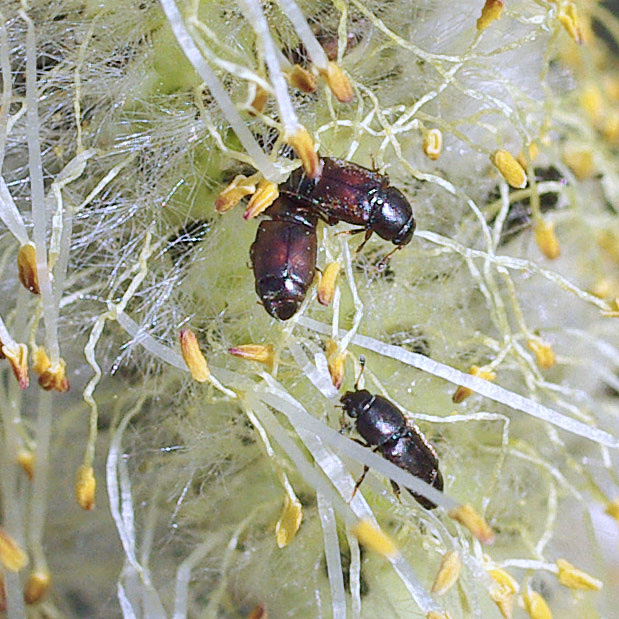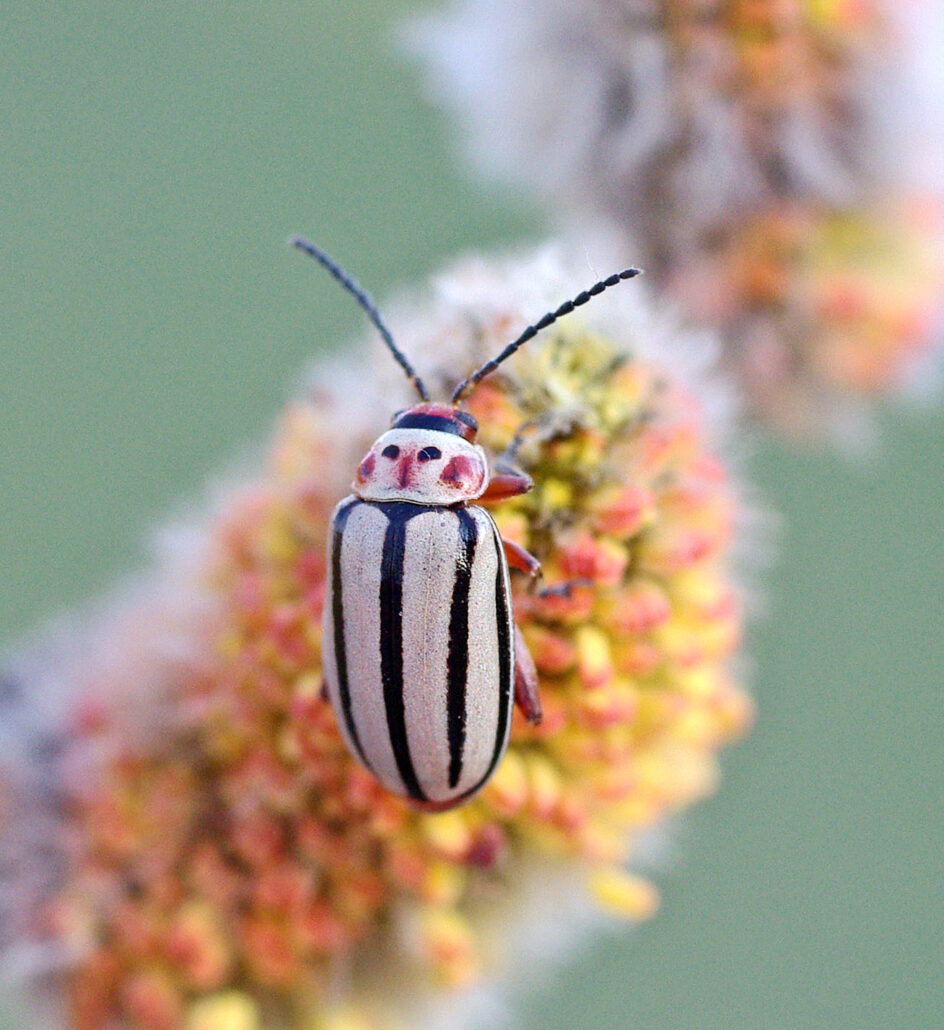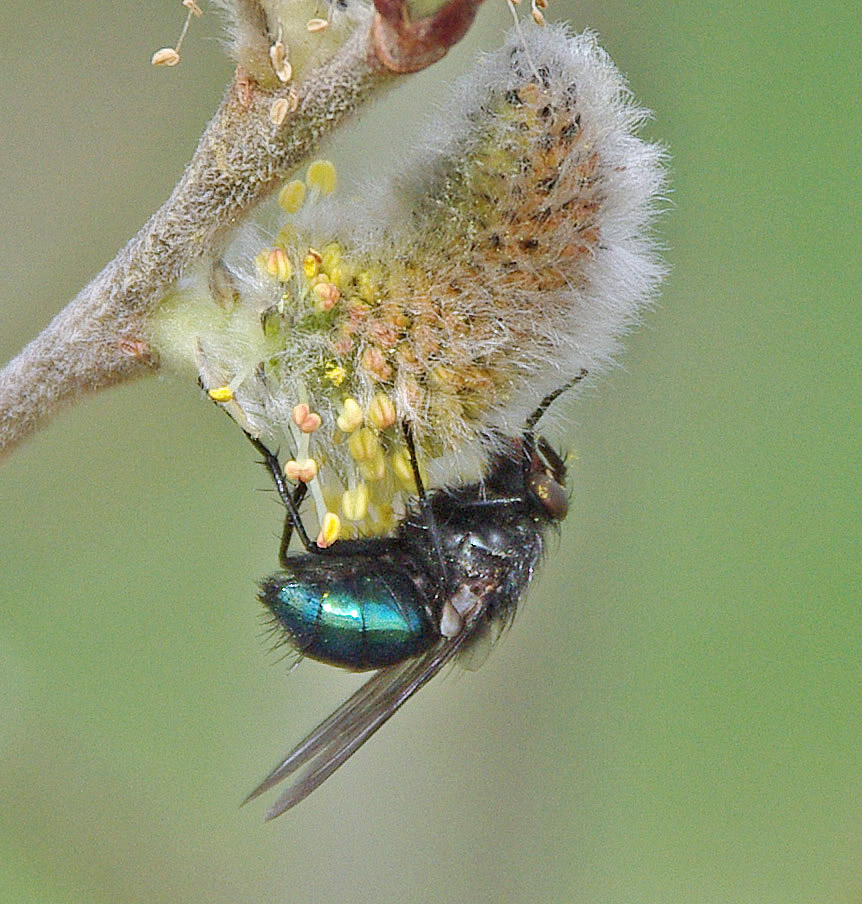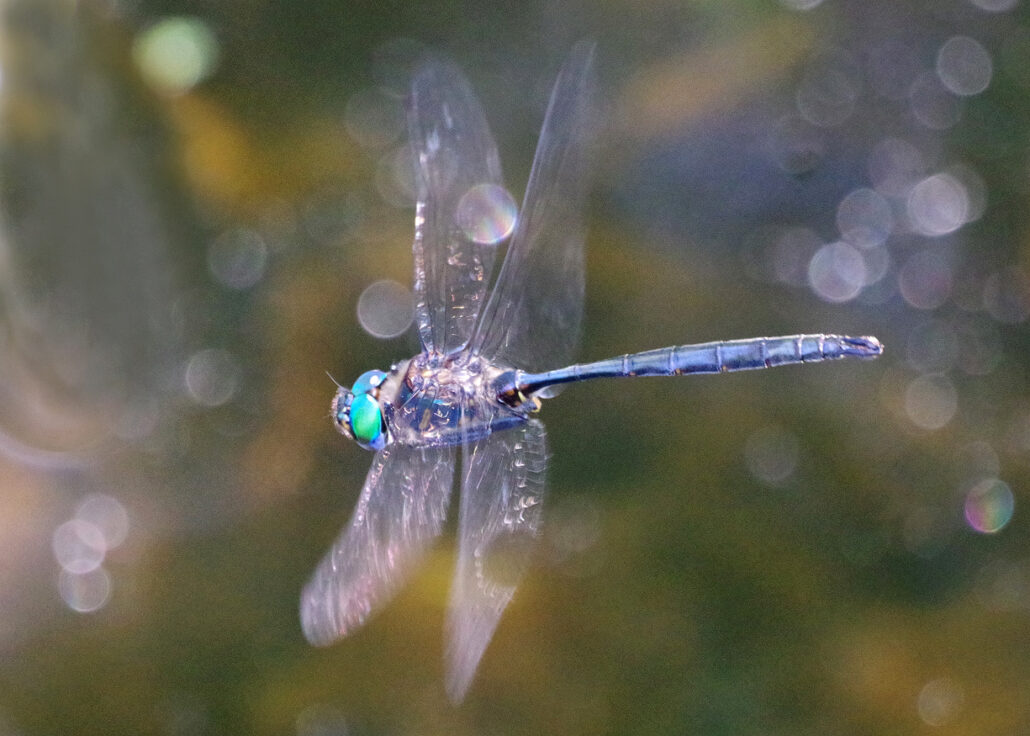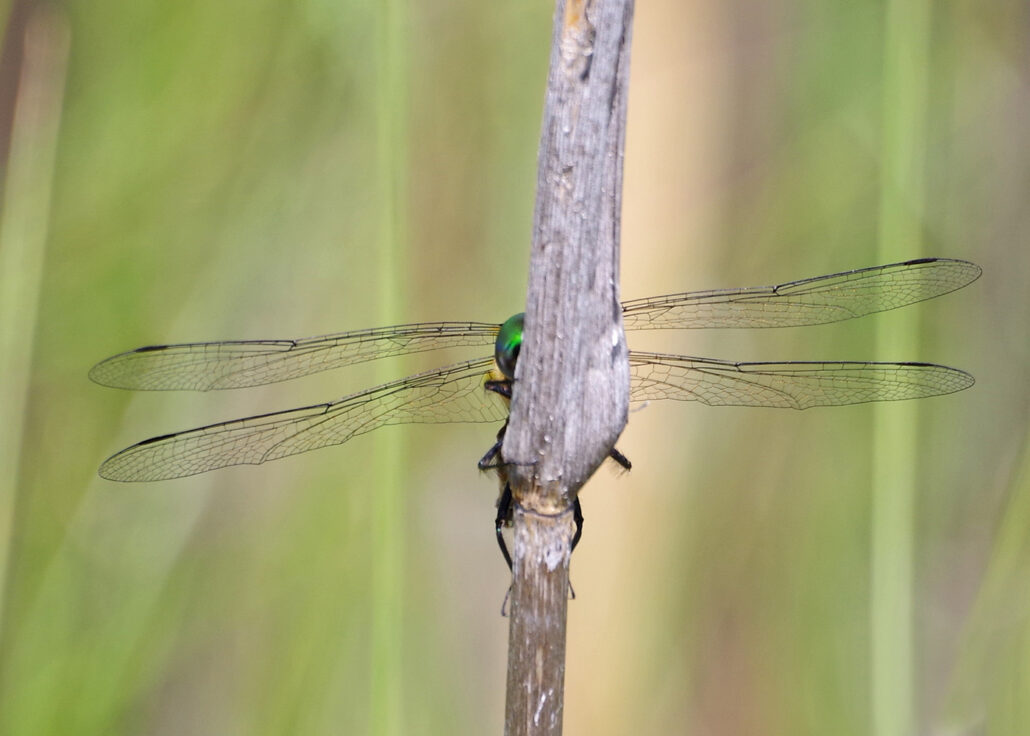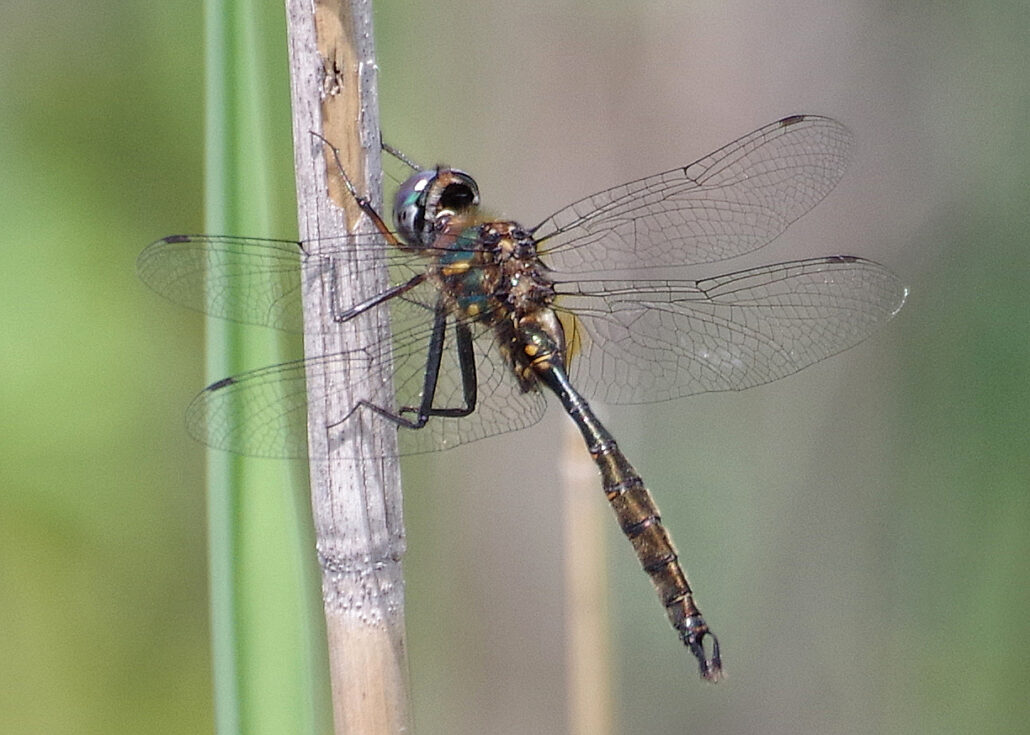
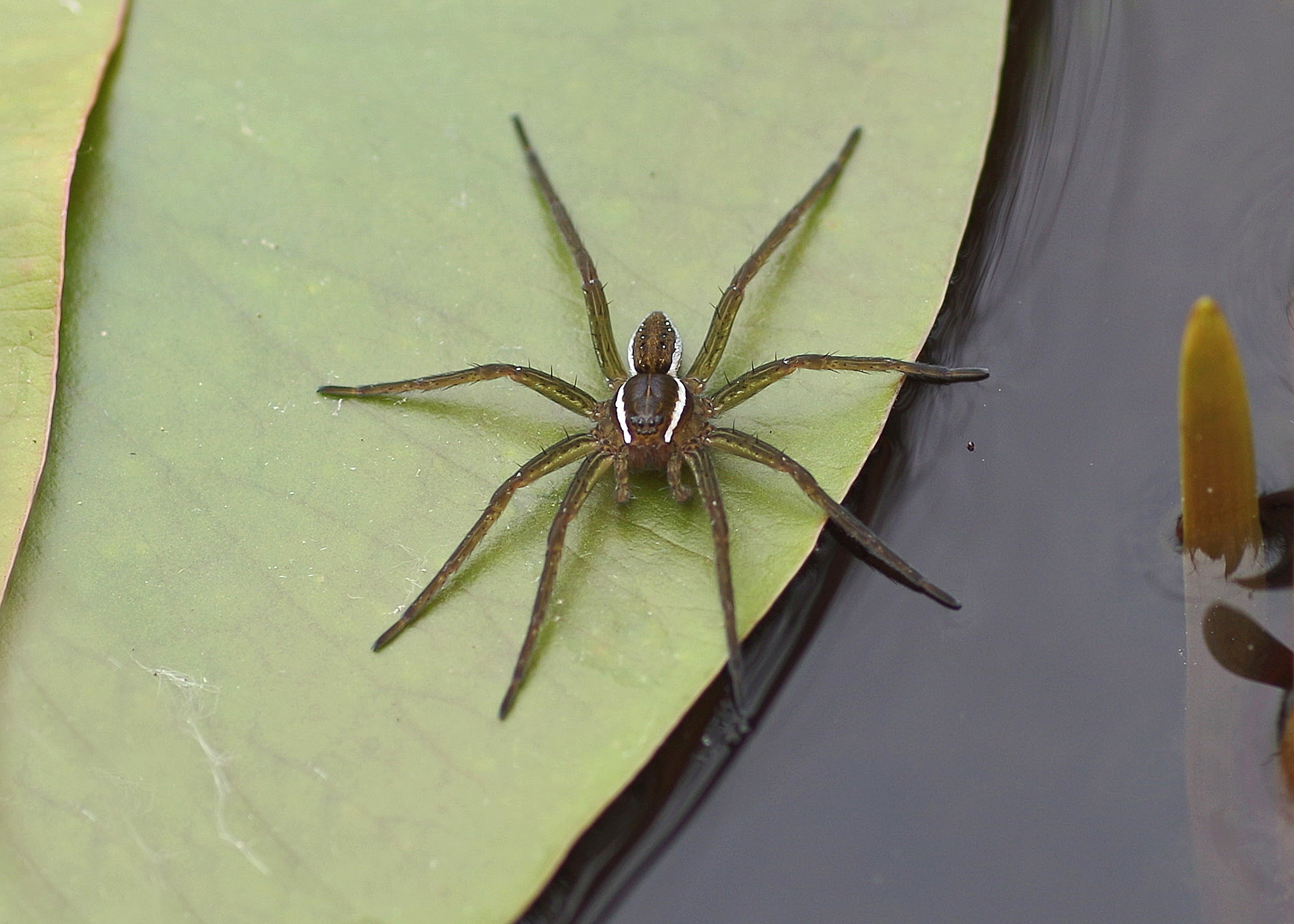
It’s the start of December – and of meteorological winter – and it’s cold out, and the BugLady is still wondering what, exactly, happened to August. Here’s a little slice of August, from 15 years ago.
The BugLady’s advice for the day is: Find yourselves a big clump of goldenrod and start looking. Bring your camera. Bring a lawn chair. Bring Eaton & Kaufman’s Field Guide to Insects of North America and The Audubon Society Field Guide to North American Insects and Spiders by Lorus and Marjory Milne so you can find out what you’re looking at. Bring Donald W. Stokes’ excellent A Guide to Observing Insect Lives so you can find out what they’re doing there. You have time – one inscrutable species of goldenrod follows the next, from mid-August through the end of September (botanist Asa Gray once said that the 12 pages devoted to goldenrod taxonomy were the most boring in his book). Each critter has its own story, and it is in understanding the small stories that we start to get a handle on the big picture.
The BugLady enjoys the challenge of photographing these jumpy beauties – standing out in the field on a hot, breezy day, sweat trickling down her back, hoping for that Worried about pain? The BugLady has been photographing insects for 35 years, and she really, really gets in bugs’ faces, but she has never been bitten or stung in the process (well, except for some peripheral ants, but ants have been lying in wait for the BugLady all of her life).
Worried about allergies? The pollen of goldenrod is large and is not spread through the air, but its showy flowers take the rap for the very airborne pollen produced by inconspicuous, green ragweed flowers.
What will you see?
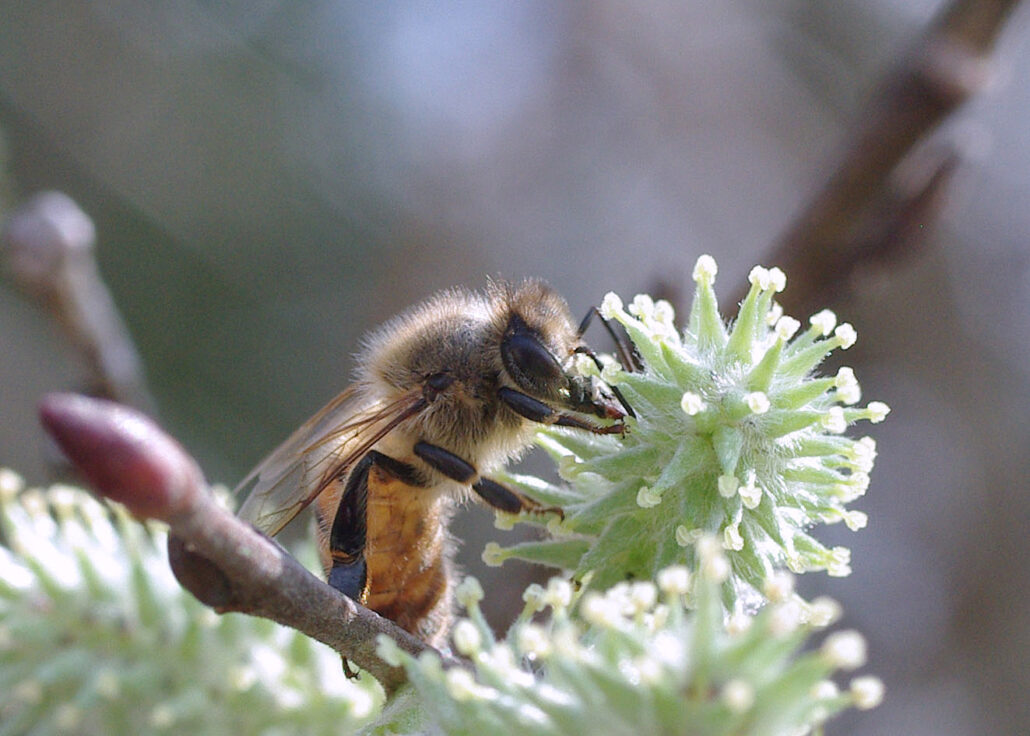
HONEYBEES who, if they start the day on a yellow flower, continue to visit yellow flowers (a phenomenon called flower constancy);
Worker BUMBLE BEES who can “buzz pollinate” some flowers – set up a vibration that loosens the pollen so they can collect it and carry it to an underground nest to nourish their queen and siblings – with no inkling that when goldenrods bloom, bumblebee days are almost over;
PENNSYLVANIA LEATHERWING (Soldier) beetles, seldom alone, who visit the flower tops to feed and frolic (count the antennae) and who discourage predators with poisonous chemicals that drip from the bases of their legs;
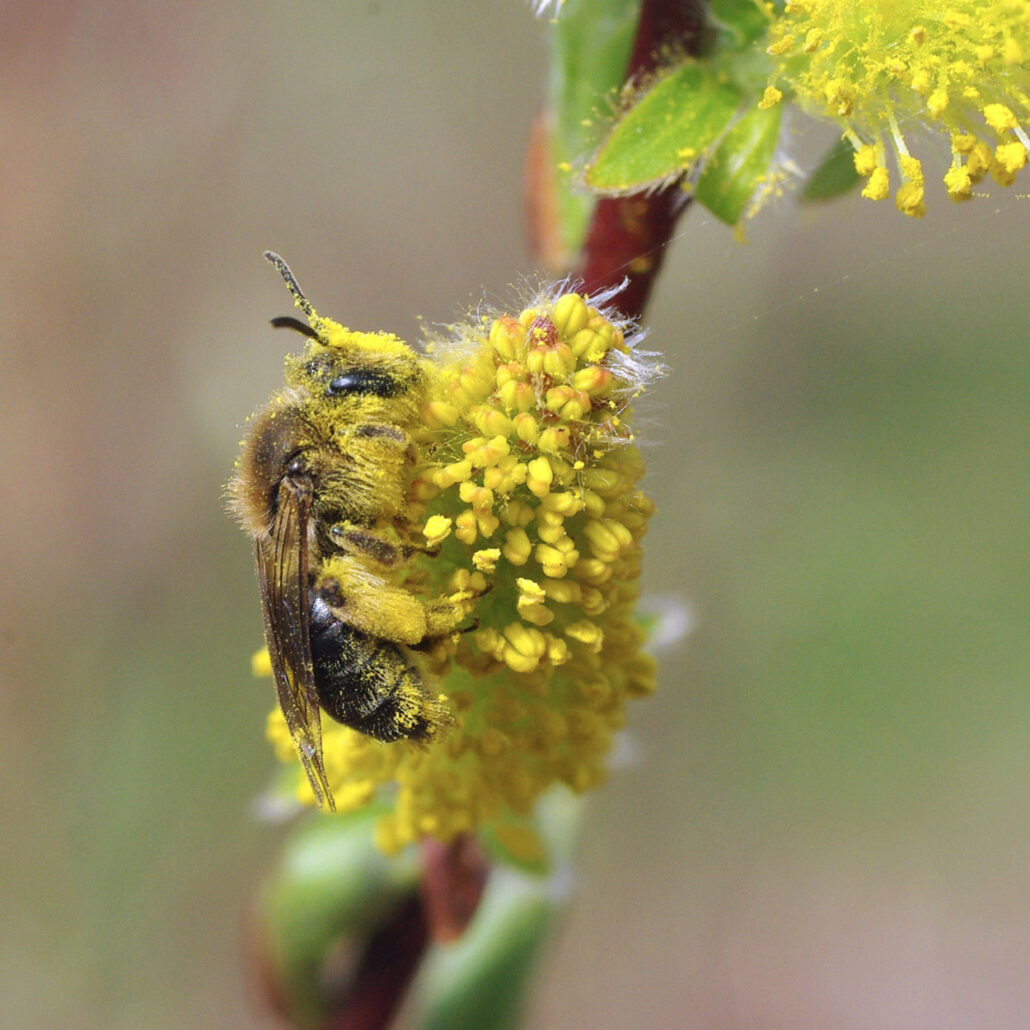
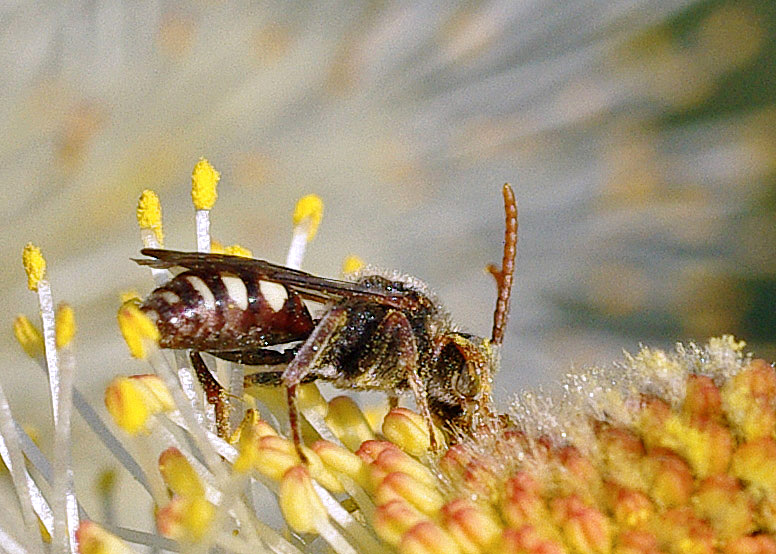
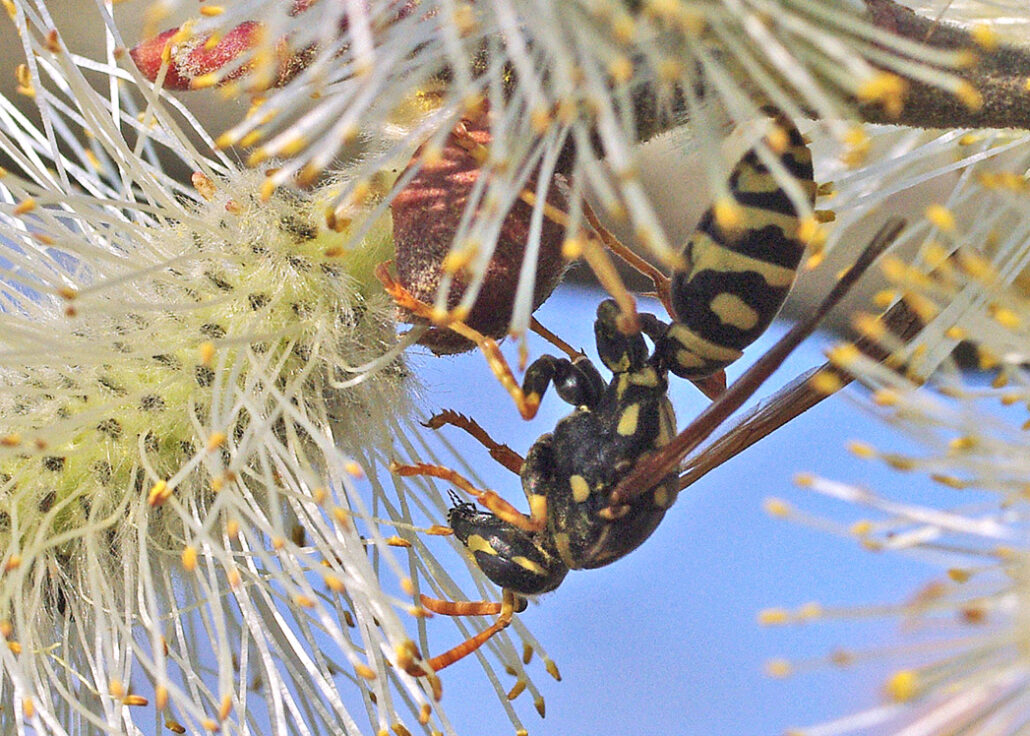
SOLITARY WASPS catching a light snack of pollen or nectar for themselves while hoping to catch a fellow arthropod to provision their offspring’s egg chamber;
BUTTERFLIES, the most graceful among us, who surround us with magic;
LADYBIRD BEETLES grazing on herds of aphids;
AMBUSH BUG – Insects that are sitting way too still, who may still be in the clutches of a well-camouflaged predator like the ambush bug (here with a Syrphid fly), who grabs and immobilizes them, injects a meat tenderizer, slurps out their innards, and discards the empties;
MOTHS – small, amorous, plain and fancy;
SPIDERS, who catch their prey using tools (an orb-weaver’s web) or ambush (jumping spiders);
BLISTER BEETLES, whose velvety, black coat contains an itch-and-lump-producing chemical that will bug you for a week. Like the Pennsylvania, they are August specialties;
SYRPHID (HOVER, FLOWER) FLIES that come in sizes so small that their flight doesn’t even rustle the pollen grains;
GRASSHOPPERS AND KATYDIDS, who see us coming and launch themselves into the air with a thrust of legs and wings;
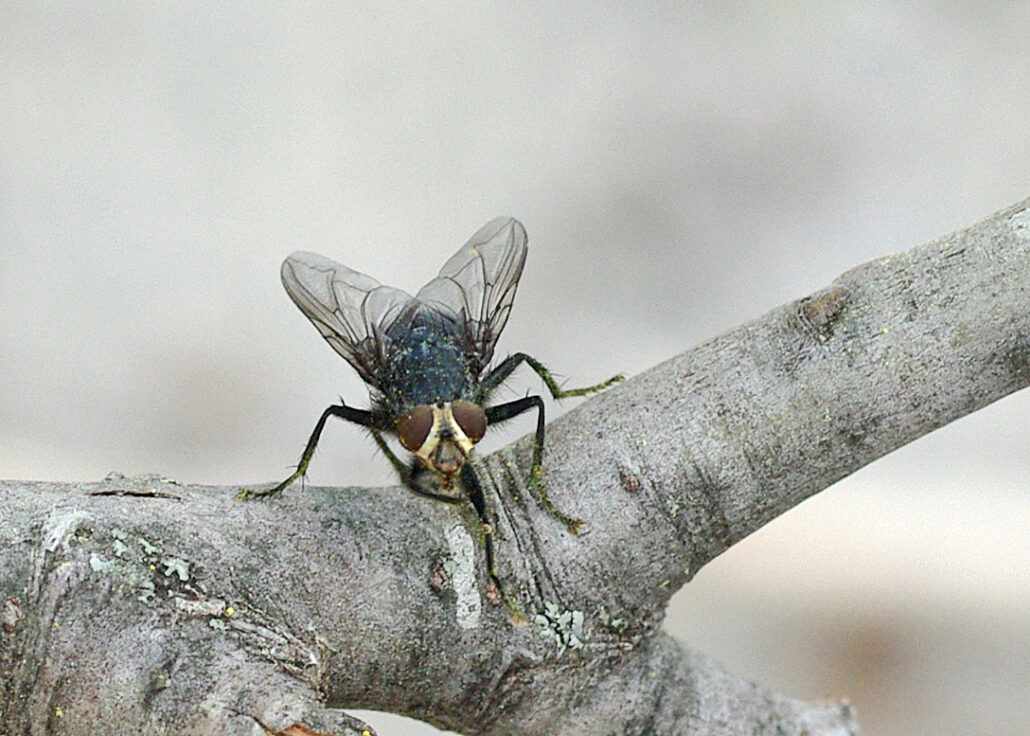
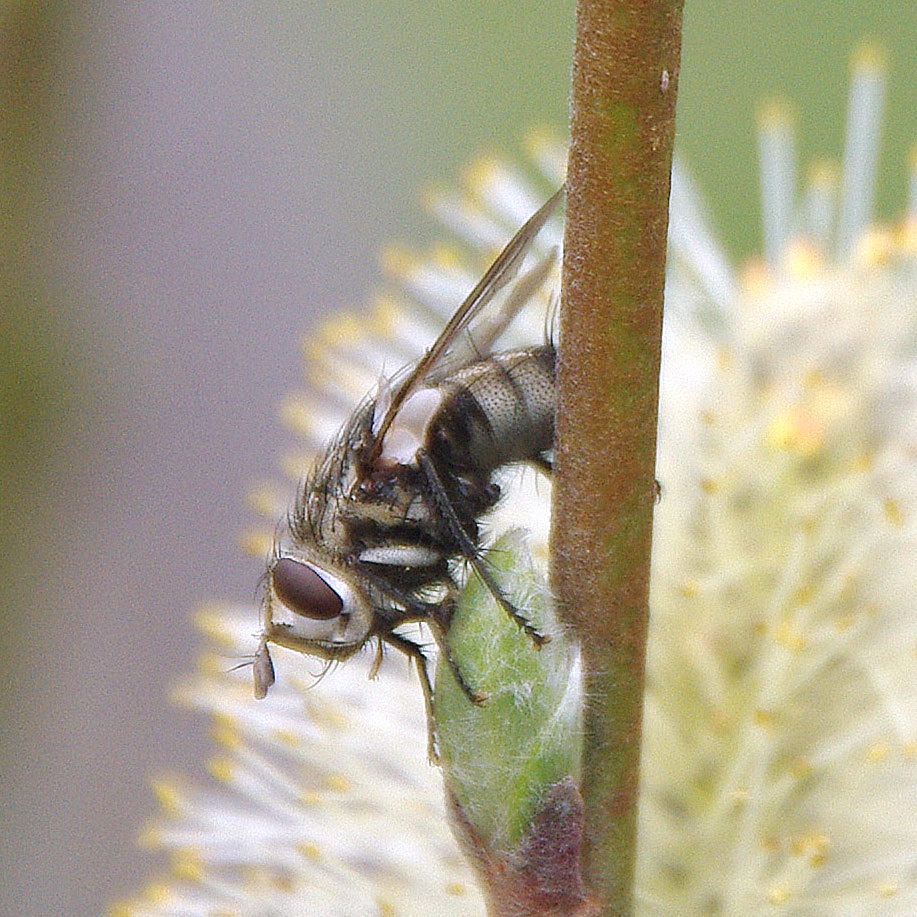
TACHINID FLIES, they of the bristly butts, who lay their eggs on flowers so that their young can climb aboard an unwary insect and eat it from the inside, out.
TIPHIID WASPS, whose larvae prey on soil-dwelling larvae of some scarab beetles like June beetles. The female doesn’t bring food to her egg; she brings her egg to food. When the female wasp locates a grub in the ground), she lays an egg on/near it
They’re all there, and more. Pollinators and predators. The drama of life and death playing out hundreds of times against the buttery backdrop of goldenrod, whose Ojibwe name means “sun medicine.”
Here’s a rerun from 2010, with a few new words and pictures.
The BugLady would like to state up front that this episode is about “pennants” (as in “small flags”), not about “penance,” which is between BugFans and their deities.
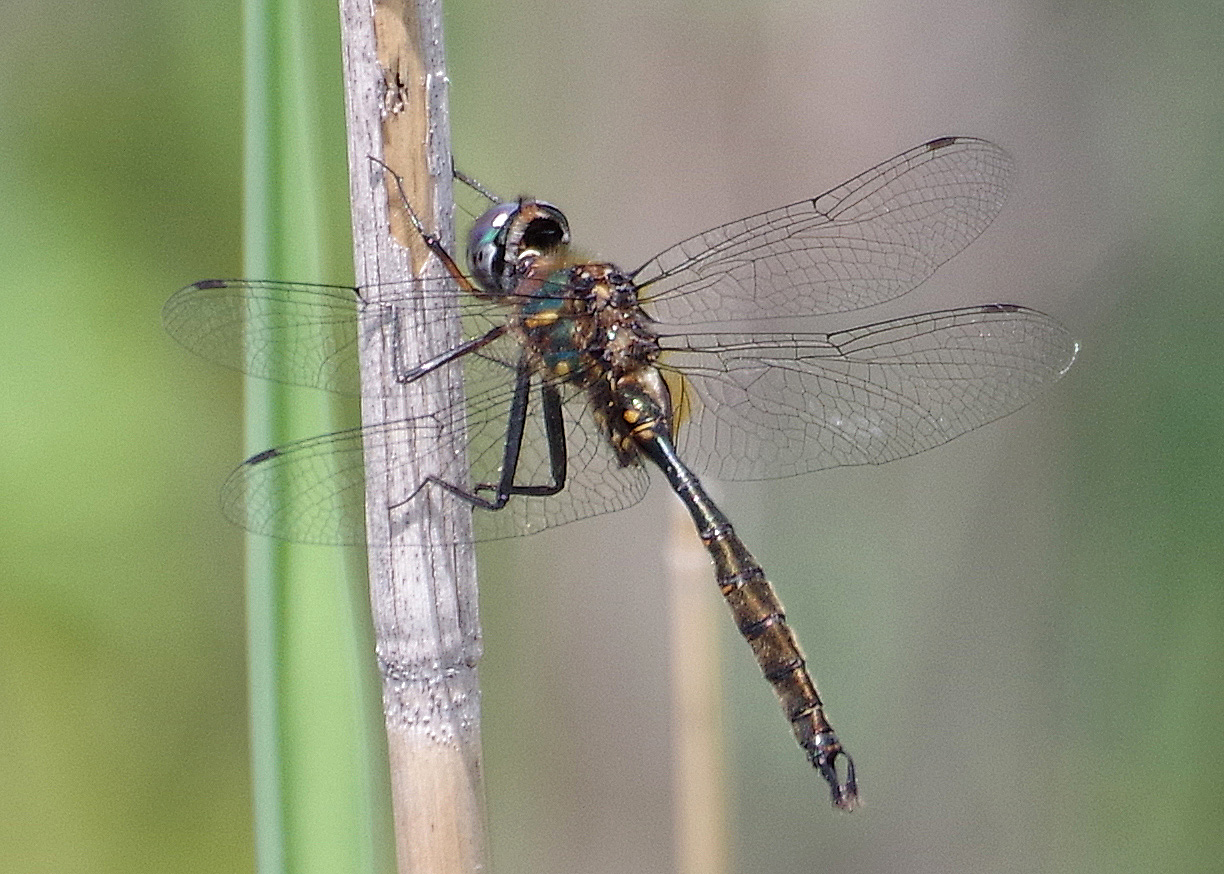
After the awesome Slaty Skimmer, some of the BugLady’s (many) favorite dragonflies are the Calico and the Halloween Pennants. The Pennants are the stuff that tattoos are made of (someday). The internet agrees; it’s light on Pennant information and heavy on Pennant pictures, but they are eye candy!
The BugLady enjoys the challenge of photographing these jumpy beauties – standing out in the field on a hot, breezy day, sweat trickling down her back, hoping for that moment of calm as the Pennants wave back and forth on the grass tops (the reason for the “pennant” part of their name is that they resemble tiny flags streaming off the weeds). Good times. In Dragonflies and Damselflies of the East, Dennis Paulson writes that, “their disproportionately long hind legs are “probably an adaptation for keeping the abdomen horizontal while tip-perching.”
Pennants are smallish dragonflies in the genus Celithemis, in the Skimmer family (Libellulidae) and there are just eight species in the genus. Most members of the genus are southeastern, but the ranges of the Calico and the Halloween Pennants take them into the Great Plains. The Halloween and the Calico have spots in their wings and reddish eyes. The Halloween’s wings are tinted an orange-ish-yellow; the un-tinted wings of the Calico have fewer spots, but males have a spot at the base of each hind wing. Both are found near water for egg-laying but may stray far from water to forage.
When naturalists explain the differences between dragonflies and damselflies, we tell people that damselflies can fold their wings over their bodies or hold them in a backwards-pointing “V” along their sides (the Spreadwings, genus Lestes), but dragonflies must hold their wings straight out to the side. The Pennants didn’t get the memo – perched, they often hold their front wings at a different angle than their hind wings, with their wings in several planes.
They are found near/lay their eggs in slow-moving to still waters https://bugguide.net/node/view/1261348/bgimage. Several sources said that the young/naiads https://bugguide.net/node/view/227987/bgimage of these Pennants are not very competitive, and as such they are more successful in newer waters (borrow pits, ditches, etc.) than in waters with lots of established predators. The naiads are great vegetation climbers and not-so-great swimmers.
Insects are cold-blooded, their internal temperature similar to the temperature of the air or water that surrounds them, and they appreciate a jump-start from the sun to get the juices flowing. But, cold-blooded or not, too much sun is too much sun. It is thought that the Pennants’ wing spots cast some much-needed shade on the thorax of this open-country percher. An alternate suggestion for the spots at the base of the Calico’s hind wings is that the dark color absorbs heat and warms the insect’s thorax (and, by extension, its wing muscles). Several sources mentioned that the thorax of the pennants is “reduced” without elaborating on what that means for the dragonfly. Is there a connection between a smaller thorax and the need to heat it? Don’t know. Do they have reduced wing muscles? Unlikely, when you consider their activities.
To minimize the amount of sun that hits their body, some kinds of dragonflies (about 10% of species, including the Calico and especially the Halloween Pennants) perch in a “tail-up” posture called the “obelisk position” (https://bugguide.net/node/view/1704521/bgimage). They will rotate their body to maintain the correct angle as the sun moves. But, a dragonfly with its abdomen raised may also be assuming a threat position, or if the sun is waning, may be trying for more sun exposure.
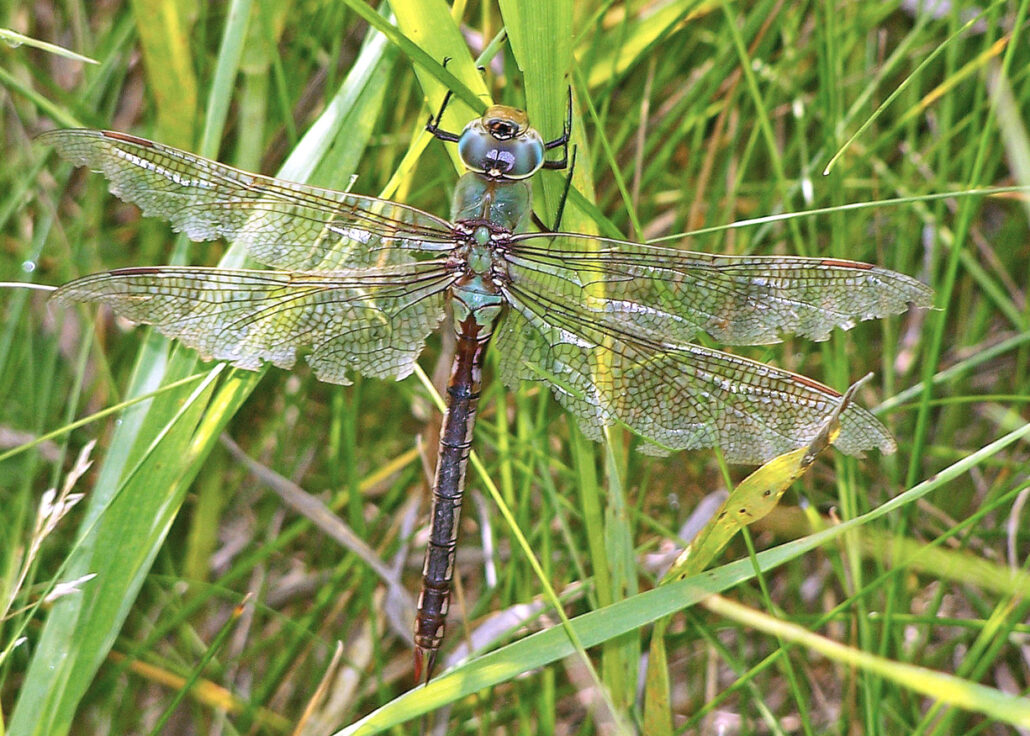
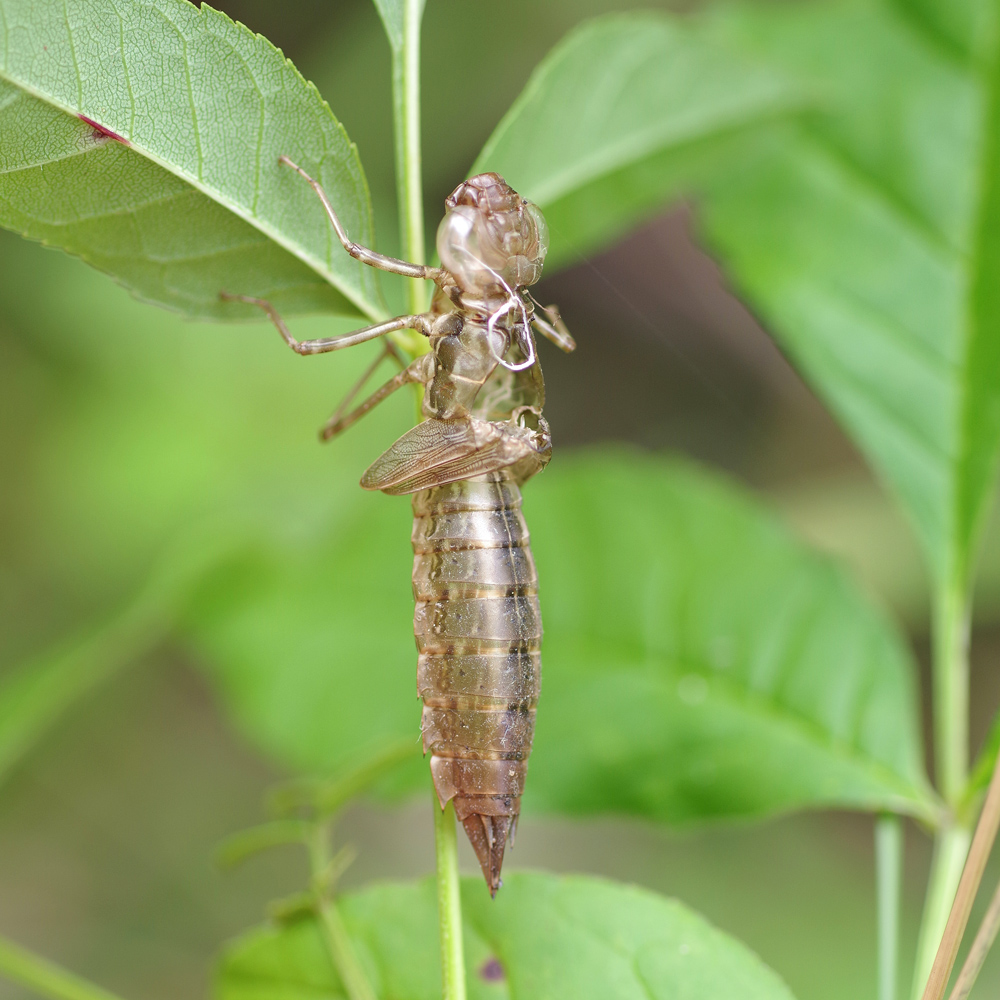
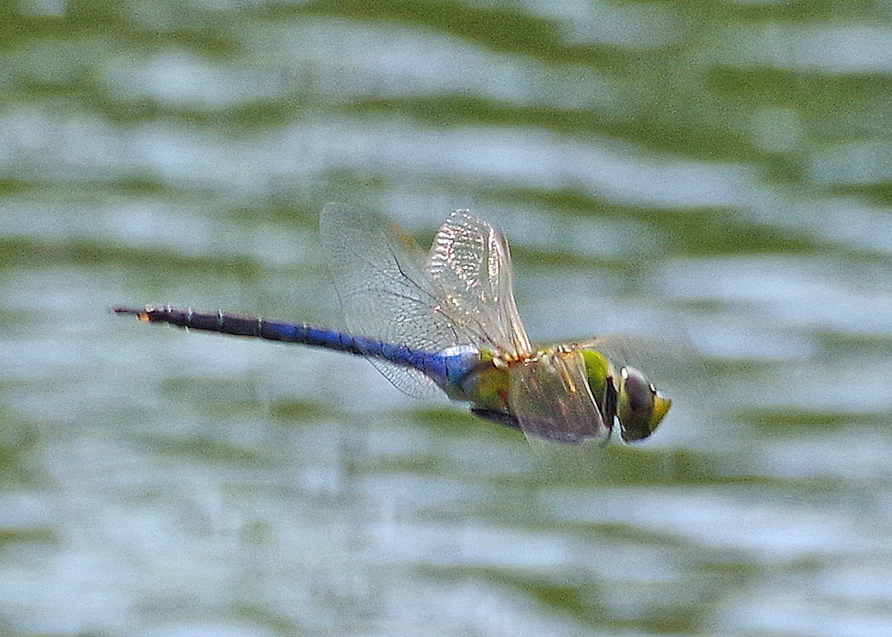
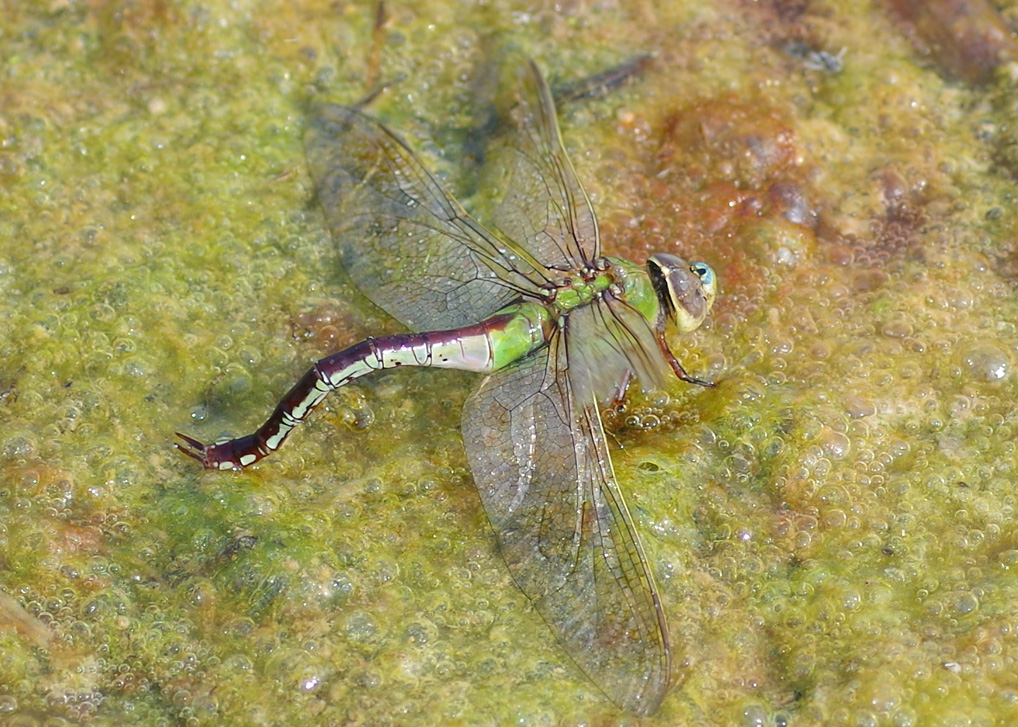
Dragonflies are unapologetic carnivores as aquatic naiads (catching with their extendable mandibles anything in the water that is smaller than they are), and as adults (catching with their spiny legs anything airborne that is smaller than they are).
CALICO PENNANTS (Celithemis elisa) are called “Elisa Skimmers” in some books. They are small dragonflies (less than 1 ¼” long), locally common in shallow water and slow streams with emergent plants east of the Great Plains. Females and juveniles are decorated with a yellow face, yellow stigmas (the solid, pigmented spot toward the tip of the wing), and yellow, heart-shaped spots along the top of the abdomen. Where the female is yellow, the male is red. Male Calicos also have the afore-mentioned dark patch on the hind wing, near the body, like a saddlebags dragonfly.
Male Calicos are not particularly territorial, though they will chase intruding males. They may patrol a pond, flying a few feet above its surface, or they may search for a mate by perching on vegetation near the water, facing away from the pond in order to spot females as they fly in. After she mates, the female lays eggs for a few minutes in the shallow water of a pond’s edge, flying in tandem with the male. He departs and she continues to lay eggs solo, tapping her abdomen on the water’s surface, breaking through the surface film so the eggs can be washed off of the tip of her abdomen. She may deposit as many as 800 eggs.
HALLOWEEN PENNANTS (Celithemis eponina) are also called the “Brown-spotted yellow-wings” (though the BugLady has no idea why anyone would hang that prosaic name on this creature!). They were named “Halloween” for their orange-tinted, black-patterned wings, and they are considered the most colorful pennant. Like the Calicos, female Halloween Pennants sport a yellowish face, elongated yellow “hearts” along the top of the abdomen, and yellow stigmas, and males are more intensely colored. Many sources refer to them as “butterfly-like” because of their bouncy flight and colorful wings. They are slightly larger than the Calico.
Much of their business is conducted in the morning. Mating generally occurs well before lunch, and the mating pair may ascend to 50’ in the air before getting down to tandem egg-laying in open water. Males are not territorial. The BugLady has seen Halloween Pennants over the water but not Calico Pennants (yet).
Halloween Pennants seem more unconcerned about weather than other dragonflies are. They are more likely to “obeslik;” they fly and lay eggs on windier and cooler days than other dragonflies; and they are out and about even in a light rain, shaking the water from their wings as they hunt.
In honor of Halloween, we’re ending the month with a spider. A very cool little spider with a big story.
The Dewdrop spider Argyrodes elevatus (Argyrodes means “silver-like), in the Cobweb/Comb-footed/Tangle-web spider family Theridiidae, doesn’t live around here, though other genera of Dewdrop spiders do, like https://bugguide.net/node/view/940747/bgimage and the awesome lizard spider https://bugguide.net/node/view/664010/bgimage. Theridiids are found in North America, indoors and out, in an almost infinite variety of habitats, from border to border and from sea to shining sea (and around the world). Thanks, as always, to BugFan Tom for sharing his pictures.
Argyrodes spiders are also called Robber spiders (more about that in a sec), and there are three genus members in the US, and more elsewhere. Argyrodes elevates is found in California and in much of a swath of Southern/mid-Southern states from Texas to Ohio to Delaware, the Carolinas, and Florida. Their silvery abdomens give them their “dewdrop” name, and they’re seriously small – females are a shade smaller than ¼ inch, and males are smaller still.
Dewdrop spiders are inquilines – animals that exploit the living space of other animals (sometimes passively and sometimes impactfully). These tiny spiders can and do spin their own silk, but they prefer to live at the outskirts of larger spiders’ webs. A host’s web may contain a lot of them – so small that she may not even notice them. For scale, here’s one in a web with another spider and a partly-wrapped, inch-long green June beetle https://bugguide.net/node/view/316493/bgimage.
When a male goes a’courtin,’ possibly attracted by a female’s pheromones, he arrives bearing a gift – prey wrapped in silk – and he doesn’t approach closely until she has accepted it. Giving nuptial gifts is uncommon in spiders. He also vibrates the web to identify himself, spider love being a chancy thing. A day after she mates (an act that, contrary to the brief encounters of other spiders, may take two to eight hours, during which she’ll eat his gift), the female will tuck one or two egg sacs onto threads at the periphery of her host’s web. Although she continues to live on the web, her egg sacs are on their own.
The big story about Dewdrop spiders is how they get their food. They’re “kleptoparasites” (triple word score) – animals that rob food from other animals. They eat wrapped prey that the host spider has stored in the web (and they can tackle wrapped prey that’s quite a bit larger than they are if the host spider has already injected tenderizing enzymes), freshly caught prey that the host hasn’t detected yet, the host spider’s egg sacs, the host’s protein-rich silk web (especially when prey is scarce), and sometimes, the host spider herself, if there are a large number of “guests” to gang up on her (Tom has observed Dewdrop spiders feeding on Gastracantha spiders https://bugguide.net/node/view/129627 in his yard). Theridiids aren’t the only spider family that has food robbers, but they are the family with the most kleptoparasitic species.
They stay hidden, and they may alter parts of their host’s web so they can remove prey without causing the telltale vibrations that might alert the bigger spider. They’re very good at it – one study assigned them a 67% success rate – and they can liberate a bit of their host’s food in as little as 12 seconds.
To support their lifestyle, Dewdrop spidershave developed some interesting behaviors. Here are some highlights from a paper called “Notes on the behavior of the kleptoparasitic spider Argyrodes Elevatus (Yheridiidae, Araneae)” by Marco Cesar Silveira and Hilton F. Japyassú (https://pepsic.bvsalud.org/scielo.php?script=sci_arttext&pid=S1517-28052012000100007).
A Dewdrop spider will take advantage when the host’s attention is diverted, grabbing a wrapped insect while she’s busy subduing a new prey item.
Sometimes, briefly, a Dewdrop spider and its host may share a meal, until the host chases it away. If the host is distracted, the Dewdrop spider will make off with the partially-eaten prey.
A Dewdrop spider alters the host’s web by replacing parts of the original web with finer threads so that the host can’t detect its vibrations, but it can detect the host’s movements. It also minimizes the signals it sends by moving very slowly.
During a heist, the Dewdrop spider spins silk that secures the prey to itself, cuts the bits of the host’s web that are attached to the prey, and then escapes to the edge of the web along a dragline that it laid down.
Host spiders may catch on and search for missing prey – and may chase the thief. The Dewdrop spider uses a dragline to get away.
When the host spider is active, the Dewdrop spider stays still, and vice versa. If the host spider is diurnal, the Dewdrop spider becomes nocturnal.
When a Dewdrop spider returns to the edge of the web after a successful raid, it will spin a mini “web within the web,” attaching the prey preparatory to eating it. Before it digs in, it tests the waters by shaking the web to make sure the larger spider can’t detect it.
In his bugeric blog, entomologist Eric Eaton writes that a study of Nephila spiders showed that host spiders don’t gain as much weight as those whose webs have no Dewdrop spiders, and that they relocate their webs more frequently.
Ain’t Nature Grand!
No BOTW next week – the BugLady is taking time off to get yet another body part replaced.
The original Buck moth episode was written in 2010, so the BugLady decided to check on the present status of the moths. New words, new pictures.
One of the BugLady’s favorite moths is the Buck moth, whose story here in Wisconsin is a complex one. Buck moths are members of the usually-summertime, usually-nocturnal silk moth family Saturniidae, home of the Cecropia and Luna moths, but Buck moths are active on warm afternoons in mid-fall. They are handsome moths with a 2” to 2 ½” wingspan (females are a bit larger than males; males have feathery antennae and red/orange segments at the rear). There are 23 species in the genus, and some are spectacular, indeed https://bugguide.net/node/view/1753633/bgpage, https://bugguide.net/node/view/967736/bgimage, https://bugguide.net/node/view/2332980/bgpage.
One explanation of their name is that they are out during the hunting season when whitetail bucks are in rut. The Wild Silk Moths of North America passes on another explanation, which has been repeated in folklore since the early 1700’s. Dead bucks were found with a glut of maggots or “bots” in their throats. These eventually [allegedly] turned into “the finest butterfly imaginable, being very large with black, white and yellow stripes.” The theory further explains that “bucks breed their [the buck moths] caterpillars in their heads and blow them out their nostrils.”
The BugLady finds Buck moths in the bog in October. Like many of their larger silk moth relatives, the adults have no mouthparts, do not feed, and get right at the task of ensuring another generation. Female Buck moths use pheromones to attract males, and the BugLady found tantalizing references to Buck moths being attracted to the webs of orb-weaving spiders because of the orb-weavers’ use of “pheromone mimicry.”
Researchers Andrew Warren and Paul Stevens investigated this phenomenon and found that males of some Hemiluca species (but not Hemiluca maia or H. nevadensis) are indeed attracted to pheromones in the webs of Argiope orb weavers (they worked with Black and Yellow Garden spiders). They considered whether the late-flying life cycle of the moths may have evolved as a way to avoid spiders.
When they are startled, they are as likely to fold their wings and drop into the vegetation below as they are to fly away.
In the bog, the caterpillar host plant is Bogbean or Buckbean. Female Buck moths lay a cuff of eggs in fall, but not on Bogbean, because that dies back in fall, so she may use bog birch or she may just toss the eggs on the ground and let the caterpillars find their own food when they hatch in spring. Until they find some, they’re pretty catholic feeders. During the first half of their caterpillar-hood, the shiny, black larvae are gregarious https://bugguide.net/node/view/1633036/bgimage. There is some speculation that a mass of dark caterpillars has both a thermal advantage (dark colors absorb the sun’s rays better and they share their minimal body heat) and an anti-predator advantage (diving into a mass of spiny worms is off-putting). Later, they go their separate ways. There are observations of caterpillars swimming from one food plant to another, a sight the BugLady would love to see, though other sources say that the caterpillars can’t swim. Caterpillars pupate in early summer and the adults emerge in fall – unless they decide to remain in the pupa until the following year.
As for the caterpillars? Look but don’t touch. They start out bristly and get bristlier and spinier and more decorative as they age. Some of the spines are hollow and contain a poison that may cause initial nausea, pain comparable to a bee sting, itching/burning, swelling, and redness that may last more than a week, and the spines get more toxic as the caterpillar ages. First aid includes gently applying the sticky side of duct tape to the site to remove spines (good for cactus encounters, too), washing, ice packs and steroid creams or baking soda. At the risk of stating the obvious, several sources suggest that the best way to avoid receiving stings is to avoid handling caterpillars that have spines.
Into the taxonomic weeds with the Buck moth:
Wisconsin’s Buck moths are a bit of a taxonomic mystery. Most species of Buck moths are western. The Buck moth that occurs in the bog may be Hemileucamaia, the Eastern Buck moth, but it is more likely Hemileuca nevadensis, the Nevada Buck moth, or it may be the elusive Midwestern fen Buck moth Hemileuca sp 3, which may turn out to be nevadensis (if nevadensis is indeed a full species), or possibly a new species or an intergrade between nevadensis and maia. There are no morphological distinctions between the three (or four). The Midwestern fen Buck moth is listed as endangered/threatened in a number of Midwestern states despite the fact that its species has not been pinned down. Cutting edge entomology right here on BOTW, once again.
But you get the picture – it’s a confusing group, and caterpillars are often identified by their food plants. The BugLady is proceeding on the assumption that these are nevadensis, because of the food plant. One theory is that nevadensis, which has an interesting checkerboard range extending north and east from southern California to a few spots in New England (https://bugguide.net/node/view/210843/data), expanded its range into the Midwest post-glacially, and here it adapted to new habitats (areas with high ground water) and to new food plants (the fen-loving Bogbean, Menyanthes trifoliata, which is common in the bog).
H. maia eats oaks; the western nevadensis eats willow and poplar; the more northern populations of nevadensis add Bog Birch, which is also common in the bog. Caterpillars from the Buckbean-loving group can eat other plants, but those not from the Buckbean group can’t tolerate Buckbean. And then there’s an interesting account of a population of larvae at a site between Milwaukee and Madison eating purple loosestrife.
Since this episode was written in 2010, some work has been done by scientists attempting to unravel the relationships between H. maia and H. nevadensis and to figure out exactly who the buckbean-eating Buck moths are. Part of the impetus has come from New York state, which now recognizes fen-living Buck moths (Bogbean Buck moths) as either the subspecies Hemiluca maia menyanthevora (which is Federally endangered) or as H. iroquois, a full species. Same critter – dueling names. The Wisconsin Bog bean eating populations may be a separate lineage.
The BugLady was once contacted by a guy who wondered if maybe she could find a Buck moth pupa and send it to him. That was a hard No. First, the pupal cases are usually hidden in the leaf litter on whatever high ground is available in a fen; and second, whatever species we have locally is, at least, a Species of Special Concern, and may be designated as Endangered or Threatened, so it would possibly be illegal (and certainly immoral) to provide him with a pupa, especially since she strongly suspected that he was going to kill and pin the moth when it emerged (a little detail that he neglected to mention).
Whoever they are, if they were ever common, they no longer are, with populations sometimes restricted to small, isolated pockets within wetlands. They are threatened by the usual suspects – habitat loss (both wetland loss/degradation, and loss of specific habitat for the sun-loving Buckbean), invasive plants, pollution, and climate change.
As Karen Rachel Sime said in an article in The Revelator (Environmental News and Commentary from the Center for Biological Diversity), “The beauty of the mating flight, with hundreds of black-and-white moths set against the backdrop of fall colors, is a privilege to see, and I hope that it can be preserved.”
The BugLady spends the spring and summer combing natural areas for bugs and flowers and other stuff to photograph, but in fall, she sits on a 10-foot-tall tower, counting migrating raptors. As a result, her meanderings have mostly been confined to Forest Beach Migratory Preserve since September 1st. As the poet Stephen Vincent Benét once wrote (not about insects, but it could have been), “This is the last, this is the last, Hurry, hurry, this is the last,..” With some recent chilly nights and cool days, the Bug Season is winding down, poised for the first frost, but tree crickets and grasshoppers still sing on the prairie, and the late season flies, bees, butterflies, and dragonflies are afoot. Here are some September and early October bugs.
AUTUMN MEADOWHAWK – Were there dragonflies? Indeed, there were! The last of the migrating darners and saddlebags passed the tower during a spell of Florida weather in September. Starting in early July, six species of meadowhawks occupy the second half of the dragonfly season, but they drop out, one by one until, in early October, only the White-faced and the Autumn (formerly Yellow-legged) meadowhawks remain.
STRIPED SADDLEBAGS – And there was one very special dragonfly. Striped Saddlebags live south – way south. About their range, bugguide says, “Normal range from Northern Argentina to northern Mexico with regular movement into Arizona and Texas and more rare movement north and east as far as MN, WI, MI in the US and NS in Canada.” So it’s pretty exciting to find one!
The WESTERN CONIFER SEED BUG is a large (¾”) and dapper member of the Leaf-footed bug family (Coreidae). People mistake it for the invasive Brown marmorated stink bug https://bugguide.net/node/view/2494360/bgimage, but it’s slimmer than the chunky stink bug. WCSBs are typically found on conifers – when they’re not gracing the BugLady’s porch rail or trying to get into the house in fall (according to the Mass Audubon website, “They can also be easily captured and returned to the outdoors—bluebirds love them! There is no need to resort to insecticides. Chemicals are dangerous—Western Conifer Seed Bugs are not.” They don’t eat your furniture or house plants, but they do suck sap from and damage conifer cones, seeds, twigs, and sometimes needles. Originally a resident of the Pacific Coast, they have moved east (and have been exported (accidentally) to Europe). If your goal is natural forest regeneration, WCSBs are unwelcome guests. They may deploy a smelly chemical when alarmed.
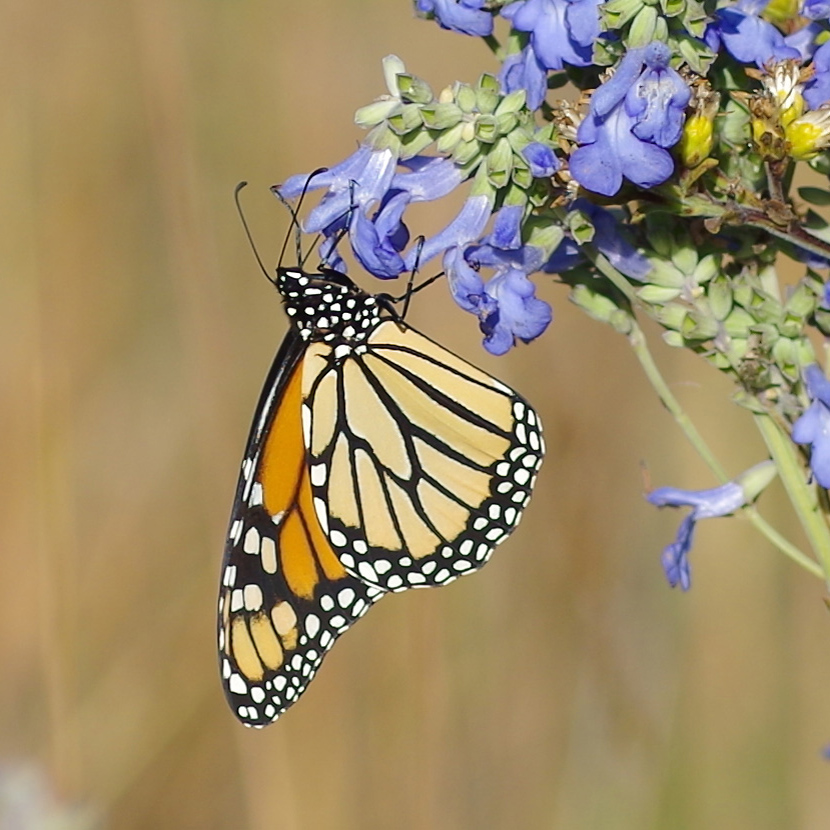
MONARCHS – There’s a time, as the Blazing star (Liatris) is fading and before the New England aster starts up, when the prairie is yellow, and goldenrod nectar fuels migrating Gen 5 Monarchs on their journey south.
MOURNING CLOAK – The migratory/Super generation of Monarchs lives a long time – emerging here in late August, overwintering in the mountains west of Mexico City, and getting at least part of the way back to Wisconsin in spring. Mourning Cloaks live even longer. A graph at the wisconsinbutterflies.com website shows that sightings start in early March and run through the start of November, but unlike other species that produce several generations to span each season, there’s only one generation of Mourning Cloaks per year.
The Mourning Cloaks of spring have overwintered as adults, and as their caterpillar host plants (mainly willow, elm and birch) green up, they feed, breed, lay eggs, and die. Their eggs hatch and their caterpillars feed and pupate, and the butterflies emerge around the summer solstice. They feed for a while and then tuck themselves into a sheltered place to aestivate (become dormant) through the heat of summer. Yes – they start flying before the parade of spring flowers has begun, and yes, the next generation sleeps through the flowers of summer, but Mourning Cloaks are mostly indifferent to flowers. They get minerals from mud; they feed at sap drips (they’re often seen in the sugar bush in early spring, but they can become dormant again if winter revisits); they like rotting fruit, dung, and the honeydew produced by aphids, and they check the feeding holes created by Sapsuckers. By the time they lay eggs the next spring, they’re about 11 months old.
FIERY SKIPPER – Good things come in small packages – this dynamite little butterfly is about an inch long, with an inch-and-a-half wingspread. Fiery Skippers are a mainly-Southern species that filters north into Wisconsin by mid-summer – a long haul on those short wings.
LARGE MILKWEED BUGS (these are nymphs) come in Large, Small, and False. They’re in the Seed bug family Lygaeidae; they make their living by inserting their beak into the seeds within a milkweed pod, pumping saliva in to soften them, and sucking out the juices. They’re very social and don’t mind sharing a good food source, and it’s possible that adults send out some kind of chemical signal to attract other adults. Adult Large milkweed bugs can survive on non-milkweed seeds, but their nymphs can’t. They aren’t considered a pest unless you’re growing milkweed for seed, and they make a spectacular splash of aposematic/warning color https://bugguide.net/node/view/2440573/bgimage.
Birds migrate, Monarchs and Common Green Darner dragonflies migrate, and so do Large milkweed bugs! It’s too cold here in God’s Country for them to overwinter in any form, so they repopulate the state in spring, after the milkweed is up. As with some birds, northern populations are long-distance migrants (and have longer wings to prove it) and southern populations don’t stray far from home.
A BUMBLE BEE busy collecting pollen for a brood that will not survive the winter.
The FALSE MILKWEED BUG looks like a Small milkweed bug (https://bugguide.net/node/view/2361061), and it’s even in the same genus, but it’s not sitting on milkweed. The BugLady usually finds them excavating the seeds of Ox-eye sunflower, aka the False sunflower. One note at bugguide.net says that if they checked their collection of Small milkweed bug pictures, they’d probably find a bunch of misidentified False milkweed bugs. Nice video of False milkweed bugs multi-tasking at the original BOTW, here https://bugoftheweek.com/blog/2021/7/16/false-milkweed-bug-aka-false-sunflower-bug-lygaeus-turcicus. Their doppelgangers are poisonous/distasteful due to the toxic milkweed sap they ingest. False milkweed bugs are adorned in aposematic coloration, but as far as the BugLady knows, they are not poisonous/distasteful. Are they cashing in on predators’ predisposition to avoid red/orange and black?
ANT FLIGHT – A hatch of royal ants emerged from their digs in the pressure-treated wood at the edge of the hawk tower’s deck (not reassuring). The royal dance attracted to the deck three tree frogs that usually live around the base of the tower and perch on prairie flowers.
This FORK-TAILED BUSH KATYDID joined the BugLady on the tower and lingered for a portrait. The large curved structure, aft, is her ovipositor (the male has the “forked tail”). She inserts her eggs into a leaf edge, between the upper and lower surface of the leaf, or lays them on twigs or leaves. And there’s nothing out on the prairie that’s cuter than her jaunty, little nymph https://bugguide.net/node/view/693504/bgimag, https://bugguide.net/node/view/2143463/bgimage. The BugLady is far more likely to see a Fork-tailed bush katydid than to hear one – as this site says, “Pffftt!” That’s all it is. There can be a lengthy pause between songs” https://www.listeningtoinsects.com/fork-tailed-bush-katydid.
BLACK AND YELLOW ARGIOPES, like some of the other orbweavers, get pretty hefty by the end of summer, alarming some folks. “Where did those huge spiders come from?” they ask. Answer – they’ve been here all along. They were smaller than the brightly-colored heads of push pins when they emerged from their egg sac in spring, and they’ve been eating ever since.
This TREEHOPPER’s thorn disguise would be more effective if it were sitting in vegetation. Just sayin’.
BUCKEYE BUTTERFLY – Buckeye caterpillars https://bugguide.net/node/view/1737799/bgimage pick up a group of chemicals called iridoid glycosides from their foodplants. These chemicals stimulate their appetites so they eat and grow fast, but have the opposite effect on their predators, stunting their growth.
Buckeyes are migratory, too, moving along coastlines and rivers, flying to the Deep South with a tailwind in fall and returning to us (a few generations later) in spring, with males arriving first.
Fun Fact about Buckeyes: flowers may change in appearance after being pollinated – maybe a clue as small as a localized color change. Researcher Martha R. Weiss did an experiment that demonstrated that a wide variety of wasp, bee, fly, and butterfly pollinators (including Buckeyes) can discriminate between “pre-change” and “post-change” flowers, and so can see which flowers will be more rewarding to visit – a win for both flowers and butterflies.
Bonus points if you know where the Benét quote came from.
The genus Micrathena (the spiny orbweavers) includes about 100 species of woodland spiders, mostly of the New World tropics. Females spin classic, vertical, disc-shaped trap webs and rest on them. The closely-placed (“tightly coiled”) strands of their webs tell us that they are after small prey like tiny moths, gnats, and mosquitoes. One source calls them “tiny, ornate exterminators.” The female consumes the (protein-rich) circular portion of her web at the end of each day and rebuilds on the original framework the next morning. One author postulates that the genus name comes from the fact that the goddess Athena was skilled at spinning and weaving.
There are four species of Micrathena north of the Rio Grande, all of them pointy, which is thought to be a defense against predators. One author described feeling a “deer fly” on his neck and slapping it – hard. It turned out to be a Spined Micrathena, and the force of the swat caused the spines to puncture his skin.
The SPINED/SPINY MICRATHENA/CASTLEBACK ORBWEAVER/SPINY-BELLIED ORBWEAVER (Micrathena gracilis) is found from the Atlantic to the Great Plains, including southern Canada and into Central America. They live in woods, especially oak-hickory woods, and most especially woods near water. They spin webs in open places in those woods and are famous for throwing a long dragline (escape line) from their webs across trails, to the annoyance of hikers.
The spiders are small, and so are their webs – they range from three to almost eight inches in diameter and are suspended four to seven feet above the ground in the shade https://bugguide.net/node/view/65966/bgimage. Webs are generally vertical but could be tilted by 45 degrees. Despite the fact that she will reuse the old framework when she spins her daily web, these spiders are known to wander and will move to a different site every six or seven days.
Females hang “belly up” from the center of the web, camouflaged from both above and below (predators from above see the dark ventral side against the ground, and predators from below see the lighter dorsal side against a dappled sky), monitoring the vibrations of the strands. The Arkansas Arthropod Museum’s article on the Spined Micrathena describes her actions as “slow and clumsy” when an insect hits the web and says that many insects escape. Most orbweavers wrap and incapacitate their prey before biting them and injecting the meat tenderizer, but Micrathenas will bite first and then wrap https://bugguide.net/node/view/716837/bgimage.
Males spin webs as young spiders, but not after they mature – then they hang out near a female’s web, waiting to make their move. Males spin “courting threads” and woo her from there, treading carefully to avoid being eaten in the process (but if they are, their protein will contribute to the development of their eggs). Females create a fluffy egg sac and attach it to nearby vegetation before they die, and the spiderlings exit the egg sac in spring.
There’s a spider called the Labyrinth/Colonial orbweaver (Metepeira incrassata) that lives in multigenerational colonies with its own kin (hundreds and even thousands of individuals) and tolerates other species of spiders on their communal webs. The Spined Micrathena is one of the species that coexists on the borders.
FUN FACT ABOUT THE SPINED MICRATHENA: Do spiders make noise? Not many spiders do, but the Spined Micrathena is one of them! Spiders have respiration organs called book lungs, and the covers of the book lungs are located on the spider’s undercarriage, just south of where the spider’s front section (the cephalothorax) meets its abdomen. When it’s disturbed, a Spined Micrathena can flick its cephalothorax up and down rapidly, which causes the base of the femur to rub on files on the book lung covers, and presto – stridulation (sound made by friction) (like grasshoppers)! The resulting buzz/hiss can be heard by humans up to about two feet away and is thought to be a defensive sound.
The BugLady has always wanted to see a trig, because – what an interesting name for an insect (a name, it turns out, that’s a shortened version of its family, Trigonidiidae). Trigs, members of the grasshopper/cricket/katydid order Orthoptera, are also called Sword-tailed crickets and Winged bush crickets. They’re crickets, but they’re not in the same family as the common, black field crickets of fall (family Gryllidae). The BugLady still wants to see a trig – these pictures were taken by BugFan Dave, who’s finding some very cool things as he rehabilitates his property with native plantings (and he’s having fun and photographing the heck out of it, too!). Thanks, Dave!
Trigs are smallish crickets that live in leafy spots in grasslands, edges, wetlands, and woods east of the Rockies, usually close to the ground. There are 19 species of trigs in North America, and they come in brown, green, and Handsome/Red-headed https://bugguide.net/node/view/2401012/bgimage.
SAY’S TRIG (Anaxipha exigua) (Anaxipha means “upraised sword”), in the brown trig genus Anaxipha, lives in the lower levels of the vegetation in the northeast quadrant of the continent. Along with wetlands and grassy areas, it likes honey locust trees (and, apparently, Dave’s house). Adults and nymphs https://bugguide.net/node/view/867950/bgimage are seen from mid-summer on, disappearing as fall progresses.
It’s one of the larger trigs, with males measuring about ¼” long, and females a shade longer, both with a lovely, stripey head. Dave’s trig was a male, with two unsegmented, sensory appendages called cerci (singular: cercus) at its rear. Females have two cerci plus an upcurved ovipositor (hence the name “sword-bearing cricket”) https://bugguide.net/node/view/697120/bgimage. Most trigs have short wings, but some are macropterous (have longer wings) https://bugguide.net/node/view/1880530/bgimage.
Like other trigs, the Say’s Trig is an omnivore, feeding on vegetation, insect eggs, and small, soft-bodied insects. They are fed upon by birds and other critters that prey on insects. The BugLady is always startled to be reminded that omnivory is not uncommon in the grasshopper/cricket bunch.
They have the ability to climb up the sides of collecting jars like a spider – but not like your average cricket.
Males make sound by stridulation – rubbing bumps/pegs (the file) on the forewing against a sharp edge (the blade) on the hind wing. In fact, one way to ID Say’s trigs is by counting the number of bumps/pegs on the file (Say’s trigs’ files have about 190 teeth). If you’re going to make noise, you need to hear it, too, and they have hearing organs (tympanums) on their front legs that allow them to detect vibrations.
They sing continuously and may sing day or night. The song is a trill http://minnesotaseasons.com/Insects/Says_trig.html (scroll down), that’s described as “high and shimmering,” “ a continuous, fast tinkle,” “pulsing at 35 – 40 per second,” “very loud for such a small insect,” and “can be heard from one hundred or more feet away.” The BugLady usually has to turn the volume way up and cup her hands behind her ears to hear some of the crickets and katydids on recordings, but she can hear this one. In lower temperatures, the song is slower, and in warmer weather, the song may be higher-pitched. Nearby tree crickets (from yet another cricket family) sing at a lower pitch. Males like to perch above the ground when they sing, concealed by a leaf, so they’re impossible to spot.
Nota Bene: remember that trigs exist deep in the vegetation, where the shelter of leaves creates a “microclimate” in which light and sound levels, humidity and precipitation, temperature, and wind speeds may differ from areas just a few feet away (the concept of microclimates is oh-so-important to the understanding of ecology).
Typically, when insects like flies, bees and wasps, beetles, butterflies and moths, and a few others – insects with Complete metamorphosis (egg, larva, pupa/resting-changing stage, adult) – mature, they not only take on a new form, but they also adopt a new menu and a new place to live. One constant in the BugLady’s firmament has been that, as the exception that proves the rule, adult lady beetles eat aphids, and immature/larval lady beetles eat aphids, too.
Vegetarian lady beetles??? Thanks to BugFan Tom, in the Deep South, for providing both the education and the pictures.
Disclaimer: Squash lady beetles, aka Squash beetles, are not the same as squash bugshttps://bugguide.net/node/view/2026342/bgimage, no matter how interchangeably the BugLady uses the terms. But, when you Google Squash beetle, you’re soon awash in hits for Squash bugs.
Squash lady beetles (Epilachna borealis) are in the Lady beetle family Coccinellidae and the Plant-eating Lady beetle subfamily Epilachninae. There are three North American species in the genus Epilachna, and a lot more elsewhere. Squash lady beetles are found in many of the states from Texas to Massachusetts, but not in Wisconsin https://bugguide.net/node/view/61612/data, and they’re said to be more abundant along the Atlantic Seaboard.
So, what about that diet? Most lady beetles are carnivores, stalking small, soft-bodied invertebrates over the plant leaves. They (inadvertently) aid farmers by eating the things that eat the crops. Squash lady beetles feed on the crops – cucumbers, melons, zucchini, gourds, pumpkins, cantaloupe, and squash. Both the bristly, little larvae (whose spikes have spikes https://bugguide.net/node/view/341984) and the adults eat the tender tissue between the leaf veins (the larvae only feed on the underside of the leaves https://bugguide.net/node/view/265041/bgimage), but they may graduate to the rind of the fruits when the fruits appear, chewing patterns that remind the BugLady of crop circles (yes – squashes and melons are considered fruits because they develop from the flower’s ovary and contain seeds).
Squash lady beetles are featured on a whole bunch of Extension Agricultural Bulletins, and although some sources say that they don’t get numerous enough to become pests, cosmetic damage due to their feeding may make produce less sale-able. Worst possible scenario – leaves skeletonized by large numbers of larvae don’t photosynthesize as readily, plants don’t thrive, and they produce fewer fruits.
Before they tuck into a leaf or rind, the beetle chews a spiral “trench” around the feeding area, a habit that has had scientists scratching their heads. Originally, it was thought that the trench, like the small, upstream cuts made by dogbane leaf beetles, worked to minimize the plant sap in the area. Scientists speculated that the chemicals in the sap (cucurbitacin), and the sticky sap itself, hindered feeding.
The BugLady found a couple of papers about this. One researcher, writing in 1985, concluded that both adult and larval feeding on leaves triggers cucurbitacin in the injured leaf and in its neighbors, and that cucurbitacin repels the lady bug and may stunt the larva, and that the trenches serve to block the movement of the chemicals, temporarily.
A second paper in 1995 (and the author of the first paper was a co-author of the second) concluded that feeding by the Squash lady beetle did not cause a build-up of cucurbitacin, that the presence of cucurbitacin actually stimulates the beetles to feed, and, in fact, ingesting it doesn’t affect the larvae. It suggests instead that the trenches may act as dams against the plant’s sticky sap, which gums up the beetle’s mouthparts.
Squash lady beetles overwinter as adults under tree bark or under leaf litter at the edge of an agricultural field. They hike/fly back into the fields when the squash plants are leafing out, feed on the leaves for a while, find romance, and then oviposit on the leaf or vine in July, laying as many as 400 eggs, in clusters of about 45 https://bugguide.net/node/view/547304/bgimage. The larvae feed, then pupate, on the underside of the leaf, and emerge in late August. Adults feed for a few weeks before leaving the field and finding a sheltered spot for the winter.
They have a Super Power.
Like “regular” lady beetles, they “bleed” from their leg joints when alarmed (reflex bleeding), and that blood repels other insects. And, oily droplets on the end of the larva’s spikes repel insects. And, oily drops on hairs on the pupae deter ants. Despite the chemical protection, stink bugs and assassin bugs prey on them, tachinid flies parasitize them, and lady beetles – including other Squash lady beetles – may eat the eggs.
The BugLady took to the trails this summer as much as her shiny, new knee and the oppressive heat and humidity allowed (her preferred maximum temperature is 72 degrees. The gods didn’t cooperate). Here are some of the bugs she found.
BLUE DASHER OVIPOSITING – A female Blue Dasher bobs up and down as she looses eggs into the water. Blue Dashers don’t oviposit “in tandem,” with the male guarding her by maintaining his grip at the back of her head, but the male stays close, flying around her as she dips the tip of her abdomen into the water, and chasing off rival males that would carry her away.
CABBAGE BUTTERFLY ON PURPLE LOOSESTRIFE – A dainty, white butterfly on a pretty, fuchsia flower. Both are non-native (hint: the butterfly’s caterpillar is known as the European cabbage worm), and both are “naturalized,” that is, having been introduced and/or having escaped into the wild, they are doing very well on their own, thank you. Only a very small percentage of non-native, naturalized species go on to create problems and to get a third label – “invasive.” For a nice discussion, see https://www.hrwc.org/invasive-non-native-or-naturalized/.
EASTERN PONDHAWK AND MEADOWHAWK – It’s a dragonfly-eat-dragonfly world out there.
MILKWEED TUSSOCK MOTH AND CRAB SPIDER – The BugLady has been receiving some queries recently from BugFans whose milkweed is looking pretty ratty. The culprit? The Milkweed tussock moth https://bugguide.net/node/view/72813, whose caterpillar is sometimes called the Harlequin caterpillar. Mom lays masses of eggs, and the caterpillars feed gregariously for a while, skeletonizing leaves by eating the tender tissue between the leaf veins. Then they go their separate ways and eat the leaves down to their midribs. Bugguide.net says, in an understatement, that the caterpillars “May defoliate patches of milkweed.”
Allegedly, they don’t interfere with Monarch caterpillars because they eat the old, leathery leaves that the monarchs don’t, and because they’re gearing up as the Gen 5 Monarchs are readying themselves for their trip south.
No, the BugLady did not see the crab spider, and what looks like an egg sac, when she took the picture.
PICTURE-WINGED FLY – This spiffy fly (genus Rivelli, family Platystomatidae) walks around, twitching its wings constantly, sending semaphore signals to nearby females. For its story, see https://uwm.edu/field-station/bug-of-the-week/signal-fly/ (only, the BugLady misspelled the family name). What a treat to watch this little fly strutting his stuff!
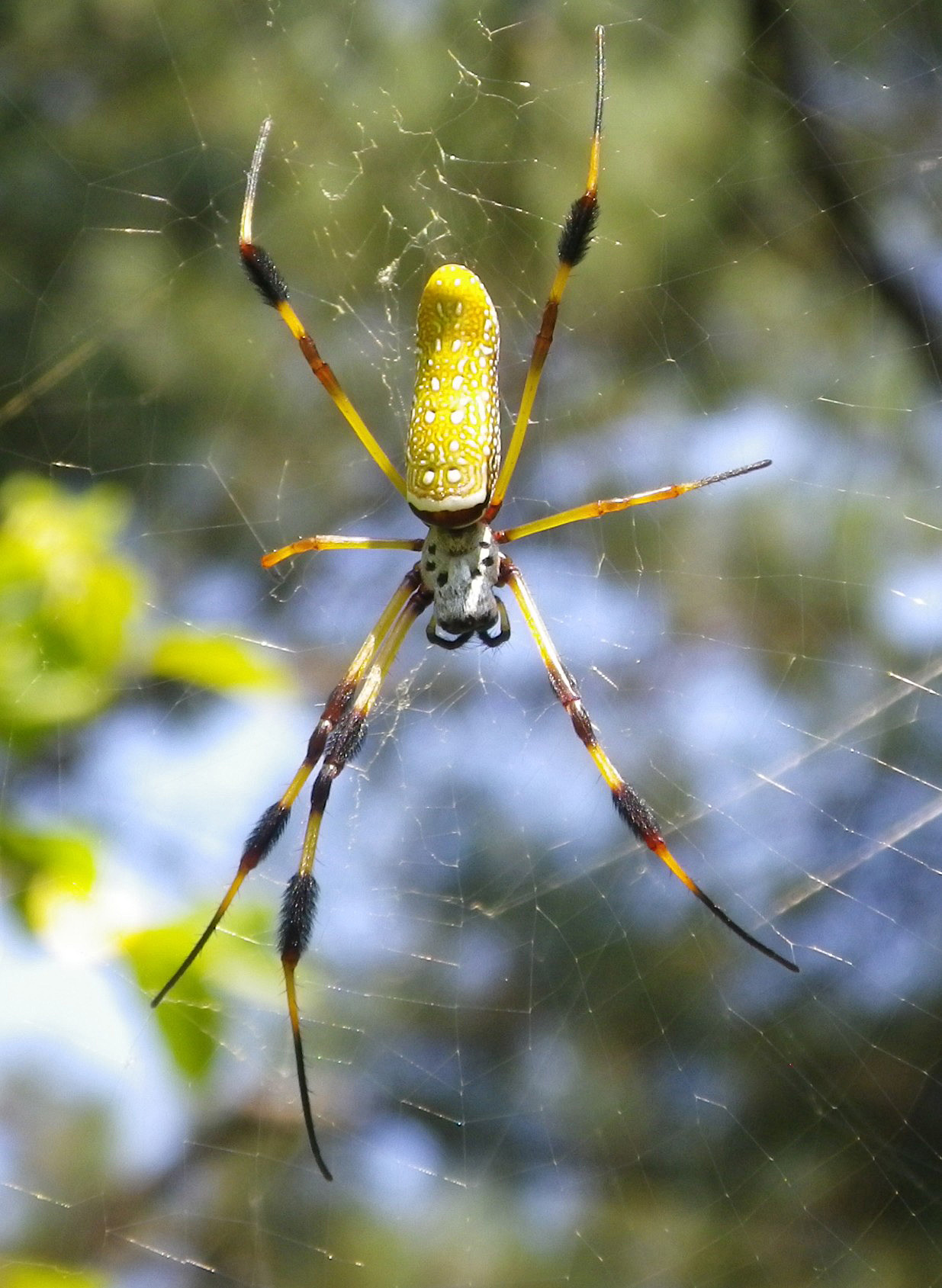
WOOD/AMERICAN DOG TICK – Yes, they’re everywhere (they prefer grassy areas and forest edges), and yes, most people feel creepy just looking at a picture of one, feeling the phantom feet of phantom ticks tickling their skin. Dog ticks need three different hosts to get through their life cycles, and they can spread Rocky Mountain spotted fever as well as Tularemia (but if your dog comes down with Tularemia, it may be playing with the local bunnies). Various sources say that Wood ticks in Wisconsin don’t often carry diseases and that Rocky Mountain spotted fever (or any Spotted fever rickettsiosis) are (for now) rare here. They don’t spread Lyme disease.
VIRGINIA CTENUCHA CATERPILLAR –Lepidopterists say that the more spectacular the caterpillar, the more homely the adult, and vice versa The Virginia Ctenucha moth is one of the exceptions that proves the rule https://bugguide.net/node/view/1991557/bgimage.
The caterpillars are out and about early – this one was photographed in May, but they overwinter as caterpillars, and the BugLady encounters them strolling along on the warm road on a warm day in late winter or early spring. Adults are large-ish, day-or-night-flying moths that tuck in under a leaf when alarmed. The “C” is silent. –
WOOLLY ALDER APHIDS AND THEIR ANTS – We’ve seen it before – aphids going about their business, assisted by ants that protect them them in exchange for being able to “milk” them for honeydew, a sugary fluid that is a byproduct of the sap that flows through the aphids when they eat. Honeydew is an important carbohydrate for the ants that farm aphids and treehoppers. If you’ve ever seen a leaf whose upper surface looks shiny and sticky, look up under the overhead leaves – they’re probably occupied by aphids. Bees, wasps, flies, and other insects will visit the leaf to eat honeydew. The woolly aphid’s wool consists of waterproof, waxy filaments made in glands in the aphid’s abdomen.
EMERALD ASH BORER – They really are lovely, little beetles, with a surprise splash of crimson when their wings are spread https://bugguide.net/node/view/1522143/bgimage. But the extensive tunnels (called galleries https://bugguide.net/node/view/687825/bgimage) that the larvae make below the bark disrupt the ash tree’s plumbing so that it can’t pump nutrients between its roots and crown.
SEDGE SPRITES – One of the BugLady’s favorite damselflies, these little beauties are scarcely an inch long.
WEEVILS ON PURPLE PRAIRIE CLOVER – Purple prairie clover is a lovely, native tallgrass prairie plant. The early settlers on the Great Plains nicknamed it “Devil’s shoelaces” because this skinny, two-foot-high plant may have roots that are six feet long – roots that grew deep enough to reach through the thick prairie sod to find water. That magnificent sod resisted the settlers attempts to plow it with their small, cast-iron plows until 1837, when John Deere invented the steel moldboard plow, which he fashioned from an old sawmill saw.
ROBBER FLY – Remember, bumble bees are vegetarians, so if you see a bumble bee with prey, it’s not a bumble bee. Mimicking a bumble bee is a pretty good survival strategy – no one messes with bumble bees. This fly is in the genus Laphria, one of the “bee-like” robber flies. Their larvae live in rotten wood and feed on insects they find there, and the adults often prey on beetles (though the BugLady saw one make a pass at a Sulphur butterfly once). Robber flies come in a variety of sizes and shapes – for information about Wisconsin robber flies (and butterflies and tiger beetles) see https://wisconsinbutterflies.org/butterfly.
RED-BELTED BUMBLE BEES – are found west of the great plains and across southern Canada and our northern tier of states. They are one of the short-tongued bumble bees, which means that they prefer “flatter” flowers like clovers, thistles, goldenrods, and asters. The BugLady doesn’t know where this one was hiking to – she saw several others on flowers in the area. A little rusty on bumble bees? Here’s a great bumble bee guide from the Xerces Society: https://www.xerces.org/publications/identification-monitoring-guides/bumble-bees-of-eastern-united-states
Go outside, look at bugs,Professor, Dr. Richard B. Fischer, the content of whose fantastic natural history courses she uses Every! Single! Day! (right BugFan Mike?) He would have enjoyed BOTW.
The Photo Club meetings are friendly and informal, with a brief discussion of upcoming activities, a short program and conclude with the opportunity to share and discuss photos. You’re welcome as a photographer, regardless of your skill level.
Ages 18+ | No pre-registration required.
Photo club meetings are always free to attend!