One of the fantastic Riveredge volunteers, who has been exploring Riveredge trails for years to both take photographs and record observations, is letting us know what she sees blooming at Riveredge. In scientific terms, this is called “Phenology.” What is phenology? It’s very similar to another word, phenomenon. Phenology means what happens, and when, in nature. Some of the most common examples are: when flowers are blooming, when buds are present, when specific migratory bird species return, when birds are nesting.
Chances are, you already notice phenology you just might not call it that. If you notice when your garden is blooming, when the trees are budding, or when butterflies return to the skies – you’re observing phenology! Read below to learn what you can find along the trails when you visit Riveredge Nature Center right now.
In Bloom
Trout Lily is easily identified by the speckled leaves.
Pasque Flower
Penn Sedge
Bloodroot
Hepatica
Spring Beauty
False Rue Anemone
Cut Leaved Toothwort
Dutchman’s Breeches
Marsh Marigold
Leatherwood
White Trout Lily
Blue Violet
Spring Cress
Wild Ginger
Wood Anemone
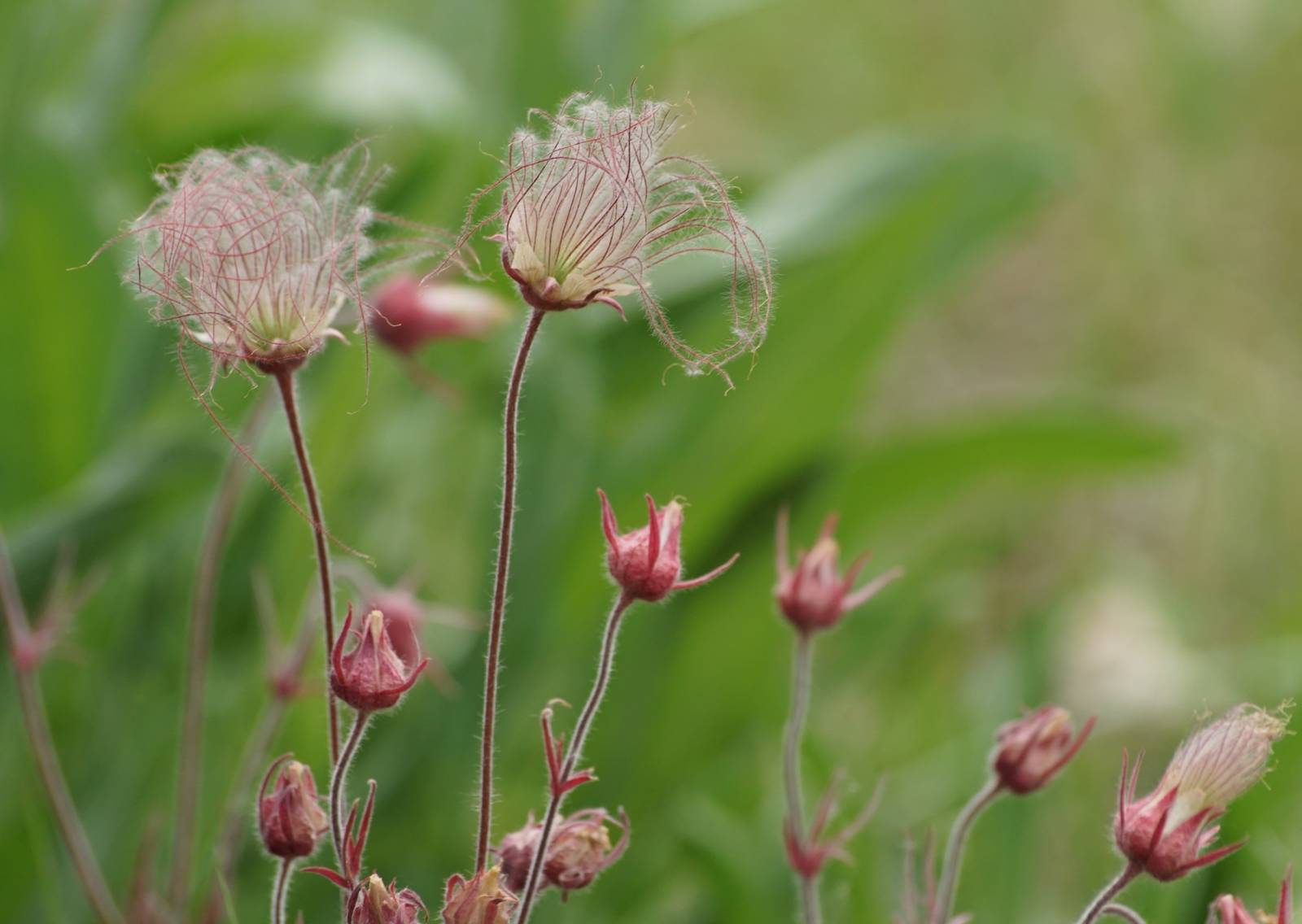
Prairie Smoke
Swamp Buttercup
Prairie Buttercup
Large Flowered Trillium
In Bud
Prairie Shooting Star
Bastard Toadflax
Blue Cohosh
Wood Betony
Draba
Kidney Leaved Buttercup
Wild Blue Phlox
Dwarf Ginseng
Jacob’s Ladder
Heart Leaved Golden Alexander
Shooting Star
One of the fantastic Riveredge volunteers, who has been exploring Riveredge trails for years to both take photographs and record observations, is letting us know what she sees blooming at Riveredge. In scientific terms, this is called “Phenology.” What is phenology? It’s very similar to another word, phenomenon. Phenology means what happens, and when, in nature. Some of the most common examples are: when flowers are blooming, when buds are present, when specific migratory bird species return, when birds are nesting.
Chances are, you already notice phenology you just might not call it that. If you notice when your garden is blooming, when the trees are budding, or when butterflies return to the skies – you’re observing phenology! Read below to learn what you can find along the trails when you visit Riveredge Nature Center right now.
Flowers Blooming
False Rue Anemone is an early spring bloom.
Pasque Flower
Bloodroot
Hepatica
Spring Beauty
False Rue Anemone
Cut Leaved Toothwort
Dutchman’s Breeches
Marsh Marigold
One of the fantastic Riveredge volunteers, who has been exploring Riveredge trails for years to both take photographs and record observations, is letting us know what she sees blooming at Riveredge. In scientific terms, this is called “Phenology.” What is phenology? It’s very similar to another word, phenomenon. Phenology means what happens, and when, in nature. Some of the most common examples are: when flowers are blooming, when buds are present, when specific migratory bird species return, when birds are nesting.
Chances are, you already notice phenology you just might not call it that. If you notice when your garden is blooming, when the trees are budding, or when butterflies return to the skies – you’re observing phenology! Read below to learn what you can find along the trails when you visit Riveredge Nature Center right now.
Flowers Blooming
Pasqueflower blooming on the prairie. Interestingly, the plant is named for the Passover, as it generally blooms at about the same time as the celebration.
Skunk Cabbage
Pasque Flower
Penn Sedge
Bloodroot (1 plant)
Hepatica (1 plant – pictured first in this post)
Flower Buds Present
Marsh Marigold when flowering…not quite there yet!
Spring Beauty
False Rue Anemone
Dutchman’s Breeches
Spring Cress
Marsh Marigold
Sprouting/Leaves Present
The Blue Flag Iris aren’t this showy at this point, but keep an eye out for them near water sources.
Wild Geranium
Cut-leaved Toothwort
Angelica
Stinging Nettle
Shooting Star
Blue Flag Iris
The BugLady was checking around the edge of a gravel parking lot near the Ozaukee Washington Land Trust’s Lake Twelve property (because there are bugs there, too) when she found this beauty (it took two trips and two different cameras to get a few almost-in-focus shots – sometimes it’s like that).
She had two immediate reactions: 1) what is it? And 2) it looks like an octopus clinging to a reef!
It’s a crab spider in the tree crab spider genus Tmarus, probably Tmarus angulatus (thanks, as always, to BugFan Mike). Mike says that there are a few documented records of this species in Wisconsin, but they are probably more common, it’s just that we don’t typically hunt for spiders in trees. And, of course, they seem to have the “camouflage” thing figured out.
Crab spiders (family Thomisidae), best known for the species that ambush insects on flower tops, are long-time favorites of the BugLady https://uwm.edu/field-station/an-album-of-crab-spiders/. They get their name from their tendency to hold those four, extra-long front legs in a crab-like pose and for their tendency to move sideways. Crab spiders don’t spin trap webs to catch their prey, they ambush it on the hoof. They paralyze their prey and then introduce (bugguide.net says “vomit”) digestive enzymes into it, wait for its innards to soften, suck out the tenderized tissue, and throw away the empty.
They do spin silk, protecting themselves from a fall by playing out a drop line as they hunt, and this Tmarus spider was guarding her eggs in a chamber she created by bending and webbing together a slender day lily leaf. She will stay nearby for about a month to protect her eggs from predators.
About the genus Tmarus the BugLady could find very little. The spiders appear regularly on state biodiversity lists, and there are a bunch of scholarly articles about new species being discovered in different countries around the world (one article from Sri Lanka was titled “Twigs that are not Twigs”). The BugLady was gratified to find that the spectacular Tmarus marmoreus spider in Australia is, indeed, nicknamed the Octopus spider https://www.brisbaneinsects.com/brisbane_spiders/OctopusCrabSpider.htm. It hunts by dangling from a line of silk with its front legs poised and ready.
Their knobby bodies are usually well-camouflaged on bark and other vegetation, where they look like buds or broken twigs. The Field Guide to the Spiders of California and the Pacific Coast States tells us that with “forelegs along either side of a stem, they wait for an insect to wander between them.” According to the Kansas School Emporium’s Checklist of Kansas Crab Spiders, Tmarus spiders have been observed eating ants, which most spiders avoid.
Tmarus angulatus, sometimes called the Tuberculated crab spider,is small spider with a body about a half-inch long (females are larger than males) that is found across the US and southern Canada. Some are pale and some were dark, and the BugLady saw a picture of a gravid female with a dark cephalothorax (front end) and a pale abdomen, with a caption that said that she looked like a spittlebug nest. Well, maybe. Here’s a little gallery of shots of Tmarus angulatus looking like the flower head of a rush https://bugguide.net/node/view/646754,
Tmarus angulatus was described and named in 1837 by Baron Charles Athanase Walckenaer (1771 – 1852), who is described as a French civil servant and scientist. In fact, he squeezed the pursuits of several lifetimes into his 80 years. He was a geographer who was named Conservator for the Department of Maps at the Royal Library in Paris, was Secretary for life of the Academie des Inscriptions et Belles Lettres (where he introduced the French to the English genre of the biography), was a co-founder of the Societe entomologique de France, member of a group of early anthropologists called the Societe des observateurs de l’homme, was mayor of a section of Paris, found a map of the Americas drawn by Columbus contemporary Juan de la Cosa (the earliest known map of the new World), and was an arachnologist and entomologist (author of Histoire naturelle des insects).
The BugLady is always excited when she finds an insect she’s never seen before – even more so when it’s a giant, orange and gray “Holy S@#&!” beetle.
She was moseying along the trail at Riveredge Nature Center at the beginning of July when she saw a flash of orange in the vegetation. A big flash. She craned and fidgeted and crossed her fingers while the beetle crawled around, revealing itself by degrees. After posing for a few shots, it flew out noisily and landed on her jeans for a second, and then moved on.
It’s a spectacular beetle, (Dr. John Hamilton, writing in The Canadian Entomologist in 1885 says that “this appears to be a rare Cerambyan, and among the choicer.”), but there’s not much information out there about it (it isbig enough and beautiful enough, but apparently, it’s not bad enough to warrant attention).
At 1 ¼” the Majestic long-horned beetle (Stenocorus schaumii) is indeed majestic. It comes in two colors (https://bugguide.net/node/view/1499994/bgimage) and some are more chiseled than others https://bugguide.net/node/view/6759/bgimage (the BugLady’s MLHB was not svelte), and females are notably larger than males. It is mostly eastern-ish – bugguide.net says New Brunswick to North Carolina to Manitoba to Oklahoma. A number of the search hits were from eastern Canada, in French.
Cerambycid larvae are vegetarians; some are pests of living plants, some feed inside dead or dying wood, and the interests of many do not collide with ours. MLHB larvae feed/develop in ash, beech, maple, serviceberry, and other hardwoods, and the adults eat nectar and pollen.
The MLHB was described by LeConte and is one of several insects named for German entomologist Hermann Rudolf Schaum, a go-to guy for all-things beetle in the mid-1800’s, who wrote and corresponded prolifically with American entomologists. Schaum apparently believed that the Continent should be the clearinghouse for insect classification. In a history of American entomology called Brethren of the Net: American Entomology, 1840-1880, author Willis Conner Sorenson tells us that “Schaum…..objected to the notion that ‘American insects ought to be described by American entomologists.’ The result, he said, had been the proliferation of isolated descriptions, a practice that had been characterized by Schaum’s colleague Erichson, as ‘the nuisance of science.’ Schaum regretted that American entomologists had added to this nuisance.”
The BugLady wrote this article for a recent newsletter of the Friends of the Cedarburg Bog (an organization that would love your support).
Slime molds are strange and wonderful life forms that can exist as tiny, single cells, but can also form a mass of cells that acts like an organism – and moves!
Back in the days when fungi (now placed in their own Kingdom) were classified as plants, slime molds were classified with the fungi. Today, slime molds defy exact classification (slime molds can’t be plants because slime molds eat!). They’re placed in a catch-all group that some people call the kingdom Protista, made up of often unrelated single-celled or colonial single-celled organisms that have similar structures and life styles. Australian researcher Chris Reid calls Protists “a taxonomic group reserved for everything we don’t understand.” They’ve been around for a billion years.
They may be so small that they live their whole lives under our radar, moving slowly through the soil; or they may aggregate to form bright yellow or white, spongy blobs on the forest floor, or pink spheres on decaying wood, or tiny, brown cattail shapes on branches. Or, they might start as the first and end as the second. They have great names, like wolf’s milk, tapioca, pretzel, white coral, red raspberry, chocolate tube, dog vomit and scrambled egg slime.
dog vomit slime mold
chocolate tube slime
wolf’s milk slime mold
Two of the main groups are the cellular slime molds (Dictyosteliida) and the plasmodial or acellular slime molds (Myxogastria). Both kinds start out as tiny, single-celled amoeba-like critters in soil or rotting material, both can use chemicals to communicate, and both, at some sign from their environment, may congregate and go into reproductive mode, transforming from a single-celled organism to a giant “megacell” (one scientist calls them “a bag of amoebas”). They feed on bacteria, algae, and fungal spores and help organic materials to decompose. They are eaten by many small animals (there are little, shiny, brown beetles apparently feeding – and cavorting – in the pink slime mold), and some are said to be edible by humans.
Their orientation is deliberate; their ability to pick the most direct route to food mimics the efficient layout of expressways and railroad systems; they were the inspiration for the Sci-fi movie “The Blob;” the math that describes their orderly aggregation is applied to video games; and some can anticipate change, learn to solve mazes and remember. And when they are chopped up, they reassemble and remember.
The BugLady loves these fancy little flies (and their habitat preferences, for the damp and the dappled, are similar to hers). Dance flies are abroad in June, and they are one of the BugLady’s “nemesis bugs;” they seem to object to being in focus, but this small spider managed to capture one. They starred in a BOTW episode at the very end of June, ten years ago: https://uwm.edu/field-station/dance-fly-family-empididae/.
Go outside – look at bugs. Tell the BugLady what you see.
As long-time BugFans know, the BugLady gets a kick out of weevils. She found these cute little Iris weevils (Mononychus vulpeculus) recently, scampering around on flowers at the Ozaukee Washington Land Trust’s Cedarburg Environmental Study Area (CESA) site (for directions to and maps of their properties, see https://owlt.org/visit-our-preserves). Obviously, iris weevils are not exclusive to iris – the BugLady sees them on ox-eye daisy and daisy fleabane (she did find two of them sitting on an iris petal that had tiny holes punched in it, but they were camera shy). Iris weevils were half of an episode about weevils that was posted four years ago https://uwm.edu/field-station/gardening-with-weevils/.
Spring flowers are flourishing right now at Riveredge! These are known as ephemerals, meaning they won’t last long – so get here to experience these beauties soon!
Great White Trillium Trillium grandiflorum has been blooming for a few weeks along the Milwaukee River trails. “But that flower isn’t white?!” you say? Indeed! As trillium flowers age, they commonly turn pinkish or purple before the petals wilt.
Golden Alexander Zizia aurea is one of the spring flowers blooming along the trails at Riveredge. It might not be immediately obvious, but this forb is in the carrot family.
Wild Geranium Geranium maculatum is blooming throughout forested areas. This herbal plant has been used for pain relief throughout history.
Another example of Wild Geranium, this image better displays the vascular structure of the petals.
Swamp Buttercup Ranunculus septentrionalis can be found throughout our moisture-rich lowlands. It can easily be confused for Marsh Marigold, but its flowers are much more pointed.
Lesser Yellow Lady’s-slipper Cypripedium parviflorum var. makasin, orSmall Yellow Lady’s-slipper, is one of the more elaborate flowers, so named because of its appearance (the image above may show a better angle of the slipper appearance. Learn about our Native Orchid Restoration Project here.
Sometimes, don’t you just feel like a third slipper?
Blooming Spring Flowers in the Prairie at Riveredge
One Wild Columbine Aquilegia canadensis was observed blooming in a shady spot adjacent to the dry prairie at Riveredge.
Prairie Smoke Geum triflorum is springing up from the soil, but hasn’t yet opened to show the wispy tassels for which it is named.
Prairie Shooting Star Dodecatheon meadia is just beginning to blossom in a few spots. This flower is easy to distinguish because it looks like it’s pointing to the ground.
Melissa Curran of Stantec is the leader of this orchid restoration project throughout the Midwest. She explains to volunteers how to plant orchid seedlings in pots inside the Orchid Shade House at Riveredge.
The Journey of an Orchid Seed
Orchids seeds begin as tiny, difficult to see specks the size of dust, and are dispersed through the wind. Minnesota Landscape Arboretum propagates and provides the seedlings for this project.
Many people may not realize that orchids are native to the Midwest. Orchids throughout this region are terrestrial, meaning that these orchids grow in the soil. Epiphytic orchids, the types that grow with aerial roots, are more commonly known.
Terrestrial orchids have complex fungal relationships, and certain species of orchid seedlings will only grow with the help of certain species of fungus. These species relationships are still a part of the mystery scientists are trying to solve. In the interim, seedlings are raised in a media culture, which provides nutrients and functions as a surrogate fungal connection.
These orchid seedlings grow in clumps and have to be pulled apart delicate care.
A soil combination is mixed, which drains quickly and doesn’t retain more moisture than the plants prefer.
Thank You Orchid Restoration Volunteers!
Thanks to everyone who helped us plant our orchid seedlings! Many hands makes light work – if you’d like to volunteer to help restore orchids throughout the Midwest, learn about volunteering at Riveredge.
One orchid seedling is planted in every pot. These plants will harden off to become acquainted with the natural conditions in the wild inside our Orchid Shade House.
Of course, once the orchids are potted, that ever important ingredient – water! We’re still looking for volunteers to help water these fledgling flowers.
And voila! Two weeks after the initial planting a sea of orchid seedlings sprout their first leaves inside the Orchid Shade House! Some of these flowers will be planted at suitable locations throughout Riveredge. Many of the orchids are destined to be planted throughout the Midwest in habitats where they are likely to flourish, or will bolster or reestablish orchid populations that have existed historically.