Bug o’the Week – Red-shouldered Pine Borer

Howdy, BugFans,

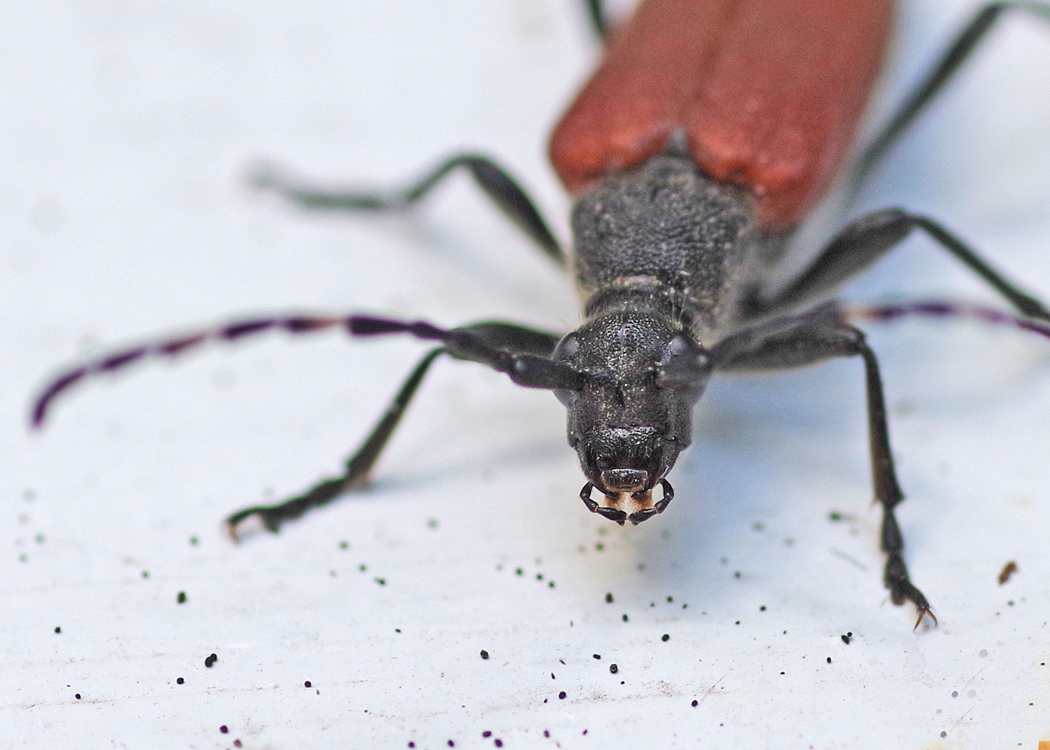
Meet another of the BugLady’s new neighbors, a handsome black beetle with red epaulets called the Red-shouldered Pine Borer.  It came to her front door – well, actually, it was trapped in her front door, between the screen and the raised glass of the storm door, and its rescue involved dismantling the glass/screen assembly with one hand while holding a jar beneath the beetle with the other (empty flip-top Parmesan cheese containers make excellent bug jars).  Five days later, it happened again, with the appearance of the red individual.

Red-shouldered Pine Borers are in the Long-horned beetle family Cerambycidae, so named because of their long antennae, antennae that make them favorites of entomologists (and collectors) everywhere.  Some have spectacular antennae indeed https://blogs.massaudubon.org/yourgreatoutdoors/have-you-seen-this-beetle/ (click to enlarge the picture of this extremely threatening beetle).  Cerambycidae (from the Greek kerambex – beetle – and keras – horn) is a large family with about 30,000 species worldwide and just under 1,000 in North America.

They are in the Flower longhorn subfamily Lepturinae, a group known for their, slim, sometimes-exaggerated wedge shapes and their habit of visiting flowers by day (they like “flat” flowers like Queen Anne’s lace rather than deep, tubular ones).  There is only one species in the genus Stictoleptura in the New World, and it’s divided into three subspecies distributed across a big chunk of North America except for the Southeast.  In his book Beetles of Eastern North America, Evans describes the range of our subspecies, Stictoleptura canadensis canadensis, as Newfoundland to Pennsylvania west to Ontario and Minnesota.

The elytra (hard wing covers) of RsPBs come in a variety of colors including all red, all black https://bugguide.net/node/view/371891/bgimage, and almost all black https://bugguide.net/node/view/998834/bgimage.  Bugguide.net tells us that the first individual that the BugLady found is unusual because its antennae were black, not banded; the second (red) beetle had a few pale bands on its antennae, but the bands can be pretty noticeable https://bugguide.net/node/view/26315/bgimage.

Another name for the Cerambycids is the Round-headed borers.  As you might guess from those long, breakable antennae, it’s the larvae that earn the “borer” label.  In general, Cerambycids may live from one to three years, mostly in the larval stage, and in general, the larvae don’t kill trees, they tunnel in and initiate the breakdown and recycling of stressed trees and dead and decaying wood (except for prairie species, which feed in plant roots).  Larvae of the RsPB are found in fir, pine, and hemlock.

Adult Cerambycids may eat sap, fruit, leaves, pollen, nectar, and fungi.  Any arthropod that crawls across flowers is, by default, a pollinator, but the RsPB is probably not an important one.  In reference to beetles’ contribution to pollination, the BugLady was tickled to learn the term “mess and soil pollinators.”  According to the US Forest Service, “Beetles were among the first insects to visit flowers and they remain essential pollinators today. They are especially important pollinators for ancient species such as magnolias and spicebush. Beetles will eat their way through petals and other floral parts. They even defecate within flowers, earning them the nickname “mess and soil” pollinators.

(The beetles she found were on the inside, looking out, and the BugLady is hoping that’s because the door is porous, and not that the cedar walls of the cottage will soon be toast.)

Alas, the Wikipedia write-up of the RsPB is not a shining example of crowd-sourcing https://en.wikipedia.org/wiki/Stictoleptura_canadensis.  It’s a very brief and general account of the whole family Cerambycidae, not of the species; it reads like a bad translation, and it was subsequently cut and pasted unquestioned by a number of other legitimate internet sources like inaturalist.  Caveat emptor.

Kate Redmond, The BugLady

Bug of the Week archives:
http://uwm.edu/field-station/category/bug-of-the-week/

Bug o’the Week – Gold-and-Brown Rove beetle

Salutations, BugFans,

This is National Moth Week – find a celebration near you.

July is turning out to be Beetle Month, and here’s a beauty.  It’s a Rove beetle, family Staphylinidae, a beetle family that rivals the weevils (and the Ichneumonid wasps) for the title of largest animal family (and scientists are still discovering new species).  It will lose its place if a proposal to divide the Staphylinidae into four families gains traction.

Anyway – the Rove beetle family is varied in size, color, diet, and habitat.  In general they are mostly drab beetles with truncated elytra that nevertheless shelter a pair of flying wings folded together like a tiny work of Origami.  Most are carnivores or scavengers, and most carry on their lives out of sight.  Over the past 200,000 millennia, various Rove beetle species have adapted to live on tidal beaches and wetland edges, and in moist microclimates under rocks and loose bark, in fungi, manure, caves, burrows, and leaf litter, as inquilines (borders) in the nests of ants and termites, and as pest controls (eating flea and fly larvae) in the nests of some tortoises, birds, and mammals.  And more.  Some are dramatically chemically defended (and some of the inquiline beetles deploy “appeasement” chemicals).

See http://entnemdept.ufl.edu/creatures/misc/beetles/rove_beetles.htm for a good general biography of Rove beetles.

Scenic Side Trip:  The University of Florida article mentions that among the places that rove beetles may cohabit are “communal nests of butterflies in Central America.” (Entomological) Social butterflies?  Yes – caterpillars of the Madrone/Mexican butterfly (Eucheira socialis) in the family Pieridae (Whites and Sulphurs) are gregarious.  And (a little lagniappe) according to the very readable and prolific Gilbert Waldbauer in Fireflies, Honey and Silk, “The silken walls of a tent, a communal nest, constructed by one hundred or more cooperating Mexican butterfly caterpillars (Eucheira socialis) have served as a unique writing surface in both prehistoric and historic times.  Eucheira is one of an extremely small number of gregarious nest-building butterflies, but there are many such gregarious species among the closely-related moths… ‘The Aztecs,’ notes Richard Peigler, ‘called [this] insect xiquipilchiuhpapalotla, which means butterfly that makes a pouch.’  He describes the walls of the tent as resembling parchment paper in texture and color and being so tightly woven and tough that they could only be cut with a sharp knife.  These silken sheets were used as writing paper in Mexico at the time of the Spanish conquest.”

We have visited rove beetles before in the form of the Hairy rove beetle, the rusty-tailed Platydracus and the amazing Shoreline rove beetle https://uwm.edu/field-station/shoreline-rove-beetle-family-staphylinidae/.

According to bugguide.net, there are at least 30 described species in the genus Ontholestes, only two of which live in North America, and only one of which is native.  The name comes from the Greek onthos(“dung”) and lestes (“robber” or “pirate”).  The Gold and Brown Rove Beetle (Ontholestes cingulatus) is native, and it can be found in the northwestern and eastern US and across Canada, often associated with fungi, decaying organic material, and dung piles, but it’s also found in grasslands and is considered an indicator of undisturbed forests.

At first glance, GaBRBs might be mistaken for fireflies because of the iridescent yellow hairs (setae) on the thorax and abdomen, but it’s not bioluminescent – it doesn’t have the equipment. The “glow” depends on the angle you view it from, and one author suggests that it warns predators about the beetle’s potential for chemical warfare.  Here’s a much better picture than the BugLady’s – https://bugguide.net/node/view/188718/bgimage, and the BugLady rarely sends BugFans to commercial photo sites, but these are beautiful pictures: http://www.cirrusimage.com/beetles_rove_o_cingulatus.htm.  In one of the BugLady’s pictures of the GaBRB, the wings are fully extended along the abdomen, and in the other, they are almost completely concealed.

The adult is about ¾” long, and the larva is about an inch – on the large side for Rove beetles – with impressive mandibles https://bugguide.net/node/view/199498/bgimage.  When alarmed, adults run around with the tip of their abdomen raised in a threatening fashion, like a scorpion.

After mating, GaBRB males guard females as they oviposit near fungi or carrion or other decomposing organic material.  Guarding takes the form of, at least, blocking a rival’s advance, but the encounter may escalate to frantic circling of the female by the two males and, at worst, to wrestling/biting.  Females are relatively scarce, and interloper males will take advantage of the fact that she may still be receptive, and the fact is, the majority of the offspring are likely to be sired by the most recent male.  The larvae feed on carrion or fungi, and the adults eat the inevitable flies, maggots, and larvae of other beetles that are found those habitats.  The larvae pupate in chambers in whatever substrate they’re in.

(it’s happened again – Spellcheck has informed the BugLady that her 113 page working document of partially-researched upcoming BOTWs has too many misspelled words and grammar errors, the result of much cutting and pasting and lots of scientific and author names.  Consequently, all spell-checking will cease until she fixes the whole document.  Apparently, it’s the boss of her.)

Kate Redmond, The BugLady

Bug of the Week archives:
http://uwm.edu/field-station/category/bug-of-the-week/

Bug o’the Week – Thistle-head Weevil

Greetings, BugFans,

Another week, another alien beetle eating an alien thistle.  The BugLady found this pair of weevils while she was chasing Thistle tortoise beetles (clearly, it’s a weevil that gets a lot of mileage out of its food plant).  And, in the “Ain’t the Internet Grand” category, a Google search for “weevil on thistle” resulted in a quick ID.

It’s a small weevil in the Snout/Bark beetle family Curculionidae.  To put things in perspective, with 400,000 species and counting, the beetle Order Coleoptera is the largest Order in Class Insecta (in fact, beetles are the largest Order of animals, period, accounting for a quarter of animal species).  Curculionidae (70,000 species) is the largest beetle family and one of the largest animal families.

It’s a small weevil with some big names – the Thistle Head Weevil and the Nodding Thistle Receptacle Beetle (NTRB) (Wikipedia defines “receptacle” as “the thickened part of a stem (pedicel) from which the flower organs grow”). Like the Thistle tortoise beetle, of very recent BOTW fame, the Nodding Thistle Receptacle Beetle (Rhinocyllus conicus) is not originally from these parts; it hails from Eurasia and North Africa.  It was introduced to control the alien and invasive Nodding/Musk/Russian thistle (Carduus nutans) and a few of its relatives, and now it’s at home in pastures and grasslands and road edges over much of North America.


NTRBs are about a quarter of an inch long and have a fairly short snout.  They are dark/black in color, but freshly-emerged individuals are mottled with a coat of short black and yellowish hairs that makes them look like they’re dusted with pollen.  The hairs wear off over time, leaving the beetle bald https://bugguide.net/node/view/1374096/bgimage

In early summer, beetles congregate, and boy meets girl.  Females lay between 100 and 200 eggs, two to five at a time, on the bracts of the developing thistle flower buds https://bugguide.net/node/view/487333/bgimage, and then top each egg with frass (bug poop) (alternatively, some sources say she caps the eggs with chewed-up plant material).  The cap dries and protects the eggs from predators, and one source said that the cap attracts ants, which care for the eggs.  Newly-hatched larvae dive into the flower head where, according to Wikipedia, they feed inside the receptacle on flower parts and developing seeds – one larva may consume as many as 25 seeds.  The plant reacts like a gall, growing tasty tissue around them, which the larvae also eat.  Despite their secretive lifestyle, the larvae are found by parasitoids.

As they feed, frass that collects inside the flower head is mixed with masticated plant material to form a stiff chamber that becomes the pupal case.  Flower heads contain multiple larvae, and the combined pupal chambers may form a large, hard mass.  After pupation, the newly-minted adult lingers in its protective case for a while before exiting the flower.  Adults may chew on the leaves a little, but the larvae do the most damage.  NTRBs overwinter as adults and emerge early in the following summer to lay eggs and then die.  They are strong, diurnal flyers, but they are reclusive when they’re not feeding.

Biological control can be a “Be careful what you wish for” scenerio, and we are getting better at it, but the BugLady worries that at the base of any bio-control decision, there’s a value judgement about acceptable collateral damages.  The main story about this weevil revolves around its use to control Russian thistle, Milk thistle (Silybum sp.) and some non-native members of the genus Cirsium.  After an introduction to Canada was deemed successful in 1968, NTRBs were released in Virginia, California, Montana and Nebraska in 1969.  On some sites, thistle populations decreased by 80% to 95% in just a few years, and over the next few decades, weevils were deployed in most of the Lower 48.  They traveled to New Zealand in 1973, to Argentina in 1980, and to Australia in 1989.

It was assumed that the weevil would stick to its non-native targets, but by the mid-‘90’s, it was obvious that the NTRBs weren’t limiting themselves to exotic thistles.  While they specialize on thistles in the genus Carduus, a lot depends on synchrony – lining up their reproductive schedule with the budding of the plants.  At the edges of Russian thistle’s range, and when Russian thistle has finished blooming, the weevil showed a willingness to move to native thistles – in fact, it has been found in 22 of our 60-ish species of native Cirsium, some of them already rare.

(Remember – native thistles support a large and complex community of animals, from cohabitants of the thistle bud, to Goldfinches and small mammals that use the fluff for nests, to butterflies and native bees that eat pollen and nectar from the flowers, to bee keepers who bottle thistle honey, to herbalists who harvest thistles for their medicinal value.)

Apparently, other continents don’t have susceptible native thistle species, so North America is the only place where the NTRB is behaving badly.  It is now listed as invasive itself in several states and is barred from interstate shipment.

In a paper called “Rhinocyllus conicus – Insights to Improve Predictability and Minimize Risk of Biological Control of Weeds“(1999) S. M. Louda discusses the history and reality of this “experiment” [the BugLady’s word] and makes recommendations about future introductions.  He says:

Hindsight now demonstrates that, although the logic and reasoning were clear, the conclusion that Rhinocyllus was unlikely to have any major ecological effects was incorrect. The case suggests that more information was needed in order to make an accurate prediction.”

There is enough evidence to suggest that this biological control agent should not be moved into the region surrounding the Great Lakes [Too late – there were several local releases in Wisconsin in the early 1980’s, and the weevil was documented on a native a Cirsium about 20 years later, 80 miles from a release site].

Perhaps most damning: “So, the weevil was released into Canada in 1968, and into the USA in 1969, after exploration and initial testing in Europe. And, research on its biology and interactions was done once it was brought into North America” [emphasis, the BugLady].

A review of information on the release of Rhinocyllus conicus to control of Carduus spp. thistles in North America suggests at least 8 lessons for future biological control efforts. (See https://www.invasive.org/publications/xsymposium/proceed/02pg187.pdf).

In the words of the Germans/Dutch/Pennsylvania Dutch/Scandinavians (lots of people claim this saying), “We grow too soon old and too late smart” (or, in the words of Benjamin Franklin – “Life’s tragedy is that we get old too soon and wise too late.”).  Not a luxury we can afford, ecologically.

By the BugLady’s (admittedly quixotic) method of counting, this is (drumroll) Episode #500 in the series!  What a journey!  (Founding BugFans – you’re getting old!)

Kate Redmond, The BugLady

Bug of the Week archives:
http://uwm.edu/field-station/category/bug-of-the-week/

Bug o’the Week – Thistle Tortoise Beetle

Salutations, BugFans,

The BugLady was wandering the trails at Forest Beach Migratory Preserve recently when she spied a lovely green Thistle tortoise beetle on Canada thistle.  Tortoise beetles have made previous BOTW appearances in the form of the Mottled tortoise beetle (http://uwm.edu/field-station/tortoise-beetle/) in 2014 and the Horsemint tortoise beetle (http://uwm.edu/field-station/horsemint-tortoise-beetle/) in 2016.  After she saw an adult, the BugLady started looking for larvae on some of the scruffier-looking plants.

Thistle tortoise beetles are in the huge Leaf beetle family, Chrysomelidae (possibly 60,000 species worldwide), and in the Tortoise beetle subfamily Cassidinae (about 3000 species).  They owe their tortoise-like appearance to flared edges of the head, thorax, and elytra (although unlike a tortoise, the front and rear ends of the “shell” aren’t fused https://bugguide.net/node/view/940106/bgimage).  The beetle’s shape allows it to squat right on the leaf’s surface, which protects its underpinnings from ants, and because it melds seamlessly with the leaf, it’s less likely to cast a shadow for predators to see.

Some tortoise beetles are brilliantly-colored https://en.wikipedia.org/wiki/Imperial_tortoise_beetle#/media/File:Imperial_tortoise_beetle.jpg and https://commons.wikimedia.org/wiki/File:Desmonota.variolosa.jpg – so striking that, according to Brittanica.com, a few are used to make jewelry.  Our native Golden tortoise beetle can change colors – not through a trick of physics, like the Dogbane leaf beetle of previous BOTW fame http://uwm.edu/field-station/dogbane-leaf-beetle-revisited/, but intentionally (“emotionally”): https://blogs.scientificamerican.com/running-ponies/glad-you-ditched-the-anal-fork-golden-tortoise-beetle/.

Chrysomelids are vegetarians – some specializing on just a few plant species, and some considered agricultural pests.

The aptly-named THISTLE TORTOISE BEETLE (Cassida rubiginosa) is also called the Green thistle beetle and the Thistle-defoliating beetle.  And the Bloody-nosed beetle – according to bugguide.net, the Latin rubiginosus means “rusty/rust-colored” and “refers to the beetle’s ability to secrete a reddish liquid from its head” (a phrase that was repeated verbatim in lots of sources but elaborated on by none of them.  A defensive cocktail?).  The spines that poke out from around the larval body are called “scoli” and are sensory organs – like the bumpers on a bumper car, they tell the larva when something brushes against it (which makes the larva hunker down on the leaf surface).

Thistle tortoise beetles are not native to these parts.  In the Old Country, they are found throughout the Continent and across northern Russia.  They were first observed in Quebec in 1901, and they spread out from there and are now ensconced in grasslands, Ag lands, and disturbed/neglected open areas across the northern part of North America (and they were intentionally introduced to Virginia).

With a few (major) exceptions, their story is similar to that of many other leaf beetles.  A female deposits her eggs, about three at a time.  In this case, they are placed on the undersides of leaves in small packets https://bugguide.net/node/view/1034057/bgimage called oöthecae.  She takes her time, ovipositing in fits and starts with sizeable time-outs in between, for a total of up to 1,000 eggs.  Before she walks away from each egg packet, she covers it with a “secretion” and smears feces over it, which discourages predators and increases the eggs’ chances of hatching.

There is one generation a year, but because the adults overwinter in soil or leaf litter and emerge in spring, and because a female may lay eggs for three months or more, and because the larvae pupate and emerge as adults the same summer and keep on eating until it’s time to tuck in for the winter (they eat knapweed and burdock, too), you can find adults and larvae abroad for much of the growing season.  Adult feeding is superficial but the leaf-skeletonizing larvae really dig in; the “window pane” appearance of the leaf is characteristic.

Here’s a pupal case – https://bugguide.net/node/view/960322/bgimage – a number of the pupal cases that the BugLady photographed were broken open at the front, where the adult had emerged.

Canada thistles aren’t from these parts, either, but they’ve lived here since the 1600’s.  Like the beetle, Canada thistle is native to northern Asia and Europe (it’s called Creeping thistle in England), so in this case, both the pest plant and one of its grazers have accidentally made it to our shores.  Thistle tortoise beetles are crazy about Canada thistles and have been introduced as a biological control in New Zealand, a country that is extremely cautious about opening its borders to exotic plants and animals (in New Zealand they call it California thistle).

Can you order up a bushel of them to take care of your Canada thistles?  You cannot.  Says the Integrated Weed Control Project at Washington State University, “This insect is known to attack native thistles, is not an approved agent, and is NOT distributed by IWCP.”  For a couple of “shout-outs” for native thistles, see https://xerces.org/wp-content/uploads/2016/10/2016-029_Native-Thistle-Conservation-Guidelines_FINAL_web.pdf and https://weedwise.conservationdistrict.org/2017/thistle-identification.html.

Interesting Tortoise Beetle Fact #1: What is that dark, dampish glob, anyway?

Apparently, the larva never throws anything away.  Instead of dropping off each time the larva molts, the old skin is stored on twin forks protruding from its aft section.  And each time it poops, the frass (bug poop) is also conserved on those caudal/anal forks.  So – skin-frass-frass-frass, skin-frass-frass-frass – repeat as necessary – the compressed and portable scrapbook of its life https://bugguide.net/node/view/1238110/bgimage and https://bugguide.net/node/view/249152/bgimage.

Why?  The “stercoraceous parasol“(1869), “faeces pack” (1915), “frass mask” (1935) or “fecal shield” (today) has long intrigued naturalists.  An early theory about it being a tiny umbrella has been rejected.  It effectively disguises its bearer as an inanimate blob of bug droppings, and many predators avoid droppings because they are unsanitary health risks.  Add to that the fact that some species of tortoise beetles eat plants that are chemically defended, and so are toxic.  And, add to that the fact that the larvae can wave the mass of stuff around in a threatening manner, as several did while the BugLady was photographing them.  It’s not foolproof – spiders and some insects like stinkbugs and damsel bugs can pierce it.

Interesting Tortoise Beetle Fact #2: And it’s a lot to digest!

Humans can’t digest cellulose, the main structural ingredient of a plant cell wall, because we lack the necessary enzymes to do so (and so it travels through our systems as roughage).  Some herbivores produce the necessary enzymes, and others outsource the job to micro-organisms like bacteria.  The Thistle tortoise beetle has developed quite a complex process.

It has the enzymes needed to digest cellulose but lacks the ability to break down another important component of a plant cell wall – pectin.  But – it hosts free-living bacteria that are found in special sacs in the beetle’s gut, bacteria that provide enzymes that the beetle uses to break down pectin.  With the help of the bacteria, the beetles can access the nutrients in plant cells; within the shelter of the beetle, the bacteria can afford to simplify and streamline its genome.  Win-Win.  https://www.sciencedaily.com/releases/2017/11/171116132757.htm.  Mom passes the bacteria along by applying a coating to the cap of each egg shell, which the larvae eat after hatching.

Interesting Tortoise Beetle Fact #3:  Medical devices R US

Hmmm – how to explain this delicately so that the corporate filters don’t block this episode.  OK – the female’s reproductive system is a long and winding road, and the male has adapted quite adequately.  So well, in fact, that your next catheter may be modeled on the organs of the Thistle tortoise beetle.  The popular press was all over it:  https://www.npr.org/sections/thetwo-way/2017/12/20/571934373/beetle-penises-may-hold-clues-for-better-medical-devices.

And yes, they do look like tiny trilobites http://mentalfloss.com/article/68881/10-terrific-facts-about-trilobites.


Kate Redmond, The BugLady

Bug of the Week archives:
http://uwm.edu/field-station/category/bug-of-the-week/

Bug o’the Week – Stag Beetle Lucanus placidus

Greetings, BugFans,

The BugLady now lives on the edge of a sand dune, with some pine and spruce around the edges, and she’s looking forward to meeting her new six and eight-legged neighbors.  This stag beetle is the first species to step up (thanks, BugFan Becca, for the fancy footwork).

We have seen stag beetles (family Lucanidae) in these pages before, in the form of the Antelope beetle (http://uwm.edu/field-station/where-the-lizard-and-the-antelope-beetles-play/).  There are maybe 1050 species worldwide, with about 30 of those residing in North America and five in Wisconsin.  As a family, they’re among our most impressive beetles https://www.sciencenews.org/blog/wild-things/rhinoceros-beetles-horn-shape-reflects-fighting-style. Those mandibles/pinchers (“pinching bug” is a common name – watch out for the business end of these beetles) endear them to the scientific community; the variability in size and shape of the mandibles has fueled a century-and-a-half of discussions about exactly how a species is defined.  Within a species, scientists rank males with larger and fancier mandibles as male majors/high males and those with lesser mandibles as male minors/low males (body shaming in beetles?? Seriously??).

They are also, of course, prized by collectors, and there are any number of websites that sell them, dead or alive.

Stag beetles are associated with woodlands (though the star of today’s show likes sandy areas).  Eggs are laid in crevices in old stumps/trees or among their roots (though the star of today’s show may oviposit in sod), and the larvae may spend a few years feeding on decaying wood inside old tree trunks (though the larval star of today’s show may feed on the roots of shrubs).  The adults are variously reported to eat honeydew, tree sap, bark, or vegetation.  Adults tend to be nocturnal and to come to lights at night.

Lucanus placidus (it used to be listed in the genus Pseudolucanus), doesn’t have a common name, but its species name means “smooth” or “pleasing,” so let’s call it the Pleasing stag beetle.  Here’s another North American member of the same genus, a beetle whose range is just south of Wisconsin https://bugguide.net/node/view/1392398/bgimage.

Pleasing stag beetles can grow as long as an inch-and-a-half.  They are often dark, but they also come in a rusty color https://bugguide.net/node/view/635763/bgimage, and they have an amber-colored patch at the base of the front legs.  The surface of the elytra (the stiff, modified first pair of wings that covers the flying wings) is described as “shagreen,” which means that it has a roughish or granular texture, like shark skin.  They are chunkier than most other stag beetles and their mandibles are relatively short.

Like other Lucanids, they are sexually dimorphic – males are bigger than females, a reversal of the usual insect practice.  The female’s mandibles are smaller than the male’s, with a single tooth at the inner tip, and the male’s are larger and toothier.  The size of the mandibles and the number of teeth they bear differs among males of the same species, and a single individual may not even have symmetrical mandibles.

She has fancier front legs (tibia), though, with four long combs.  Those strong, front legs are used to dig tunnels six to eight inches deep, in which the adults escape the heat of the day.  After they were captured outside her back stoop, the BugLady refrigerated these beetles overnight (to slow them down a bit for their pictures), and when she photographed them where they had been found the night before, she found a beetle-sized hole right there!

Females, attract their suitors by releasing pheromones/perfumes into the air, sometimes with dramatic effects, and males use their mandibles to do battle for the favors of the females. Some observers have reported remarkable assemblages of these normally secretive beetles. For a great story by someone who was, suddenly, beetle-rich, read http://labs.russell.wisc.edu/insectlab/2016/06/23/buckets-of-beetles/.  The experts advise us that it’s not necessary to get out the pesticide – Pleasant stag beetles have a short shelf life and will be gone in a week or two.

Not a lot is known about Pleasant stag beetle biology, and their larvae are very difficult to distinguish from those of their close relatives.  Eggs may be deposited in sod, and the larvae migrate from there to find their preferred food source.  They feed about a foot below the surface of the soil and pupate in the ground, and when they become adults, they wait below the surface until dark to emerge.

Kate Redmond, The BugLady

Bug of the Week archives:
http://uwm.edu/field-station/category/bug-of-the-week/

Bug of the Week – River Damsels revisited

Howdy, BugFans,

The BugLady is still on hiatus but plans to get back in the saddle soon.  She spent a magic day at the river recently, where the bushes were sparkling with Ebony Jewelwings.  This is a slightly modified version of an episode from 2011 – some new words, all new pictures.

The stars of today’s show are two, big (close to 2”), beautiful, unmistakable members of the Broad-winged damselfly family Calopterygidae.  Once again, the BugLady would like to recommend Damselflies of the North Woods by Bob DuBois (watch for the 2nd edition, coming soon, if the creek don’t rise), Dragonflies and Damselflies of the East, by Dennis Paulson, the Beginner’s Guide to Dragonflies, by Nikula, Sones, Stokes and Stokes, and the on-line Wisconsin Odonata Survey (http://wiatri.net/inventory/odonata/).  There are eight species of Broad-winged damselflies in the US, and the Odonata Survey site lists four of those for Wisconsin – River and Ebony Jewelwings, and American and Smoky Rubyspots (but the Smoky Rubyspot has been recorded from only two counties in the extreme southern part of the state).

Broad-winged damselflies get their name from the base of their wings, which taper gradually instead of looking “stalked,” as in other damselflies.  When they sit, they hold their wings together vertically over the top of their abdomen.  They come in metallic colors, with the male showier than the female (the female is no slouch, though).

Like dragonflies and other damselflies, Rubyspots and Jewelwings are tied to the water – in this case, running water.  Other Odonates may hunt far from streams and ponds, but the Broad-winged damselflies tend to be homebodies.  They are perchers – sitting on plants or rocks and sallying forth to hunt or to defend their territories.  Rubyspots seldom gain more than a foot or two in altitude, but the BugLady has seen jewelwings seven or eight feet off the ground.  Like all Odonates, they are carnivores, both as naiads in their aquatic nurseries and as airborne adults, eating whatever small, soft-bodied invertebrates they can catch.  They are eaten by a host of bugs, bats and birds, as well as by some fish, frogs and turtles.

Ebony Jewelwings and American Rubyspots lay their eggs in the stems of submerged plants or in decaying wood in waters with a moderate current. The books say that the males guard their ladies during egg-laying but are not in contact with them (but keep reading).  Their naiads, which are well camouflaged and not agile, move little and are found on vegetation under water.  Broad-winged damselflies overwinter as naiads, and full grown naiads are about an inch long by the time they are ready to emerge as adults the next summer.

EBONY JEWELWINGS (Calopteryx maculata) (“beautiful wing with a spot”) prefer streams in woods east of the Rockies, and they are said to be the most common damselfly in North America (they certainly are among the most striking).  Their main flight season is in June and July but a few hang around into September.  Several sources testified about their approachability and the BugLady laughed a lot – they can be pretty jumpy.  The flight of Ebony Jewelwings is often described as “butterfly-like,” and they remain on the wing until late in the afternoon.

Male Ebony Jewelwings (a.k.a. Black-winged damselflies) have a stunning Kelly-green, metallic head, thorax and abdomen (unless you see them from a certain angle, and then they are a shiny royal blue), spectacular coloration that effectively camouflages them in the sun-dappled wetland edges that they inhabit. The females’ greens and blacks are more muted and they have a white dot at the tip of each wing.

Donald Stokes, in his wonderful Observing Insect Lives, reports that males are territorial.  When an Ebony Jewelwing spots an intruding male, he will attempt to chase it away.  The two males bounce off each other until one wears out and gives up (males are territorial around patches of floating aquatic vegetation, and patches of the river may sparkle with them).  Plan B involves a behavior called “wing-spreading,” in which he psyches out his rivals by spreading his wings and raising his abdomen (raising the abdomen displays a bright, white spot under its tip which the BugLady has never seen).  An approaching female rates a “cross-display,” in which the abdomen is raised, the hind wings spread, and the front wings folded.

According to Stokes, if a female is unimpressed, he flies around in front of her, faces her, and performs the irresistible “rapid-wing-flutter.”  Both males and females have commitment issues.  DuBois rates her as “blatantly promiscuous,” mating with four or five different males a day for two weeks or so and depositing nearly 2000 eggs!  Stokes says that while the male is guarding her egg-laying efforts, he is making cross-displays to nearby females (though he won’t pursue them until she is finished and out of sight).

The AMERICAN RUBYSPOT (Hetaerina americana) likes larger streams and rivers; its range includes all of the lower 48 states (it’s uncommon in the Pacific Northwest) plus the eastern half of Canada around the east edge of Hudson Bay.  The American Rubyspot is a summer damselfly that notably likes a crowd (one observer caught 75 in a single net), and it has been observed feeding in groups (swarm-feeding) on clouds of emerging mayflies.  The reason for its name is obvious if you see a male in bright sunlight, but in shade their posture is characteristically “hunched over,” and they are not as conspicuous.  The BugLady often sees them as red dots on rocks or on floating plants in the river.  The proximal third of the male’s wing is ruby/blood red (according to Paulson, the spot starts small and grows in size for about two weeks).  The (more variable) female’s wing often has a red wash at the base, and its overall color is often amber.

Males defend territories that change daily, chasing rival males in ever-widening circles until one poops out and flies off and the other claims/reclaims the spot.  Females are also somewhat territorial, but neither gender has display behaviors like the Ebony Jewelwing.  Receptive females fly into a territory, hover, and are grabbed/clasped by the male.  As they fly in tandem to a perch to exchange bodily fluids, rival males may charge them and separate them. Duke University professor Clifford Johnson described how, still clasped, they may land on a floating mat of vegetation.  The male walks backwards toward the water with the female backing up behind him until the female is fully submerged (several sources noted that she is partly to completely submerged while laying eggs, but she will enter the deep end on her own, too).  She may stay under water briefly or for almost an hour (in fact, though other researchers have seen them, Johnson said he never saw a female re-emerge and wondered where/if they did).  The male guards her from all comers – con-specific or not.

Ironically, those crimson wing spots that make us gasp render males potentially more visible to predators as they cruise low over the river’s surface.  And, it turns out, they are also a “hunting handicap” that make males more visible to their own flying prey.  In one study, males (and females with red spots painted onto their wings) gained weight more slowly than the better-camouflaged “natural” females.  The things we do for love.

Find a river and enjoy the show.

Kate Redmond, The BugLady

Bug of the Week archives:
http://uwm.edu/field-station/category/bug-of-the-week/

Bug o’the Week – Crayfish Revisited

Greetings, BugFans,

Still in the process of moving, and it’s May, so another re-run.  The BugLady dusted off another decade-old episode (yes, BugFan Laurel – 10 years!!!) and added new pictures and information.  And yes, as always, the BugLady is using a rather inclusive definition of the word “bug.”

Crayfish are classified in the Phylum Arthropoda (“jointed legs”), in the Class Crustacea (referring to their hard, outer coverings), and in the Order Decapoda (“ten legs”).  More than 300 species of these “mini-lobsters” blanket North America; the Rocky Mountains and western Great Plains have historically been fairly crayfish-lite, and the Southeast is most species-rich.  A Wisconsin DNR publication dated 2012 lists eight species in the state at that time – Northern Clearwater, Rusty, and Virile crayfish (the three most common species), and Devil, Calico, White River, Red swamp, and Prairie crayfish.

Crayfish inhabit shallow waters, running and still, though some live in damp-lands away from standing water, and some will even settle at the base of a hillside where run-off from above provides their moisture.  Most species are intolerant of pollution.  Species that live in drier conditions or whose aquatic homes dry up in late summer build “chimneys” in an attempt at climate-control.  In search of water to keep their gills moistened, these relative landlubbers excavate vertical tunnels in the earth, constructing at the mouth of the tunnel a cylindrical pile of mud pellets – a chimney. There they live, in damp and solitary splendor (except for a bit of co-habiting during the breeding season).  The Bug Lady’s youngest child once wrote in a poem that “crayfish build chimneys so their voices will echo when they sing.”

According to Wikipedia, “The study of crayfish is called astacology.

A carapace covers the cephalothorax (fused head and thorax), and the “snout” that protrudes from the front of the carapace is called the “rostrum.”  Antennae and stalked eyes decorate the cephalothorax, and five pairs of walking legs are found on its underside (the front set has been modified into a pair of impressive claws that they use to crush or rip their food).  Gills and a balance organ, into which the crayfish incorporates grains of sand as sensors, are located inside it.

The abdomen consists of six segments terminating in a flipper-like “telson” (tail).  Below the first five segments are pairs of small appendages called swimmerets.  The swimmerets move to create water currents that wash over the gills and assist in respiration, and they also function in reproduction.  Crayfish go forward by creeping and move backward pretty fast by tucking/folding their jointed abdomen under them several times, and they can walk sideways.  If a limb is lost, a crayfish can regenerate it.

See https://www.biologycorner.com/worksheets/anatomy_crayfish_virtual.html for an up-close look at the external anatomy of a crayfish.

Crayfish (crawfish, crawdads, mudbugs) are omnivores and often scavengers, feeding on dead plants, live plants, snails (mainly those species with thinner shells), aquatic insects, small fish and carrion (when she was in a much earlier instar, the Bug Lady was given some raw bacon with which to angle for crayfish, and both she and the crayfish thought it was mighty tasty).  Crayfish are eaten by raccoons, otters, screech owls, lots of fish (and, apparently, Ring-billed Gulls), and by humans, who should cook them well in order to avoid a lung fluke that some crayfish are intermediate hosts of in the eastern part of their range.

Reese Voshell, Jr, in his excellent book A Guide to Common Freshwater Invertebrates of North America, tells us that crayfish are an important domino in aquatic ecosystems. Their actions may determine the density of the aquatic plants, which determines the health and composition of the accompanying animal community.

Invasive crayfish?  Two of Wisconsin’s species are.

The aggressive Rusty crayfish (Orconectes rusticus), is an invasive “native” (native, that is, to the Ohio River Basin) that was first found in Wisconsin in 1960 and has since achieved pest status here.  Rusty crayfish were probably introduced by bait fishermen and/or aquarium owners discarding unwanted animals into ponds and waterways, but they are also sold to schools by biological supply companies, and when the kids go home for the summer…..  They are aggressive toward native crayfish, toward the fish that would normally eat them, and toward the toes of wading humans.  They eat twice as much as native crayfish, and they impact fish populations by eating fish eggs, small fish, insects eaten by fish, and aquatic vegetation needed by fish for cover and for spawning areas.  And they reproduce avidly.  Pretty much a clean sweep, damage-wise.

Here’s their present range: https://nas.er.usgs.gov/queries/FactSheet.aspx?speciesID=214; for an interesting tale of crayfish eradication, see https://news.wisc.edu/in-whole-lake-experiment-have-invasive-crayfish-met-their-match/.  Rusty crayfish control?  You can help: https://onwisconsin.uwalumni.com/on_campus/tasty-invaders/.

Since this original crayfish episode was written 10 years ago, a second alien crayfish has appeared in Wisconsin, the Red swamp crayfish (Procambarus clarkii).  Back in the summer of 2009, residents of a subdivision northwest of Milwaukee started finding bright red crayfish in their lawns (and running them over with lawnmowers).  When the DNR investigated, they found a population of Red swamp crayfish in a local pond and began an all-out effort to eliminate them https://bayviewcompass.com/aggressive-red-swamp-crayfish-invades-wisconsin/.  This species is farmed extensively in the south and shipped live to people who want to have a real Cajun crawfish boil, and it’s also sold as a classroom animal – whatever the origin, someone released the extras.

Red swamp crayfish are called an “ecologically plastic species,” another way of saying that they’re very adaptable.  They tolerate drought and can hike considerable distances looking for water.  Like the Rusty crayfish, they out-compete and out-reproduce the native species, and they are notably hard on amphibians.  Red swamp crayfish can transmit to native crayfish a fungal disease called “crayfish plague,” which damages the muscles.  On their home turf around the Gulf Coast, this crayfish is famous for weakening earthen berms and undermining stream banks with its tunnels.

Here’s the present range of the Red swamp crayfish: https://nas.er.usgs.gov/queries/factsheet.aspx?SpeciesID=217.  They’ve also immigrated to more than 25 European and Asian countries.

Yay – dandelions are blooming!!!  http://uwm.edu/field-station/wildflower-watch-dawdling-among-dandelions/.

Kate Redmond, The BugLady

Bug of the Week archives:
http://uwm.edu/field-station/category/bug-of-the-week/

Bug o’the Week – Bumble Bee redux

Greetings, BugFans,

The BugLady has been out enjoying the spring warbler migration, and as she searches the branches for birds, she’s also loving the soundtrack – the echo of Wood Thrushes and the buzz of early bumblebees.  She wrote this episode ten years ago, and then in 2014, she “Celebrated Bumblebees” http://uwm.edu/field-station/celebrating-bumblebees/.  Here’s an updated version of the 2008 episode – some new words, all new pictures:

The impressively-sized bumblebees that visit spring’s early flowers are the queens, newly emerged from their underground winter shelters.  Bumblebees do not store food over the winter, a la honeybees, and only the fertilized queen survives until spring because she is better nourished than the workers.  There are 46 species of bumblebees (family Apidae) north of the Rio Grande, and they emerge at different times of the spring and early summer.

Their bodies are plump, and their wings are too small for their bulk (bumblebee flight was long thought to be mathematically impossible https://www.livescience.com/33075-how-bees-fly.html), and they are clumsy fliers.  They have a fuzzy thorax and a hairy abdomen, and a yellow and black color scheme (Mother Nature’s warning colors).  Their antennae are short, and their mouths are shaped for biting as well as sucking.  Yes, they will sting to defend hearth and home, and their hidden nests surprise pedestrians, outdoor workers, and livestock.

Bumblebees emerge early to claim the limited available nest sites, but their extra hairy bodies are well insulated against the chill of April.  In the dandy Field Guide to Insects of North America, Eaton and Kaufman refer to bumblebees as an essentially “warm-blooded bee.” This housing crunch also causes the queen to camouflage her nest by piling dried vegetation outside its entrance when she leaves.  Even so, an interloper queen may discover a nest site and evict a resident queen.

After the queen locates a cavity – underground in a deserted rodent burrow or in the walls of an old building or even in outdoor furniture – she makes a nest of moss and grass, and lays eggs (400 to 1,000) in a disorganized array of wax cells.  She sits on them for four or five days to keep them warm (maternal solicitude is uncommon in invertebrates).  When the larvae hatch, they feed on a mixture of pollen and nectar.  Some species provide a cache of pollen for the larvae to nibble on, and others regurgitate nectar and pollen into individual larval cells.  Four to five weeks after the eggs were laid, the newly-minted adults (sterile female workers) emerge from their cocoons to gather pollen and nectar and care for the queen and her future broods.  Fertile males and females are produced in late summer.

Kaufman and Eaton say that bumblebees “buzz pollinate” some blossoms – they set up a vibration that causes pollen to be rain down on them.  Though they feed protein-rich pollen to their offspring, adult bumblebees mainly eat high-energy nectar, collected from a variety of flowers (they are generalist feeders).  Different species of bumblebees have tongues of different lengths, and this governs their flower choices.  They’re also “muscly” pollinators, able to force their way into flowers that other bees can’t.

[Quick aside – The BugLady gave a program about native orchids a few years ago.  Some species of orchids are pollinated by “naïve bumblebees.”  Naïve?  Many orchids have alluring arrangements of flower parts but little or no nectar to reward those who visit.  Bumblebees may be fooled once or twice, but sooner or later they catch on and eschew the orchids.  The orchids, therefore, are pollinated by bumblebees who haven’t caught on yet.]

Not all bees are social – in fact, most are not.  Bumblebees are our only native social bees (like most of our ancestors, honeybees came over on the boat).

The BugLady, who enjoys etymology as well as entomology, is pleased to report that “bumble” is derived from a Middle English word (bumblen or bomblen) meaning “to boom.”

Kate Redmond, The BugLady

Nota Bene – The BugLady pulled off her first deer tick of 2018 last week.  http://uwm.edu/field-station/deer-ticks-revisited/

Bug of the Week archives:
http://uwm.edu/field-station/category/bug-of-the-week/

Bug o’the Week – Bugs in the News – the Videos

Howdy, BugFans,

In past years, the BugLady has taken off during the month of May or June to refresh her sadly depleted “BOTW Future” file with new images of emerging insects, and she plans to do that.  BUT – she’s also in the process of moving out of a house that she’s lived in for 40 years (rule of thumb – if you haven’t seen it/thought about it/used it for 10 years or so, you probably don’t need it).  St. Vinnies’ is thrilled.  The BugLady is thrilled that she’ll go forward with about 1/3 of her present worldly possessions.

So – BOTW will be sporadic for the next month or so.  In the meantime, here are some Bugs in the News links that BugFans have sent in.

As the BugLady’s Mother used to say, “apropos of nothing”…….. – enjoy https://player.vimeo.com/video/251621697

Confession time.  The BugLady’s family got its first Golden Retriever in 1952, and she submits that there is nothing (sorry, kids) cuter than a Golden pup.  However – these guys run a close second (sorry, kids).https://www.youtube.com/watch?v=M0E3OoBi_4o.

After some short ad content, ants, doing what ants do – https://video.nationalgeographic.com/video/news/one-strange-rock/180402-ants-clean-new-york-city-eat-food-scraps-one-strange-rock-deleted-scene-vin-spd?utm_source=NatGeocom&utm_medium=Email&utm_content=WatchThis_20180413&utm_campaign=Ngdotcom&utm_rd=2030610309

Monarch butterfly migration seen through a different lens (and with subtitles) (but first, a 30 second ad) – https://video.nationalgeographic.com/video/news/170306-mexico-monarch-butterfly-sanctuary-vin.

Common Green Darners have been spotted in southeastern Wisconsin in the past week!  These are part of the state’s migratory population, the offspring of the dragonflies that departed last fall (http://uwm.edu/field-station/common-green-darner-rest-story-family-aeshnidae/).  BugFan Freda even saw a pair flying in tandem.  See a 14 second video of a pair ovipositing here: https://www.youtube.com/watch?v=QmXwg0OpNHE.  And remember, if you see a swarm of dragonflies (doesn’t have to be in Biblical numbers), report them to the Dragonfly Woman at https://thedragonflywoman.com/dsp/report/.

Spring.  The BugLady photographed porch bugs last night for the first time since last fall, a few moths, an ichneumon, a brown lacewing, a box elder bug, and some midges.

Go Outside!  Day or Night!  Look at Bugs!!!!

Kate Redmond, The BugLady

Bug of the Week archives:
http://uwm.edu/field-station/category/bug-of-the-week/

Bug o’the Week – Speed-dating the Spiders II – Ghost Spiders

Greetings, BugFans,

This is the second of an occasional series begun last week with house spiders, and (belatedly) titled “Speed-dating the Spiders” (sorry, BugFan Mary).  Once again, the BugLady would like to thank BugFan Mike, who looks at the BugLady’s out-of-focus spider pictures and identifies them (to the extent that they can be), and tells her about them.  Remember the old saying “Your guess is as good as mine?”  Well, in the case of spiders, BugFan Mike’s guess is a highly educated one that is way better than the BugLady’s.

Ghost spiders, family Anyphaenidae, get their name from their generally pale appearance and the fact that they are (mostly) nocturnal.  There are about 500 species of ghost spiders globally, with only a single species in northwestern Europe, and 37 in North America (10 of those in Wisconsin).  Look for them on living or dead vegetation or on rock piles, or under loose bark in winter.  Today’s spiders are in the genus Anyphaena, and you have to get up-close-and-personal to ID them to species.

They range from smallish (a half-inch) to very small.  Some species (the grassland dwellers) have long legs, and others (the leaf litter dwellers) have short legs.  Their legs are tipped with distinctive clusters of hairs on the bottom of each “foot” (“claw tufts”); these increase traction and allow them to be good climbers.  Most spiders have eight eyes, and a ghost spider’s are arranged like a smiley face (https://bugguide.net/node/view/307226/bgimage).

Like crab spiders and jumping spiders and some others, ghost spiders are active hunters that don’t build a trap net.  They do spin silk “retreats” in sheltered spots, and their egg sacs are made of silk https://bugguide.net/node/view/608037/bgimage.  Males vibrate their abdomens really fast during courtship (the European ghost spider is called the “buzzing spider” because of the small noise made by the male’s abdomen as it vibrates against vegetation). Mom sticks around and guards the egg sac until the spiderlings hatch https://bugguide.net/node/view/575133/bgimage.

They prey on small insects and are considered to be good controls of agricultural/orchard pests, and some species even add insect eggs to their menu.  This is a very active spider that doesn’t indulge in a lot of “down time,” and it needs energy to sustain it while hunting.  What’s a spider to do?  It turns out that some species of ghost spiders are among the spiders known to feed on nectar from flowers or from extra-floral nectaries (http://uwm.edu/field-station/ants-in-my-plants/).  Some spiders eat sap, honeydew from aphids, pollen, spores, or even fruit (they bite the fruit, inject a tenderizer and wait a bit, just like they do when they catch an insect).  This habit mostly exists in warmer climes and does not totally replace meat-eating.

Ghost spiders figured in a study of the occurrence of spiders in urban areas.  Researchers Meinke, Holmquist, Wimp and Frank looked at the invertebrates that live in urban trees.  It was known that populations of plant-eating insects increase with the temperature, but the effect of warmer weather on their predators was not known.  The researchers observed that ghost spiders don’t like it hot.  Or dry.  Seasonal rises in temperature, exacerbated by the urban heat island phenomenon, are hard on them, and they may escape by ballooning, leaving the trees to the leaf-eaters, and recolonizing when temperatures cooled.  The authors suggest that global climate change could eradicate heat-sensitive organisms from cities and bring about boom populations of tiny grazers.

They’re baaacccckkkkk – Raise your hand if the outside of your house is decorated with box elder bugs.  For more information, see: http://uwm.edu/field-station/box-elder-bug-revisited/

Kate Redmond, The BugLady

Bug of the Week archives:
http://uwm.edu/field-station/category/bug-of-the-week/

Become a Member

Take advantage of all the benefits of a Riveredge membership year round!

Learn More