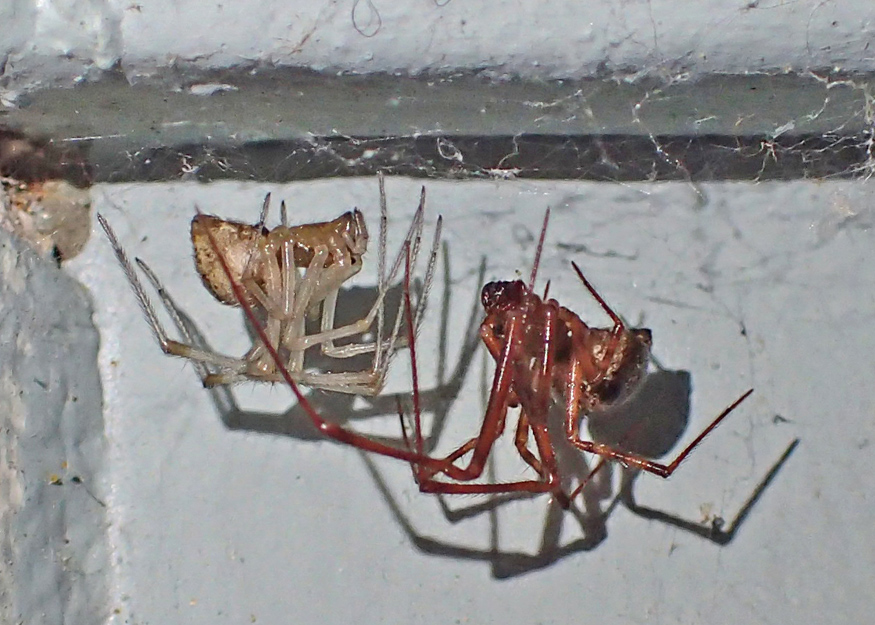
“House spider” is, of course, a name that’s applied to lots of different species in lots of different countries. Because they hang around human habitation, Common/American house spiders (Parasteatoda tepidariorum, akaAchaearanea tepidariorum) are one of our most familiar spiders, and Wikipedia says that “Statistically, they are the most often encountered spider by humans in North America.” They are – vocabulary word of the day – asynanthropic species (from “syn” (together) and “anthropic” (man)), a species that lives near people and benefits from that association. They are on the BugLady’s Porch Bug list.
Common house spiders (CHSs) are in the Class Arachnida and in the family Theridiidae, the “cobweb” or “comb-footed spiders” (comb-footed because of the spines on the lower part of the final pair of legs, spines that help them draw/comb silk from the spinnerets). They are related to the notorious Black and Brown widow spiders, but despite that, CHSs are shy, don’t take offense easily, and will run away/drop to the ground when alarmed. Their bites are painful but are not considered dangerous unless you’re allergic (or unless you are a grasshopper-sized-or-smaller invertebrate).
CHSs probably originated in South America, but they’re now recorded across most of the Lower Forty-eight, into southern Canada, and around the world, apparently hitchhiking in shipments of plants. The front pair of legs is extra-long; females, at about ¼ inch, are larger than males and are variably-colored (https://bugguide.net/node/view/853226/bgimage and https://bugguide.net/node/view/1507434/bgimage) and the dark red-orange males have smaller abdomens (https://bugguide.net/node/view/960840/bgimage). According to BugFan Mike, a newcomer in town, an Asian look-alike named Parasteatoda tabulata whose abdomen is relatively smaller than the CHS’s (pea-sized vs chickpea-sized), may be more common in Wisconsin now than the CHS.
The three-dimensional webs are described as “random” and “tangled.” The spider constructs a densely-woven nook near the center of the web, in which it awaits its prey. Prey may get caught in the body of the web or stick to the extra-gluey “guy lines” that anchor it. Like a good fisherperson with a finger on the line, the CHS monitors the vibrations of the web, and if it feels a struggling insect, rushes out to paralyze and secure it. Apparently, it is able to shoot web at a thrashing insect from afar in order to get it under control before getting close.
Unlike species that spin daily, the CHS tries to maintain its web by discarding used food items, but it will also abandon a web spun in an unproductive area (they favor spots that are open to air currents). Females tolerate other females that make adjoining webs (though a neighboring female may get eaten if she strays too close). This can result in some pretty big masses of cobwebs, like the one in the water treatment plant in Baltimore that covered tens of thousands of square feet and probably held a spider population of more than ten million, more than half of which were CHSs https://www.huffingtonpost.com/2014/11/03/four-acre-spider-web_n_6095724.html. In the picture of the dark and the light spider, the light-colored individual has recently shed and her color isn’t set yet (thanks, BugFan Mike).
Contrary to the practices of many spiders, in which the males’ post-courtship survival depends on getting out of Dodge, fast, male CHSs often share webs with females. After mating, females start making distinctive, tan, papery egg sacs containing 100 to 400 eggs each, and (uncommon among spiders) she may make as many as 15 of them! She puts non-viable eggs in the sacs, too – these her young will eat during the four days between hatching and leaving the egg sac. The spiderlings stay together for a few days, adding to their mother’s web, and then, after about 10 days, they disperse aerially, by ballooning. They are extremely vulnerable during this stage (the second instar) because they are very small and can only prey on critters that are even smaller, and even though they can go without eating for three weeks, mortality is about 98%. Females mature in about 40 days, and can live more than a year; males mature in about 30 days.
They feed on insects – mostly flies and mosquitoes – but they’ll take prey up to the size of a grasshopper, and will also eat a few species of spiders. There were several accounts of CHSs taking very small lizards that had been attracted to their webs by snagged flies. One of today’s pictures shows a CHS that has captured a daddy long-legs. Their eyesight is poor, no more than three or four inches. They hunt at night and take shelter during the day.
One day, a decade ago, when the BugLady was prowling around a building looking for bugs to photograph, she came upon an interesting tableaux (and photographed it badly). A solitary wasp had flown close to the corner of a window that held a CHS web. The BugLady can’t recall whether the wasp had targeted one of the spiders, was already carrying one of the spiders or was just confused by the window. At any rate, it encountered a strand of web, a female responded, and then the second female (while the male looked on), and pretty soon they had everything wrapped up.
“There’s never a leaf nor a blade too mean to be some happy creature’s palace.” J. R. Lowell
First of all, with apologies to botanists everywhere, here’s a quick and dirty review of the anatomy of a leaf. It’s a thin, green organ that consists of the working guts sandwiched between top and bottom layers of epidermis that keep the innards in place and prevent them from dehydrating. The area between the epidermal layers is the mesophyll (“middle leaf”), which is made up of a “spongy” and a “palisade” layer of living “filler” or ground cells called parenchyma (the parenchyma that contains the chloroplasts that carry out photosynthesis is called chlorenchyma). This tissue is served by veins that move food and water into and out of the leaf and provide a certain amount of rigidity (and may restrict a leaf miner to a small portion of the leaf). There’s a nifty diagram at PBS Learning media (who knew?): https://wpt.pbslearningmedia.org/resource/480848277-plants-animals/leaf-anatomy-plants-and-animals/#.WsjrbS7wbIU.
What is a leaf mine? It’s a translucent trail left by a tiny larva as it feeds in the parenchyma of a leaf. Mines may be linear in shape, or serpentine, trumpet, blotch, or tentiform (a slightly three-dimensional blotch). The larvae grow as they feed, and so does the circumference of their mine. Artist/blogger Anita Sanchez calls mines “botanical doodling.”
And what are leaf miners? Sibyl Hausman, in her article “Leaf-Mining Insects” (The Scientific Monthly, July 1941), says “These tiny creatures are small worms, the larval stages of insects which are able to obtain plenty of food and a suitable lodging by living entirely between the surface cells of the leaves. Certain members of the Lepidoptera, Coleoptera, Hymenoptera, and Diptera spend their larval life within the leaf tissues, feeding on either the palisade or spongy parenchyma cells where chlorophyll is located, well protected and concealed by the thin, colorless cells of the upper and lower epidermis….. The forms of these mines or tunnels and the leaves of the plants in which they occur are both characteristic of a given species.” Researchers Connor and Taverner refer to leaf mining as “consuming live foliage while simultaneously dwelling inside it.”
Being a leaf miner is just a hair’s breadth away from being a borer (which excavates deeper into plant tissue) and a gall-maker, and insect families that contain one often have the others. Leaf miners generally do their work in more mature leaves; if they started chewing on young, actively-growing leaves, the plant would produce extra tissue and envelope them, creating a gall. Leaf miners can tolerate lots of the chemical defenses that leaves throw at other grazers, like toxins and sticky, milky juices (though they sometimes drown in excess latex). Of the approximately one million species of insects known today, about 10,000 are leaf miners, and most families of plants entertain miners, even conifers, and aquatic plants.
What goes in, must come out – according to Sibyl Hausman, “Often the mines are obscured by the accumulation of dark particles of waste material, known as frass, but some species keep their mine clean by distributing the frass in separate pockets.” https://bugguide.net/node/view/862705/bgpage.
What do the miners look like? Needham, Frost, and Tothill, in Leaf Mining Insects (1928) describe them, “The principal needs of the miner in accordance with which all its peculiarities of form have been evolved, are for thin, flat, forward-reaching mouthparts, and for holding apparatus for keeping them up against the mesophyll for their work. Hence the mouth turns forward and the head takes on the shape of a flat wedge. Walking legs tend to disappear and a variety of stay apparatus tends to be developed – spacing humps, and tubercles and bristles and setulae …The larva may develop chewing mouthparts capable of devouring cells bodily, or it may develop cell-shearing apparatus and sap-feeding habits.”
[NB. The four orders that produce leaf miners are all flying insects (so they can find their host plants) with complete metamorphosis, and despite the radically different appearance of the adults of those orders, their leaf-mining larvae, shaped by the demands of their environment, are quite similar.]
Eggs are often laid in or on the underside of the host plant. “The larvae of some of them on hatching from the egg may come out on the surface of the leaf, but in all the more specialized miners they pass directly into the leaf through the epidermis that the egg covers, and do not appear outside (Needham, et al).” Some larvae spend only a short time in the mines, some live their larval stage there and pupate elsewhere, and others pupate there, too, poking through the leaf’s epidermis to emerge as an adult.
In describing the emergence of an oak leaf gall-maker, Needham says, “the pupa has a sharp, hornlike process on its head with which, when ready for the final transformation, it can penetrate the walls. When part way out of the leaf the pupal shell (chrysalis) breaks open on the back, and from it emerges a resplendent little moth, clad in scales of gold and ermine and jet, a veritable atom of Lepidopterous loveliness. There is hardly anything in nature more beautiful than are some of the moths that have leaf-mining larvae.” (It’s a wonderful book: https://www.biodiversitylibrary.org/item/28922#page/8/mode/1up).
Just how safe is this pantry/hideaway? Not as safe as you’d think. Egg predation is rare (anything that fits between the top and bottom surfaces of a leaf has a pretty tiny egg), but despite the fact that they’re undercover, the larvae are preyed upon by a varied bunch of parasitoids whose mothers manage to locate them. They’re also eaten by predatory insects, a few bird species, and accidentally, by general leaf-eaters who get a bit of protein as a bonus. Premature leaf drop also takes its toll.
And apparently, they’re not protected from cosmic events like asteroids, either. Mines persist in leaves after the leaves fall, and they can even be seen in fossil leaves and used by paleo-entomologists to study the miners’ lifestyles, gauge populations, and even clarify taxonomy. The BugLady found a paper out of Penn State about how the dinosaur-killing asteroid that hit the Yucatan Peninsula in the late Cretaceous period also killed off the leaf-mining insects in the western US (and elsewhere, since three-quarters of all of the plant and animal species on earth became extinct in that one event) (it’s called the Cretaceous–Paleogene (K–Pg) extinction event – see the lovely video at https://www.britannica.com/science/K-T-extinction). According to a study done in southeastern Montana, the leaf miner fauna bounced back in that area after only a million years, populated by newly-minted, post-Cretaceous species.
Except when the mines appear on leafy vegetables like spinach, or in large outbreaks, mines are a fleeting, cosmetic issue. The tissue around the mine does dry out, but mostly, the plant is not injured. Chemical control is tough since the larva is inside the leaf.
Needham, et al, tell us that “The feeding operations of many leaf-mining larvae may be observed with a good lens, holding their leaf up to the light and watching them work by looking through the transparent epidermis,” which, of course, violates the Prime Directive since you have to pick the leaf to do it (unless you’re far sprier than the BugLady and can climb underneath).
The BugLady is feeling a little cranky. It’s snowing as she’s writing this – 3” to 5” are expected, and the temperatures predicted for the next week mean that the snow’s not going anywhere soon, so the newly-returned robins, cranes and killdeer will be very unhappy – and she’s leading her first woodcock and frog walk in three weeks (though she has led them with snowflakes in the air), so we need to get our act together.
Anyway. Here are a few insects about which the information is sparse, though they are undoubtedly worthy.
PERITHOUS(no common name)SCURRA
The pretty, little ichneumon wasp Perithous scurra (probably) fits the criteria perfectly for inclusion for Bugs without Bios – there are an estimated 60,000 species in the family Ichneumonidae globally, and there may be another 40,000 awaiting discovery, so who can keep track of all of them? Larvae of the ichneumons are parasitoids – consumers of the larvae and pupae of butterflies, moths, beetles, and other wasps.
This small (maybe ½”) wasp occurs worldwide – there were papers about it from countries across northern Europe, Russia, and Turkey. According to a British website dedicated to identifying Ichneumonids (most of the natural history information that the BugLady found was on British sites), its habitat is hedgerows, and the larval hosts are the larvae of solitary wood and stem-nesting wasps.
Perithous scurra was included in a paper about the way some ichneumons locate their larval hosts by tapping the substrate with their antennae and assessing the quality of the sound that bounces back in order to locate a larva within (it’s essentially echolocation in wood). It’s an uncommon ability, and one that comes in handy when the insect you’re looking for is in a tunnel. Alternately, members of this subfamily (Pimplinae) find potential hosts via sight, odors of the host bug, or odors of the host bug’s host plant. In the case of Perithous scurra, after Mom stings the host larva (as one article so delicately put it, “inactivating it,” she lays an egg in it. The larva feeds within and eventually pupates in the cell designed for its host. Adults feed on nectar and honeydew.
And that, unless we want to dive deep into a detailed description of the final instar larva or a phylogenetic analysis of its chromosomes, is all the BugLady could find about Perithousscurra.
BRACHYSOMIDA(no common name)BIVITTATA
The BugLady was way off-base with her original identification of this beetle and had to call in an expert. Instead of being a Pyrotablister beetle that doesn’t occur around here anyway (https://bugguide.net/node/view/254964/bgpage), it’s a long-horned beetle named Brachysomida bivittata in the family Cerambycidae (thanks, Dan – as they say, any mistakes from here on belong to the BugLady).
There are a lot of Cerambycids, too – around 30,000 worldwide, with about 360 of those in the subfamily Lepturinae, the Flower Longhorns. The Flower Longhorns are often-colorful, often-slender, often “broad-shouldered,” diurnal beetles, usually seen feeding and/or cavorting on flower tops. Many Cerambycids, including members of Lepturinae, can make little squeaks by rubbing together the edges of the first two segments of the thorax.
According to Evans, in Beetles of Eastern North America,Brachysomida bivittata larvae bore into and feed on oak, hickory, and dogwood (mostly in dead or dying woody tissue), and the adults are found on dogwood, viburnum, sweet clover, and anemone flowers (they apparently like yellow or white). A good meal allows the eggs to mature and facilitates oviposition.
For all your scrabble needs, the internet delivers a website that gives us great lists of words that “match the pattern “tata.” Likedigitata, tridentata, cantata, etc.
Last (and least) – is OLETHREUTES ATRODENTATA(hopefully) a small moth with some big names. According to bugguide.net, its genus name, Olethreutes, comes from the Greek word “’olethreuonta,’ meaning ‘destroyer, annihilator,’ a term used to describe the devil in Greek biblical texts,” its species name means “dark-toothed” and refers to its markings, and several obscure sources called it the Astronomer moth. No idea.
It’s in the family Tortricidae, often called the leaf-roller moths because of the way caterpillars roll up and tie a leaf so they can feed inside (though some feed in roots). Some are generalist feeders, and others, like the members of this genus, specialize. Tortricidae is another big group, containing more than 10,000 species worldwide, but micro-lepidopterists suspect that there are lots of un-named species lurking in the tropical vegetation. Many family members are agricultural/silvicultural pests.
Dragonfly season can’t come soon enough. This BOTW is a renovation of a BOTW from five years ago – some new thoughts, all new pictures. Apologies – life is busy.
The BugLady is looking forward to chasing Sedge Sprites again this year. They hang out in the kinds of low, dark, inaccessible places that require contortions by photographers – places that both need a flash and are overpowered by one. And no, the BugLady has not started chasing faeries; the Sedge Sprite (Nehalenniairene) is a tiny, shiny damselfly in the family Coenagrionidae, the narrow-winged damselflies.
There are only six species of sprites (genus Nehalennia) worldwide (the genus name is taken from an early AD, northern European/Celtic goddess of seafarers and of others who traveled the water). One sprite is Eurasian, one lives in Central and South America (there have been a few sightings in extreme southern Florida), and the other four are North American. Both Sedge Sprites and Sphagnum Sprites (Nehalennia gracilis) are found here in God’s Country, although Sedge Sprites are far, far more common.
Male
Female
The sprites are sexually dimorphic – the Sedge Sprite more so than the Sphagnum Sprite – with males flashier than females. Males of both species are an audacious, metallic, emerald green above, and females are generally duller (though male-colored females do occur). Both are pale ventrally; the females are yellowish, and males are initially white below but later turn an amazing powder blue. While the last 2 ½ segments of a male Sphagnum Sprite’s abdomen is solid blue, the blue at the end Sedge Sprite’s abdomen is variably arced, showing dark spots in the blue. Female Sedge Sprites have little or no blue at the tip of the abdomen; female Sphagnum Sprites have more. Both species have blue eyes, and while they don’t have eyespots like the bluets do, there is a narrow, pale line on the “back of the neck.” They are somewhat the same color scheme as the slightly larger male Eastern Forktail (but he isn’t shiny).
Eastern forktail
The two sprites have in common their ridiculously small size (often less than an inch), metallic coloration, and love for dense stands of plants around quiet, clean wetlands like marshes, bogs, fens, and ponds. As their name suggests, Sphagnum Sprites like peat bogs, especially with floating mats.
The BugLady came across an interesting paper by Beatty, Andres, and Sherrat on the topic of sexual dimorphism in Sedge Sprites (and other organisms). Males are brightly colored, we’ve been told, so they can attract mates. Maybe not. Maybe their brilliance is a warning signal to other males not to waste their time in an energy-intensive pursuit. Male Sedge Sprites, after all, approach females from above, and his color is mainly dorsal, so she doesn’t get to see him throwing off sparks.
Sedge Sprites are found across southern Canada and the northern half of the US. They are said to be more common in the eastern part of their range, and Kurt Mead, in his Western-Great-Lakes-centric Damselflies of the North Woods calls them “perhaps the most abundant damselfly in the north woods.” Because they spend most of their time flitting among the stems of sedges and other emergent plants (Stokes, in the Beginners Guide to Dragonflies and Damselflies, describes them as “skulking low in dense vegetation.”), they’re easy to miss. It is, literally, like watching a sewing needle floating through the sedges.
There’s not a lot known about the life history of Sedge Sprites. Females lay eggs in floating, dead plants like cattails and sedges. Like other sprites, the male Sedge Sprite continues to clasp the front of the female’s thorax while she oviposits (it’s called “contact guarding;” other species of dragons and damsels may guard their ladies from a perch or from the air or not at all); her body is horizontal and his tilts at about 45 degrees. As Dennis Paulson says in his encyclopedic Dragonflies and Damselflies of the East, “in temperate species, pairs oviposit with male held up like little blue-tipped stick.”
She uses a blade on her ovipositor to slice into plant tissue and then she inserts one or more eggs. According to one source, the eggs hatch in just a few days; another says it takes a few weeks. The naiads must grow and shed a dozen times before they are ready for adulthood, and their growth rate is influenced by water temperature (the warmer, the faster). They overwinter as almost-grown naiads and complete the job in early summer of the next year. Adults may feed away from water until they are ready to mate.
Damselflies, young and old, are carnivores. Paulson says that the adults’ “long tibial (leg) spines and wings held over abdomen when perched may indicate they are flycatchers.” Midges are probably a big part of their diet, and the aquatic naiads feed on any small critters they can catch.
It’s hard for us to wrap our minds around how populations of an organism that occurs by the millions (like the horseshoe crab, of recent BOTW fame) could be threatened. And yet.
In the early 1990s, an estimated 400 million Monarch butterflies (by some accounts, 700 million) overwintered in the mountains west of Mexico City. By 2010, that number had dropped, but it stabilized at around 100 million, though only 33 million were found in the winter of 2013-14. This year’s population is estimated at 93 million; the biomass of Monarchs went, according to the Center for Biological Diversity, from covering 39 football fields to covering about one. In the mid-1990’s, overwintering butterflies were found on about 44 mountainous acres; in 2013-14 on less than two acres; and this winter, on about 7.5 acres, down about 15% from last year.
The “Eastern Monarchs” that winter in the oyamel fir forests represent the entire migratory population this side of the Rockies. Pacific monarchs, whose numbers are also in steep decline, migrate along the coast to California, and there are non-migratory populations along the Gulf Coast and South Texas.
Still, 100 million butterflies is a lot of butterflies, right? Not when you consider the impossibility of what they do, which is to undertake a 2,000-plus mile migration. Monarchs weigh about one-half of a gram each, which means that a Quarter pounder is equivalent to about 225 Monarchs (the BugLady was told there would be no math). They face the physical dangers of a trip that takes them from as far north as Canada all the way to Central Mexico, where they spend months in resting mode before (right about now) perking up and meandering north. The same individuals that left Wisconsin to begin the return trip, but their offspring’s offspring tag home here in May.
They face predators, cars, habitat loss, agricultural pesticides, and the shifting seasonal temperatures and increasingly severe weather events precipitated by Global Climate Change (aka Global Weirdness. There were three hurricanes and two tropical storms at the start of the 2017 fall migration period http://monarchwatch.org/blog/2017/09/15/forgotten-victims-of-harvey-the-pollinators/). The fall migration of 2017 along the Atlantic Coast was late, with some butterflies lingering into late October and even early November, lulled by unseasonably warm weather, the late migrants left susceptible to storms and freezes. For a rundown on Monarch mortality factors, see “The State of the Monarch,” an August 2015 BOTW, at http://uwm.edu/field-station/the-state-of-the-monarch/). The only cushion against mortality factors like that is a huge population.
The US Fish and Wildlife Service tells us that “nearly a billion monarchs have vanished from the overwintering sites since 1990,” and according to a recent article in USA Today, “A 2016 study by the U.S. Geological Survey concluded that because of ongoing low population levels, there is an 11% to 57% risk that the eastern monarch migration could collapse within the next 20 years.”
Not on our watch!
Milkweed has declined dramatically in agricultural areas in the Midwest, where the Monarch’s population strongholds are (the “Milkweed Limitation Hypothesis”). Planting milkweed for caterpillars – and other nectar-bearing wildflowers for adults – as a part of grassland habitat restoration is a good start and it’s pretty and it can’t hurt. Chip Taylor, of Monarch Watch, goes further, saying that “we need a comprehensive plan on how to manage the fragmented edges and marginal areas created by development and agriculture since it is these edges that support monarchs, many of our pollinators, and the many forms of wildlife that are sustained by the seeds, fruits, nuts, berries, and foliage that result from pollination.” Late-blooming, nectar-bearing flowers fuel the fall migration and allow Monarchs to gain the fat reserves that will carry them through the winter.
Finally, the Monarch is under consideration for Endangered Species protection, a decision that will be made by June 2019 (https://www.fws.gov/savethemonarch/SSA.html). It needs to be on that list so that legal protections will apply
[Mildly political aside: And, of course, there needs to be an effective Endangered Species Act https://news.nationalgeographic.com/2017/05/endangered_speciesact/. Wonder what would happen if every school child drew pictures of Monarchs and sent them to their Congress-people and to the Fish and Wildlife Service?]
Ever since the BugLady started her “Bugs in the News” sub-series, alert BugFans have been sending links to articles they’ve come across. Thanks, BugFans! Alas, to view a few of these, you have to wade through some ad content.
And, if you’re interested in other things with wings, try this (after yet another ad), mostly in the daylight: http://rowe.audubon.org/birds/crane-cam (you may have to hit Reload).
This episode has been adapted from the Spring, 2010 issue of the BogHaunter, the newsletter of the Friends of the Cedarburg Bog; it was written by the BugLady, wearing a different hat. Woodcocks were a big part of her childhood – their return to our brushy fields was celebrated each year. Thanks, Mom, thanks, Dad.
Coming soon, to a field near you!
American Woodcocks (Scolopax minor) are long-billed, big-eyed, short-legged, round-winged, Robin-sized birds. The Cornell University All about Birds website says “Their large heads, short necks, and short tails give them a bulbous look on the ground and in flight” (“bulbous?” Really?). Their brown-streaked plumage makes them impossible (for the BugLady) to spot on the ground – she once stood near two young birds for about five minutes until they couldn’t stand it anymore and departed, with wings whistling. Woodcocks are shorebirds that are not tied to the shoreline – upland game birds, the “Landlubbers” of the shorebird family. These odd-looking birds (apparently, hunting dogs find them odd-smelling, too) have many nicknames, like “timberdoodle” and “bog-sucker” and “night partridge.”
A woodcock is a bundle of adaptations. Their short wings make it easier for them to maneuver in the brushy fields, woody edges, wet meadows, and open woodlands that they call home, and the fact that they are able to fly slower than any other bird – 5 MPH – serves them well in those spots.
Most of their adaptations have to do with their feeding habits. That long bill allows a woodcock to extract earthworms and other invertebrates from deep in the moist soil. The tip of the bill is both flexible and sensitive and can be opened without opening the base. Worms are slippery little devils, and roughened surfaces on the tongue and upper bill help it to get a grip. And a good thing – a woodcock may eat its weight (about a half-pound) in worms daily. See http://www.ruffedgrousesociety.org/Woodcock-Facts#.Wp2XumrwbIU for a video of a woodcock foraging.
Several sources said that the woodcock’s typical rocking walk may produce vibrations that rouse earthworms into motion so that the woodcock can hear it (and yes – you’ll get some interesting hits if you Google “Woodcock walk like an Egyptian”).
Any animal that feeds with its head down runs the risk of becoming a meal while having a meal. Over time, woodcock eyes have migrated toward the top of their head. As a result, woodcocks have good vision both to the back and to the sides while they probe for worms (as opposed to a robin, which has eyes on each side of its skull and can’t see much to the fore or aft). Because their eyes have thus migrated, their brains are upside down.
But, they’re famous for something besides their looks.
Woodcocks make their presence known in early spring – often by mid-March – when males take to the air to perform their amazing “sky dance.” They begin around sunset and continue into the wee hours, especially if the moon is full – the BugLady has heard them in her field at 1:00 AM. Here’s how it goes. After calling from the ground for a while – a nasal sound described as a “peent” https://www.youtube.com/watch?v=4Owj52XhoxI – the male takes off. Specially-shaped wing feathers produce a twittering sound as he spirals into the air, sometimes more than 300 feet up. From high in the sky he zigzags back down, vocalizing a rich “chirp, chirp, chirp, chirp” sound.
Let Aldo Leopold tell it: “Up and up he goes, the spirals steeper and smaller, the twittering louder and louder, until the performer is only a speck in the sky. Then, without warning, he tumbles like a crippled plane, giving voice in a soft liquid warble that a March bluebird might envy. At a few feet from the ground he levels off and returns to his peenting ground, usually to the exact spot where the performance began, and there resumes his peenting.”
There, the theory goes, the awed female woodcock will find him. The dance is repeated at dawn.
The first sound on this audio is the chirping call of a descending bird https://www.allaboutbirds.org/guide/American_Woodcock/sounds, and if you listen, after he’s landed and is peenting, you can hear the faint “Whoop – Whoop” sound that apparently is a communication between two birds that are on the ground. More vocalizations can be heard in the “Sound and Calls” section at the bottom-right-hand corner of the first page http://www.audubon.org/field-guide/bird/american-woodcock.
Once she finds him, he struts and bows with outstretched wings. Females may make the acquaintance of several males and vice versa, but by the end of April, the show’s about over. Males will continue their sky dance into early May – even though most of their potentially appreciative audience is sitting on eggs. Hope springs eternal, and some females will join the dance even while they’re caring for young.
Woodcocks nest on the ground; females line a shallow depression with leaves and deposit (usually) four eggs in it. She will sit on them for about three weeks, often incubating during the final snowstorms of spring. The young are “precocial,” (think “precocious”) – unlike the blind and naked young of songbirds, woodcock nestlings are dried off and running around within hours of hatching, and although she continues to feed them for a week or so, the young are probing for food when they’re just three or four days old, and flying after two weeks. The male does no incubation or child care.
As ground-nesting birds, woodcocks are preyed on by dogs, cats, skunks, possums, and snakes. The BugLady once saw a woodcock fluttering across the grass-tops in a field, pursued by a raccoon; it may have been a female, leading the raccoon away from her nest.
Many birds undertake epic migrations, but as the ground chills and worms migrate vertically to escape the frost, woodcocks need only travel to the Southeastern and Gulf States, where unfrozen ground allows them access to food. Woodcocks migrate at night, at low altitudes, alone or in small groups, usually starting in October. The trip is unhurried, with the birds’ cruising along at about 25 MPH on these flights. They start the return trip in February.
Around the beginning of the 20th century, books were being cranked out by “nature-f
akers,” who romanticized and anthropomorphized the daily lives of the animals they wrote about. They wrote that a woodcock was able to set its own leg if one got broken – the proof being the crusted mud often seen on woodcocks’ legs.
Back in 2011, the BugLady wrote about a spectacular arthropod called the Horseshoe crab that pre-dates insects by maybe 100,000,000 years. Despite the fact that they occur by the millions, horseshoe crabs are facing dire threats to their populations, and the BugLady wondered if anything had changed since the original episode. New text, old text, and pictures of a 1 ½” long, translucent, infant horseshoe crab that washed up on Sanibel long ago, that the BugLady happened to have in her collection. Put your feet up – this takes some telling.
The BugLady had taken herself on a little road trip to the Delaware Bay, the home of the horseshoe crab. Because of their cute faces and their long and primitive lineage (they are called “living fossils”), horseshoe crabs grab our imaginations – they are one of those creatures whose appearance immediately transports us to ancient swamp forests and shallow inland seas.
Horseshoe crabs have, in the words of local news-people, a “Wisconsin Connection.” They are close relatives of our beloved State Fossil called the Trilobite, an ancient inhabitant of those inland seas.
The story of the Atlantic horseshoe crab stretches from the great extinctions of the Silurian Period to the unique threats of the 21st century. The operative question is whether an animal that has survived for almost a half-billion years will join its extinct trilobite ancestor under our watch.
They are shaped like horseshoes, but they’re not crabs. They are under the same big umbrella as crabs – phylum Arthropoda (“jointed limb”) – but horseshoe crabs headed out on a completely different limb of the family tree a very long time ago, and they’re more closely related to spiders and scorpions. They’re in the class Merostomata (“legs attached to the mouth”), in the order Xiphosura (“sword tail”), in the family Limulidae. There are four living horseshoe crab species in the world, three of which reside along the edges of Asia. The Atlantic horseshoe Crab (Limulus polyphemus) (“Limulus” means “askew,” and the BugLady trusts that BugFans recall who Polyphemus was) is found in shallow ocean edges with soft, mucky or sandy floors from Maine through the Gulf of Mexico.
The fact that horseshoe crabs can survive dramatic changes in temperature and salinity and can fast for months (up to a year) helps to explain their longevity, and so does their decidedly tank-like physique. A hard, smooth shell makes them difficult for predators to handle, and the shell is a bulldozer that allows them to dig into the sand/mud for food. From above, they’re divided into three sections – a curved front shell, a trapezoid-shaped middle segment that is hinged to the front shell, and a long, sharp tail that they use as a rudder and as a pry bar when they get flipped over. They can see potential mates from about three feet away with large compound eyes located on the side curve of the front shell, and several centrally located simple eyes register UV light. It’s murky where they hang out, and the tail is equipped with photo-receptors.
Flip one over and your main impression is legs. The first five pairs are for locomotion and for passing food to the mouth, which is, indeed, surrounded by legs. The final pair is adapted for pushing.
Females are larger than males – some females may measure two feet from stem to stern. When it’s time to breed, horseshoe crabs move into shallow waters. There is some suspicion that females are imprinted on the muck they hatched out of, but it’s not known what – or how – they sense there. A female crawls up on shore, attended by piggyback males https://bugguide.net/node/view/352897/bgimage. She lays eggs, a few thousand at a time (up to 120,000 total), in a depression/”nest” in the sand, the males fertilize them externally, and waves cover them https://bugguide.net/node/view/1396827/bgimage.
Eggs hatch in two weeks and the minute’ young (initially tail-less) head for tidal flats to eat and shed and burrow. Their food supply – clams, worms, a few small fish and crabs and other invertebrates – dwell in the mud and sand with them. Rasps on their legs “pre-process” the food, and their sand-filled gizzard finishes the job. They will molt six times, increasing their size by one-third each time, and reaching a half inch by their first birthday. After they blow out the first candle or two, they move to deeper waters, molting once a year and reaching sexual maturity in about ten years. Older horseshoe crabs collect quite a load of hitchhikers during their lives – limpets, sponges, leeches, mussels, crabs, periwinkles, and other snails attach to the shell.
According to Japanese folklore, warriors killed in battle were reborn as horseshoe crabs, eternally roaming the sea floor, celebrated in art and poetry. Eastern tribes of Native Americans harvested horseshoe crabs for food (the muscles in the second section), fertilizer (and they taught the in-coming Europeans this trick), for bowls made from the front part of the shell, and for the sharp tail, used as a tip for fishing spears. The rubbery eggs, roasted “in the shell” are a delicacy in some Asian cuisines, though the roe of one species contains a neurotoxin called TTX by scientists and “Zombie Powder” by practitioners of Vodou.
Horseshoe crabs are armored but not invincible, and they face some unique modern challenges. They are vulnerable to predation by sea turtles, gulls, fish, and crabs (especially as eggs and newly-hatched young), to habitat degradation caused by shoreline development, to pesticide run-off, oil spills, and to being stranded during spawning. Their intersection with humans has not been a happy one – historically horseshoe crabs have been used for human and poultry food and for fertilizer, and today they’re taken and chopped up as bait for conch and eel fishing. Females with eggs are the most desirable bait, and they have even been harvested off their spawning grounds, and it doesn’t take a Brain Trust to see where that road leads.
Alas for the horseshoe crab, researchers discovered in the 1960’s that components of its blood could be used to screen drugs and intravenous compounds/devices for the presence of certain bacterial contaminants. In order to harvest this blood chemical, which is extremely important in today’s medicine, horseshoe crab are caught, relieved of up to one-third of their blood over a period of several days, and then released. In addition, the shell can be used to make absorbable sutures, treat certain eye problems, and speed blood clotting time
When she did her original research six years ago, the BugLady read that the “bleeding” process carried a 3% to 15% mortality rate (a figure offered by the industry). More recent studies suggest that mortality from the process alone could be as high as 30%. Add to that the trauma of being commercially collected and the fact they are stressed by being out of water during the bleeding process (and losing one-third of their blood), and it’s not surprising that they are disoriented and debilitated when they are released, and that females’ ability to spawn may be compromised (In response to criticism, an industry spokesperson noted that, “One of my suppliers built a water slide to put the crabs back into the water. They love it!”). Medical use is expected to go up, not down, but there has been talk of farming horseshoe crabs.
The food web to which Atlantic horseshoe crabs belong is complex and their contribution is vital. In uncountable numbers, horseshoe crab eggs have fueled migrating shorebirds, especially Red Knots, which time their spring migration from South American wintering grounds to coincide with the horseshoe crab spawning season (excellent video at https://www.youtube.com/watch?v=xLy6G53VOPw, and so is the longer one following it) (nice slide show, but cookieshttp://www.arkive.org/red-knot/calidris-canutus/image-G11960.html). They arrive at Atlantic shore staging areas – irreplaceable way-stations in their 9,000 mile journey – with depleted energy reserves. After two or three weeks of gorging on horseshoe crab eggs, rich in calories, protein and fat (they graze from nests uncovered by wind and waves, leaving plenty of intact nests undiscovered), up to a million shorebirds continue their journey to the Arctic circle having doubled or tripled their body weight. In recent years, as horseshoe crab numbers have fallen, so have shorebird populations. And when an animal doesn’t reproduce until it’s ten, like the horseshoe crab, it takes at least a decade to recover.
Today, population trends for the horseshoe crab are a good-news-bad-news story. They are declining in the Northeast and around much of Florida’s coast, but growing along Southeast beaches. Several Mid-Atlantic States have imposed moratoriums on harvesting horseshoe crabs, and populations there are stabilizing. In the Delaware Bay, the proposed take for the last three years has been 500,000 males and zero females. Biomedical companies harvested around 225,000 annually in the ‘90’s, and that number doubled by 2012 https://www.popularmechanics.com/science/health/a26038/the-blood-of-the-crab/. The problem is that because they return the horseshoe crabs to the water, the biomedical companies are not subject to these restrictions, and they are not required to reveal the numbers of animals they process to anyone except the state DNRs (which share it with the Atlantic States Marine Fisheries Commission).
According to an article called “Medical Labs May be Killing Horseshoe Crabs” that appeared in Scientific American in 2016, “The Atlantic States Marine Fisheries Commission’s most recent survey shows that although the number of horseshoe crabs in the Delaware Bay region has stabilized, the female population is just a third of what the bay is capable of supporting, says Larry Niles, a biologist for several nonprofit conservation groups. And the populations along the coasts of New York State and New England continue to decline. ‘Nobody has ever argued that the crab was going extinct. What we’re talking about is the collapse of an ecosystem, because a key species has been reduced extensively,’ Niles says.”
Long story short, the horseshoe crab is considered to be at a higher level of danger than it was in 1996, and populations could drop by 30% over the next four decades. The BugLady is reminded of the Passenger Pigeon, which also occurred in uncountable numbers, and when over-hunting took its toll and the birds disappeared, it was suggested that they must have flown off somewhere, like South America. Or the moon.
Another change – when this episode was originally posted, it was number 200 in the series. Now, we’re sneaking up on 500!
As veteran BugFans can attest, the BugLady is intrigued by galls. How many kinds are there? To quote from the first BOTW on galls (October, 2009) “Lawlor, in Discovering Nature Close to Home, states that North American plants support more than 2,000 kinds of galls – 800 different kinds form on oaks alone, about 125 kinds on roses, and more than 50 kinds on goldenrods (genus Solidago).”
So many galls, so little time.
Why are galls? Here’s the quick and dirty explanation offered in a Wisconsin Extension vineyard report for Door County. “Gall formation in many instances is initiated by egg laying (oviposition) by the adult form of an insect or by feeding of early larval stages. Feeding by certain gall-making insects results in the release of salivary fluids that may contain plant growth regulating substances (Auxins, IAA) and plant digesting enzymes, pectinases, proteases, and cellulases. The growth regulating substances released by feeding insects work in concert with the grapevines’ response to insect attack. The grapevines’ response to mechanical or chemical irritation is to isolate the toxins or invasion, resulting in a tumorous mass of tissue or gall.” In addition to galls caused by insects and mites (and nematodes), various fungi, bacteria, and viruses may cause galls on plants.
Many gall makers have complicated life cycles that, like the waterlily/reddish-brown plum aphids of recent BOTW fame, may include alternate hosts, and both sexual and asexual generations; in many cases, great chunks of their life histories are unknown. A gall maker tends to be named after the gall it makes.
The GRAPE FILBERT GALL is described in “The Ohio Naturalist” journal (December 1914) as a “Bud gall, being a spherical mass 15-50 mm. diameter, of small, lozenge-shaped galls, each about 5 x 15 mm. Leaf-green, covered with a felty yellow or orange pubescence. Infrequent.”
It has been on our radar for some time – according to the 1916 Bulletin of the University of the State of New York, “Apparently the same gall is found on wild frost grape in Illinois and was described and figured by Messrs. Walsh and Riley in 1868. They state that the gall develops from a common center at a point where a [leaf] bud would ordinarily occur….. Large specimens of this gall bear a general resemblance to a bunch of filbert or hazelnuts as they grow on a bush, which led to the designation vitus-coryloides” (Vitus is the genus name for grapes, and Corylus is the genus name for filbert/hazelnut). Its cause is the Filbert gall maker midge now named Schizomyia coryloides, in the fly family Cecidomyiidae. For many galls, there’s not much information that is more recent than these century-old sources; here’s a drawing of it from 1883 http://www.spiderpic.com/stock-photos/istockphoto/11378771-grape-vine-filbert-gall.
One of the big questions about galls is whether (other than cosmetically) they harm a plant. Sometimes. The larger, woodier, heavier galls that inhabit branch tips and persist for a year or more may weigh a branch down and make it more susceptible to wind and rain damage, but many of the smaller galls that grow on leafy tissue are nothing to worry about. Where would they be, after all, if they habitually killed their host plants? The Wisconsin Extension report concludes, “Galls may look destructive, but galls seldom injure the plant. Grapevines can support a large number of galls and still grow and reproduce normally ……. most galls that infect the soft tissue (leaves, tendrils, shoots) of grapevine are of little economic importance.”
A female-only generation exits the galls (one individual per) in late fall https://bugguide.net/node/view/265686/bgimage) and almost immediately oviposits. The all-female (asexual) generation of this tiny wasp alternates with an even tinier sexual generation that hadn’t even been identified as recently as 2009 when researchers managed to rear some.
When the BugLady started photographing this gall, it was green and was attended by ants. Turns out that rough bullet galls are one of a number of species of galls that produce a sweet substance that, like aphid “honeydew,” attracts insects like bees and wasps. And ants https://bygl.osu.edu/node/907. The ants may be deterring both the insects that graze on oak leaves and the parasitic wasps that seek to lay their eggs in the gall. Honeydew-making galls are induced by just a few genera of Cynipid wasps. In her search, the BugLady came across some papers about hairstreak butterflies that feed on honeydew from galls and from scale insects. For BugFans who want to wander down that very interesting side road, see this article in the American Entomologist https://academic.oup.com/ae/article/61/3/160/2194543 and this report on the first report: https://entomologytoday.org/2016/07/07/rare-butterfly-feeds-on-oak-galls-and-other-non-nectar-sources/.
A different Cynipid wasp, Andricusquercuspetiolicola (Quercus is the genus name of the oaks), makes the OAK PETIOLE GALL on various species of white oak. Unlike the bullet gall, this gall is produced in the softer tissue of the petiole (leaf stem), around the base of the leaf, and so it falls off when the tree loses its leaves. The gall starts growing in early spring, as the leaves start, and the gall makers exit by mid-summer. “BugTracks,” the website of Charley Eiseman, co-author of the excellent field guide Tracks and Signs of Insects and Other Invertebrates, has some amazing pictures in his blog: https://bugtracks.wordpress.com/2013/11/25/two-year-gall/.
Someday, the BugLady will write a book about trying to pry information about this wasp from the ether (once she figured out that it isn’t a Sphex or a Podalonia); it will be subtitled (with apologies to Judith Viorst) “Google has aTerrible,Horrible, No Good, Very Bad Day” (and possibly sub-sub-titled “Net Neutrality and Entomological Research? Really??”). Anyway – different pulpit.
The BugLady found one common name for Palmodes dimidiatus – the Florida Hunting Wasp – though it was not universally embraced. FHWs are in the family Sphecidae, the thread-waisted wasps (loosely called digger wasps), a family that contains some large and handsome, metallically-colored wasps that are named for the elongated constriction (called the petiole) between the thorax and abdomen. We have visited them before in the form of the Great black wasp, the Golden digger wasp, Thread-waisted wasps, Cricket hunters, and Mud daubers. All lead, as do the vast majority of wasps and bees, solitary rather than communal lives. Because they have no hive full of sisters to defend, solitary wasps are – generally – less likely to inflict pain on observers. Despite the fact that they are conspicuous on flowers in high summer, they are an under-studied group.
It’s a small family, with about 125 members in North America. They mostly live out in the open and make nests in the ground for their eggs. Adults feed on nectar (they’ll sip from extrafloral nectaries, of previous BOTW famehttp://uwm.edu/field-station/ants-in-my-plants/), and they sometimes partake of honeydew and of the bodily fluids of some of the invertebrates they capture for their young. They’re considered pollinators.
There are 10 species in the genus Palmodes (either, says bugguide.net, from the Latin for “palm tree” or “hand,” or from the Greek for “vibrating” or “throbbing”). The FHW is found across the continent, but it’s the only member of its genus in the eastern half of North America. Palmodes specialize in the katydids (Tettigoniidae), and some western species prey on Mormon crickets (which are actually katydids and may be 2 ½ inches long). The FHW prefers immature Shield-backed katydids (Atlanticus).
Female FHWs dig a tunnel https://bugguide.net/node/view/1167453/bgimage in loose or sandy soil and make a widened chamber at the end. She digs by biting at clumps of dirt, and scraping the loosened chunks away using the “combs” on her front legs. She forms loose soil into a ball that she tucks “under her chin,” holding it against her mouthparts with her front pair of legs and walking on the other four legs back up to the surface. She saves the soil in a small pile. When she is finished excavating, she plugs the tunnel temporarily and flies off to find a katydid.
She’s about an inch long, but she routinely tackles prey that is much larger than she is (studies suggest that she will go after the biggest prey she can handle), grabbing it, paralyzing it by stinging it once at the base of each set of legs and finally in the throat, then straddling it and dragging it back to the nest https://bugguide.net/node/view/64743/bgimage and https://bugguide.net/node/view/1375820/bgimage. Unlike some other solitary wasps, she makes only one chamber per tunnel, and she provisions it with only one katydid. That task complete, she lays a single egg on the still-living katydid, fills the tunnel with the reserved dirt, and disguises its entrance. When her larva hatches, voila – dinner is served. It will eat, grow, and pupate underground, eventually emerging as an adult.
In his book called Reproductive Behavior and Evolution of Tettigoniidae, Darryl Gwynne parses the difference between predators and parasites, “Digger wasps are often referred to not as predators but as parasitoids, “parasites” whose feeding activities eventually kill but do not dispatch the ‘prey’ right away so that it is kept fresh and unspoiled. The line between predator and parasite is blurred because the actual capture of the host insect by the adult wasp is certainly akin to predation, whereas the larva’s slow consumption of its motionless but still living cellmate has all the hallmarks of a parasitic act.”
Words. The BugLady appreciates the nice turn of a phrase; here are two gems she gleaned while researching this wasp.
From Gwynne’s book, in a discussion of Great Golden digger wasps, he quotes Howard Ensign Evans (1962), who said that that “he knows of few things more exciting than sitting by a flourishing colony…..and watching the females soar in, each with a katydid clutched beneath her: crisp, green songsters, creatures of the sunshine and warm, moonlit evenings, doomed to be devoured by flabby grubs in dark chambers.”
And, the dedication of a doctoral dissertation on wasp phylogeny and behavior, “To Burton and Joseph Payne, who walked high steel so the author wouldn’t have to.”